Cursive Z
Lowercase z is the hill family's finale: a small curve over the top, a slanted dash down, and a swing out with the exit tail. Both forms numbered below, with a printable sheet.
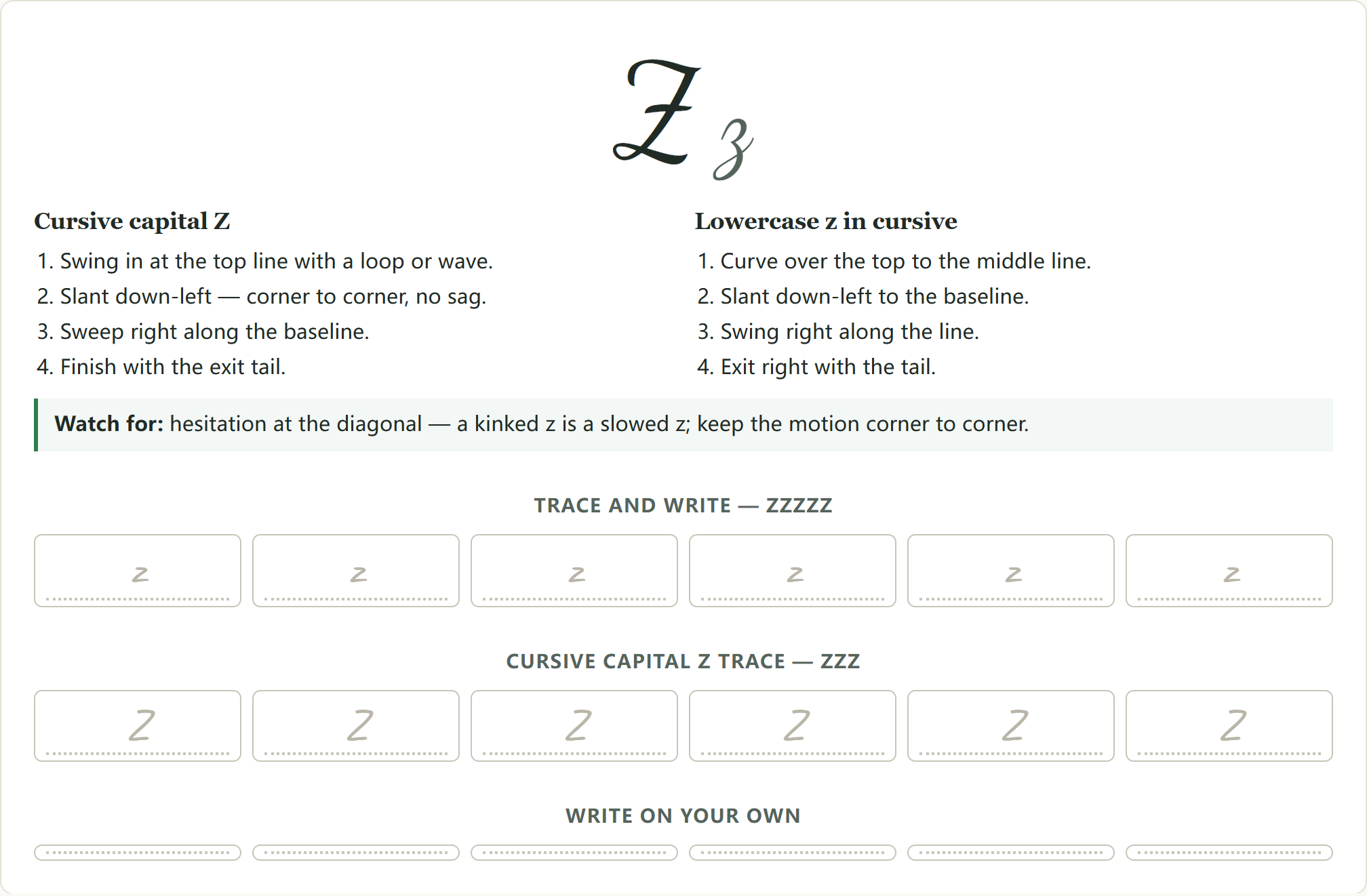
Cursive capital Z
- Swing in at the top line with a loop or wave.
- Slant down-left — corner to corner, no sag.
- Sweep right along the baseline.
- Finish with the exit tail.
Lowercase z in cursive
- Curve over the top to the middle line.
- Slant down-left to the baseline.
- Swing right along the line.
- Exit right with the tail.
Watch for: hesitation at the diagonal — a kinked z is a slowed z; keep the motion corner to corner.
Trace and write — zzzzz
Cursive capital Z trace — ZZZ
Write on your own
PNG version — the exact file Download PNG saves
The zigzag that learned to connect
The lowercase z keeps print's zigzag skeleton — top stroke, diagonal, bottom stroke — but rounds its corners and ends with an exit tail that print never had. Some styles add a tiny loop at the top instead of the plain curve; both are taught in American programs, and this sheet draws the looped version lightly, since it matches the entry style of the rest of the lowercase. The letter is rare — z closes out words like jazz and buzz — and short; its main risk is overthinking: writers who hesitate at the diagonal produce a kinked, cramped z. One confident motion, corner to corner.
The capital Z is the lowercase scaled up with a flourish tradition: a top swing with a loop or wave, the diagonal down-left, then the bottom stroke sweeping right into the exit tail. In the looped styles the top loop is pronounced — a little ticket-scroll — while plainer styles keep it as a soft wave. Either way the diagonal is the spine: it should run corner to corner at the letter's full height, not sag into the middle. Z is the last letter most programs teach, which makes it the traditional "finish line" — worth a small ceremony on the sheet.
Capital Z in cursive
The cursive capital Z keeps the print letter's zigzag skeleton and wraps it in the script's grammar: a swing in at the top line with a loop or wave, a diagonal running corner to corner down to the baseline, then a sweep right along the line into the exit tail. Loopier styles make the top a little ticket-scroll; plainer styles keep it a soft wave — both are standard American forms.
The diagonal is the letter's spine and the place it goes soft: it should run at the letter's full height, corner to corner, without sagging into the middle. Z is the traditional finish line of the alphabet — most programs teach it last, which makes it the letter that gets the ceremony. Finish with real words (jazz, buzz, zebra, zip) rather than one final row of lonely letters, and the whole alphabet lands.
Teaching tips
One motion, corner to corner
Hesitation at the diagonal kinks the letter — say "over, down, out" and keep the pencil moving. A confident z is clean even when imperfect.
Don't inflate the top loop
If your style loops the top, keep it a curl, not a hoop — the loop is an entry gesture, not the letter's main event.
End the alphabet with words
z's celebratory words: jazz, buzz, zebra, zip. A finish-line row of real words lands the whole alphabet better than a final sheet of isolated letters.
Frequently asked questions
How do you write a capital Z in cursive?
Swing in at the top line with a loop or wave, slant down-left corner to corner, then sweep right along the baseline into the exit tail.
How do you write a lowercase z in cursive?
Curve over the top to the middle line, slant down-left to the baseline, then swing right along the line and out with the exit tail — one motion, corners rounded.
Does cursive z have a loop?
Some styles loop the top entry (this sheet draws it lightly), others use a plain curve — both are standard American forms. What is not optional is the exit tail.
Why is z taught last?
It is rare in words and adds no new skill — by the time a learner reaches it, everything z does has been learned twice over. Programs keep it for the finish line.
How is cursive capital Z different from print Z?
Same zigzag skeleton, different grammar: the cursive Z opens with a looped or waved top swing, runs its diagonal corner to corner with rounded corners, and finishes with an exit tail along the baseline. The shape is familiar; the entry and exit strokes are what make it cursive.