Cursive M
Lowercase m is n twice: downstroke, hump, hump, out. Two identical arches, evenly priced. Both forms numbered below, with a printable practice sheet and the second-hump check that catches most m mistakes.
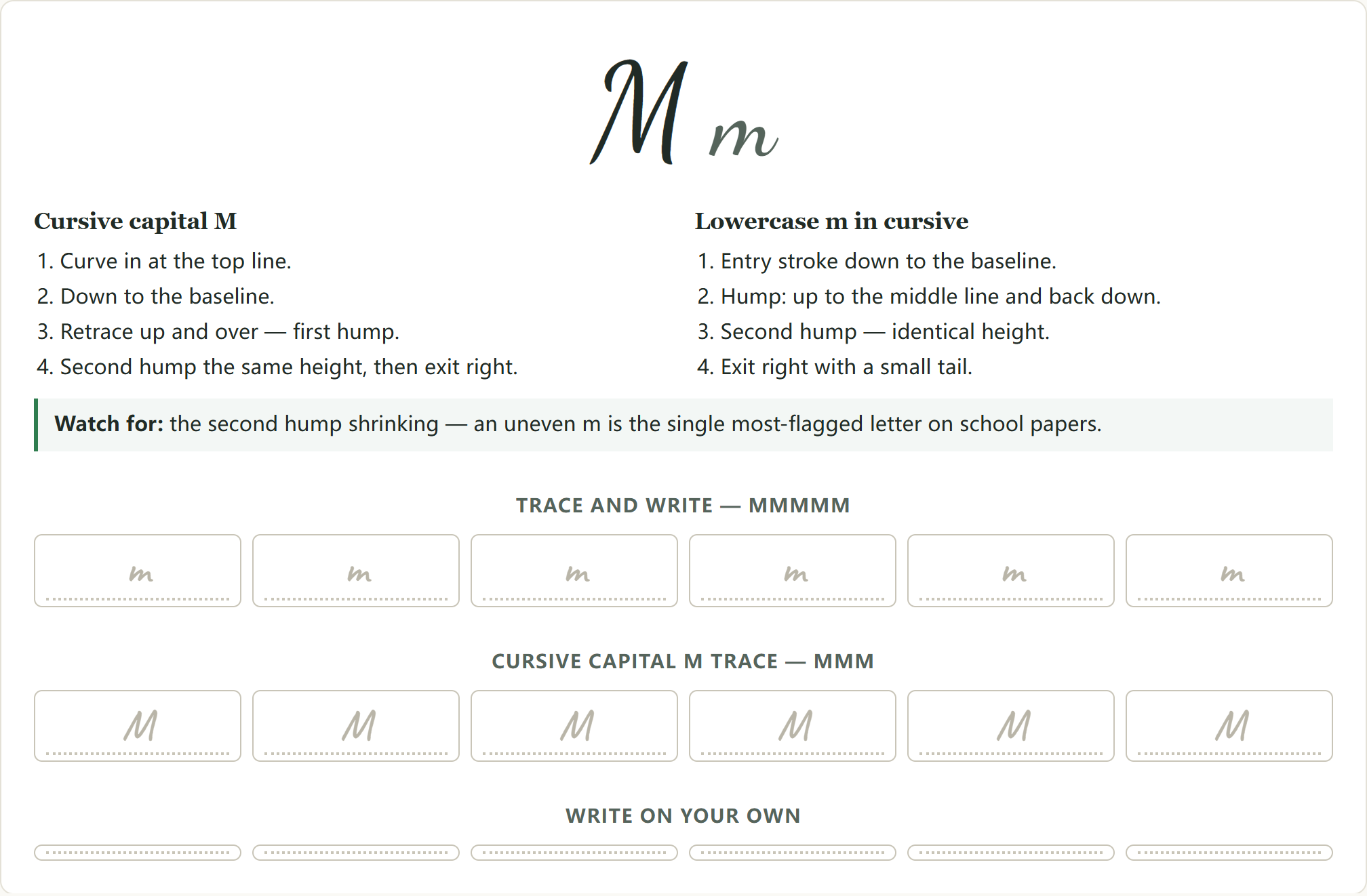
Cursive capital M
- Curve in at the top line.
- Down to the baseline.
- Retrace up and over — first hump.
- Second hump the same height, then exit right.
Lowercase m in cursive
- Entry stroke down to the baseline.
- Hump: up to the middle line and back down.
- Second hump — identical height.
- Exit right with a small tail.
Watch for: the second hump shrinking — an uneven m is the single most-flagged letter on school papers.
Trace and write — mmmmm
Cursive capital M trace — MMM
Write on your own
PNG version — the exact file Download PNG saves
Two hills, same height
The lowercase m is the alphabet's rhythm section: entry stroke, down, then two humps — each one up to the middle line and back down — before the exit. Its entire difficulty is equality. The second hump, written by a hand already moving, comes out shorter or narrower than the first almost every time, and an uneven m is the most common handwriting note on third-grade papers. The cure is counting: two humps, said out loud, at the same speed, each touching the same ceiling.
The capital M is all shoulders: a top curve in, down to the baseline, then two retrace-and-hump sequences like a giant lowercase m, exiting with a tail. It is among the easiest capitals precisely because it reuses the lowercase motion at scale — teach the lowercase first and the capital arrives nearly free. The failure mode is drift: three humps instead of two, added when the hand is on autopilot. M has exactly two; count them.
Capital M in cursive
The cursive capital M is the lowercase m at full scale: a curve in at the top line, a stem down to the baseline, then two retrace-and-hump sequences exactly like the small letter's, finishing with the exit tail. It is among the easiest capitals to teach precisely because it invents nothing — a child who owns lowercase m already owns the motion and only needs to stretch it.
The letter's whole discipline is the count: exactly two humps. On autopilot the hand drifts into a third, and a three-humped M is one of the most common capital errors on classroom walls. Say "one, two, out" while tracing and the count installs itself. Compared with print M there are no separate peaks drawn as pieces — the cursive M is one continuous road, loop to tail, without lifting the pencil.
Teaching tips
Count the humps aloud
"One... two... out." Spoken counts stop the mystery third hump and keep both arches the same height — the two fixes m needs most.
Same ceiling, same rent
Both humps touch the middle line. Trace a dashed middle line across the practice row so the second hump has no excuse.
Capital M = lowercase m at scale
Show the side-by-side once: same retrace-and-hump rhythm, taller walls. Learners who see the reuse skip a week of separate practice.
Frequently asked questions
How do you write a capital M in cursive?
Curve in at the top line, down to the baseline, then retrace up and over two humps — like a large lowercase m — finishing the second hump at the baseline with an exit tail.
How do you write a lowercase m in cursive?
Entry stroke down to the baseline, then two humps — each rising to the middle line and returning — followed by the exit tail to the right.
Why does my m look like an n?
The second hump went missing — usually the hand exited early. Say "two" out loud while writing until the count is muscle, not memory.
How many strokes is cursive m?
One continuous stroke: down, up-over (hump one), up-over (hump two), tail. No pencil lift — retracing the same line is what keeps the humps connected.
How many humps does a cursive capital M have?
Exactly two, same as the lowercase — a third hump is autopilot drift, not a style choice. Counting aloud while tracing ("one, two, out") is the standard classroom fix.