Cursive H
Lowercase h is a tall l-loop that lands on n's hill instead of exiting. Both forms numbered stroke by stroke below, with a printable trace-and-write sheet and the hump-height check that keeps h from collapsing into r.
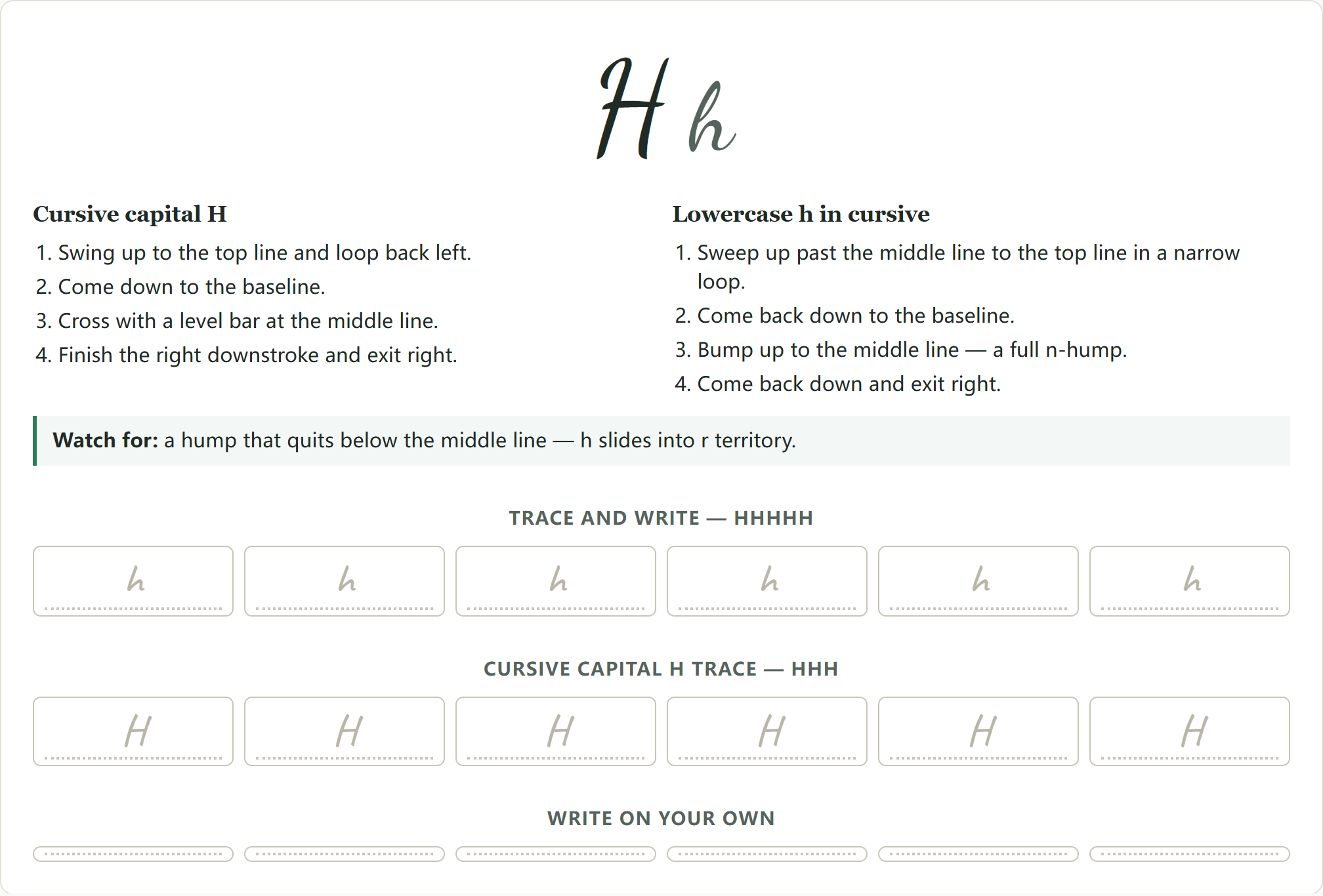
Cursive capital H
- Swing up to the top line and loop back left.
- Come down to the baseline.
- Cross with a level bar at the middle line.
- Finish the right downstroke and exit right.
Lowercase h in cursive
- Sweep up past the middle line to the top line in a narrow loop.
- Come back down to the baseline.
- Bump up to the middle line — a full n-hump.
- Come back down and exit right.
Watch for: a hump that quits below the middle line — h slides into r territory.
Trace and write — hhhhh
Cursive capital H trace — HHH
Write on your own
PNG version — the exact file Download PNG saves
Tall loop, then the hill
The lowercase h is l and n fused: the tall loop of the loop family climbing to the top line, and on the way back down, instead of exiting, the hand bumps up into the hill of n and over. It is the letter that proves a child has both families — loop on top, hill on the bottom — and it is worth checking that the hump actually reaches the middle line. An h whose bump is timid collapses into something unreadable between h and r; the hump should have the confidence of a fully paid n.
The capital H is a top loop, a leg, and a crossbar: up-and-over into a loop at the top line, down to the baseline, then a crossbar at the middle, and a second downstroke — or, in the one-stroke tradition, the crossbar flows directly into the right leg. It is a workhorse capital — names, Helen and Henry, Houston — and its failure mode is a crossbar that climbs. The bar is level; a rising bar makes the letter look like it is shrugging.
Capital H in cursive
The cursive capital H is a top loop, a leg, and a crossbar: swing up and over into the loop at the top line, come down to the baseline, cross at the middle line with a level bar, then make the second downstroke and exit. In the one-stroke tradition — the one most American programs teach — the crossbar flows directly into that right leg, so bar and leg are one continuous movement rather than two separate marks.
Its failure mode is a crossbar that climbs: the bar runs level, and a rising bar makes the whole letter look like it is shrugging. The print reflex is the other enemy — hands that learned H as three separate pieces (upright, upright, bar) tend to draw a stick H with a loop stapled on. H is a workhorse capital — Henry, Helen, Houston — and its top loop follows the universal loop rule: narrow as a sliver, never a hoop.
Teaching tips
Full-price hump
The hump must reach the middle line — a half-height bump is an r wearing h's loop. Trace an n directly above the h to calibrate the hump's ceiling.
Loop, check, then hump
Beginners who rush fuse the loop and hump into one mush. Pause (pencil down) between loop and hump for the first week — clean beats continuous at this stage.
Level crossbar on the capital
The capital's bar runs flat through the middle. A tilted bar is the difference between H and A leaning on its side.
Frequently asked questions
How do you write a capital H in cursive?
Swing up and over into a loop at the top line, come down to the baseline, cross at the middle line with a level bar, then make the second downstroke — many styles connect the bar directly into that right leg.
How do you write a lowercase h in cursive?
Sweep up into a tall narrow loop to the top line, come back down, bump up to the middle line like an n, and come back down to the baseline, exiting right.
What's the difference between cursive h, n and r?
Height and hump count: h has the tall loop plus one full hump to the middle line; n has no loop, one hump; r has no loop and only half a hump. The loop is h's only identifier — keep it narrow.
Why does my h look like an l?
The hump is missing or too shallow to read — usually the downstroke went straight into the exit. Retrace the sequence: loop, down, UP to the middle line, over, down, tail.
Does the crossbar on cursive capital H connect into the second leg?
In most American styles, yes — the level crossbar flows straight into the right downstroke as one continuous movement. Drawing two uprights and inserting a bar afterward is the print habit, not cursive.