Cursive V
Lowercase v looks like u until you reach the bottom: where u curves, v turns on a dime. Both forms numbered below, with a printable sheet and the sharp-valley rule.
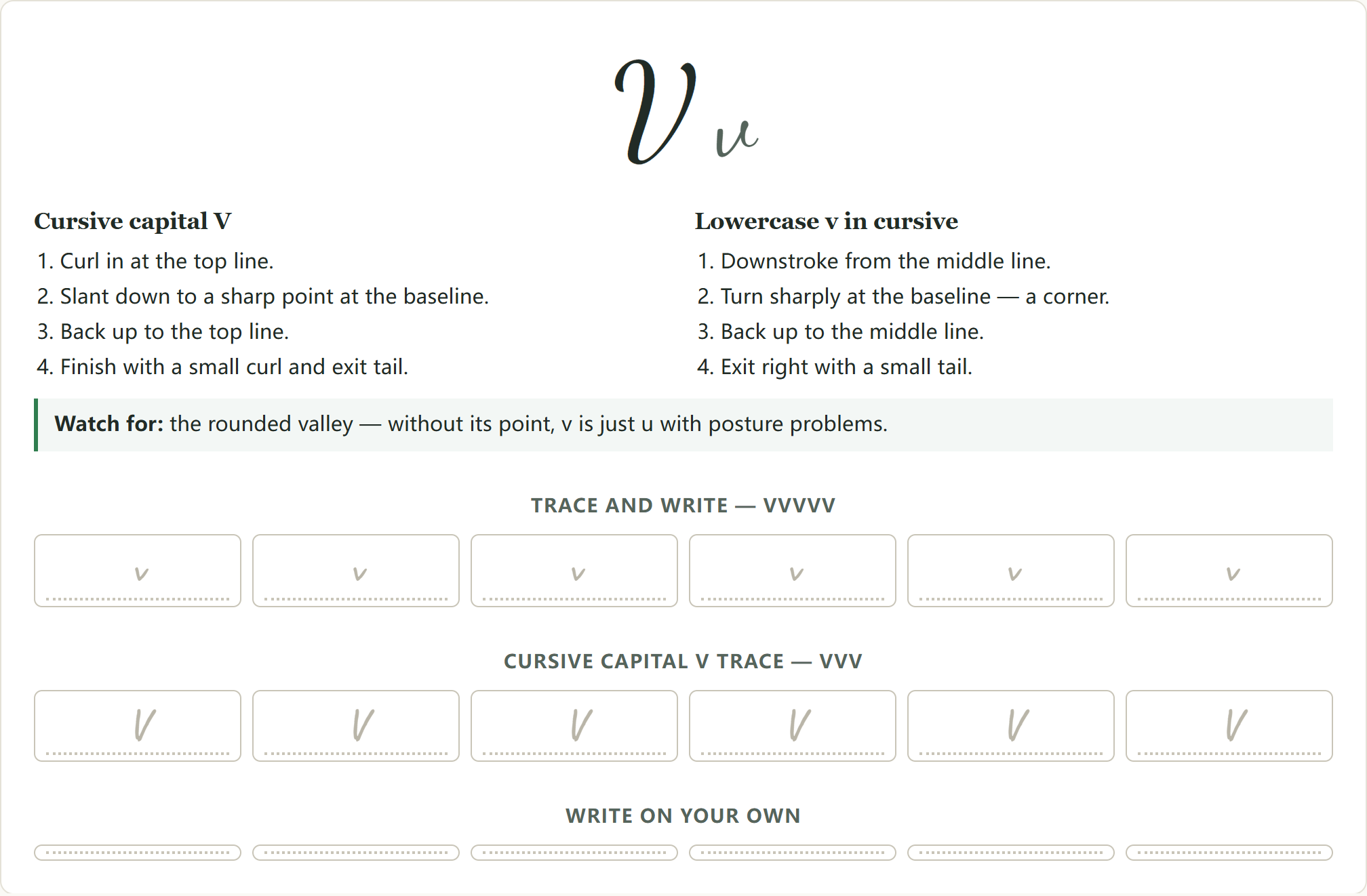
Cursive capital V
- Curl in at the top line.
- Slant down to a sharp point at the baseline.
- Back up to the top line.
- Finish with a small curl and exit tail.
Lowercase v in cursive
- Downstroke from the middle line.
- Turn sharply at the baseline — a corner.
- Back up to the middle line.
- Exit right with a small tail.
Watch for: the rounded valley — without its point, v is just u with posture problems.
Trace and write — vvvvv
Cursive capital V trace — VVV
Write on your own
PNG version — the exact file Download PNG saves
The valley with a point
The lowercase v runs u's opening play — downstroke — but at the baseline it refuses the cup and makes a point instead: a sharp turn back up to the middle line, then the standard exit tail. The point is the letter. A rounded valley is a u; a hesitant one drifts into a scribble; only a confident corner reads as v. This is the first letter where "stop and turn" is the skill, and it transfers directly to w (two valleys) and y (valley plus dive), so the crispness learned here pays out three times.
The capital V is a top curve and a clean diagonal pair: curl in at the top line, slant down to a point at the baseline, then back up — with, in many styles, a small top curl finishing the second stroke before the exit. The classic error at both sizes is the sagging valley: the point drifting up the page until the letter looks like a shallow bowl. Trace with the baseline visible and touch it — the valley's floor belongs exactly on the line.
Capital V in cursive
The cursive capital V is a top curl, a sharp diagonal down to a point at the baseline, a climb back up to the top line, and a small finishing curl into the exit tail. The point is the entire letter: where capital U rounds its floor into a valley curve, V turns on a corner — same two walls, completely different basement.
Those top curls are not optional decoration; they are the standard cursive entry gesture on capitals that begin with a slant stroke, the same way every lowercase opens with its little swing. The letter's one health check is the floor: the point must touch the baseline exactly. A valley that floats above the line drifts back toward a shallow, apologetic U — trace with the baseline visible and land the corner on it every time.
Teaching tips
Point, not cup
Say "down, TURN, up" — the middle word is a corner, not a curve. Ten traced v's against a marked baseline install the turn faster than a hundred blended ones.
The valley touches bottom
The point sits exactly on the baseline. A valley that floats high makes v read as a weak u — check the floor on every rep.
Preview w and y
After v is crisp, write w (two valleys) and note y's valley-plus-dive. The point skill is shared — point it out and two future letters arrive pre-installed.
Frequently asked questions
How do you write a capital V in cursive?
Curl in at the top line, slant down to a sharp point at the baseline, then back up to the top, finishing with a small curl and the exit tail.
How do you write a lowercase v in cursive?
Downstroke to the baseline, turn sharply at the bottom — point, not curve — back up to the middle line, then exit right with a small tail.
What's the difference between cursive v and u?
The bottom: u swings under in a rounded cup, v turns on a sharp point. Same two walls, completely different floor.
Why does my v look like a u?
The valley rounded off — the turn needs a corner. Slow the downstroke's ending so the change of direction is a decision, not a drift.
Why does cursive capital V have curls at the top?
They are the standard cursive entry and exit gestures — the same little swing every lowercase letter opens with, scaled up. Without the curls the letter is just two printed diagonals; with them it belongs to the script.