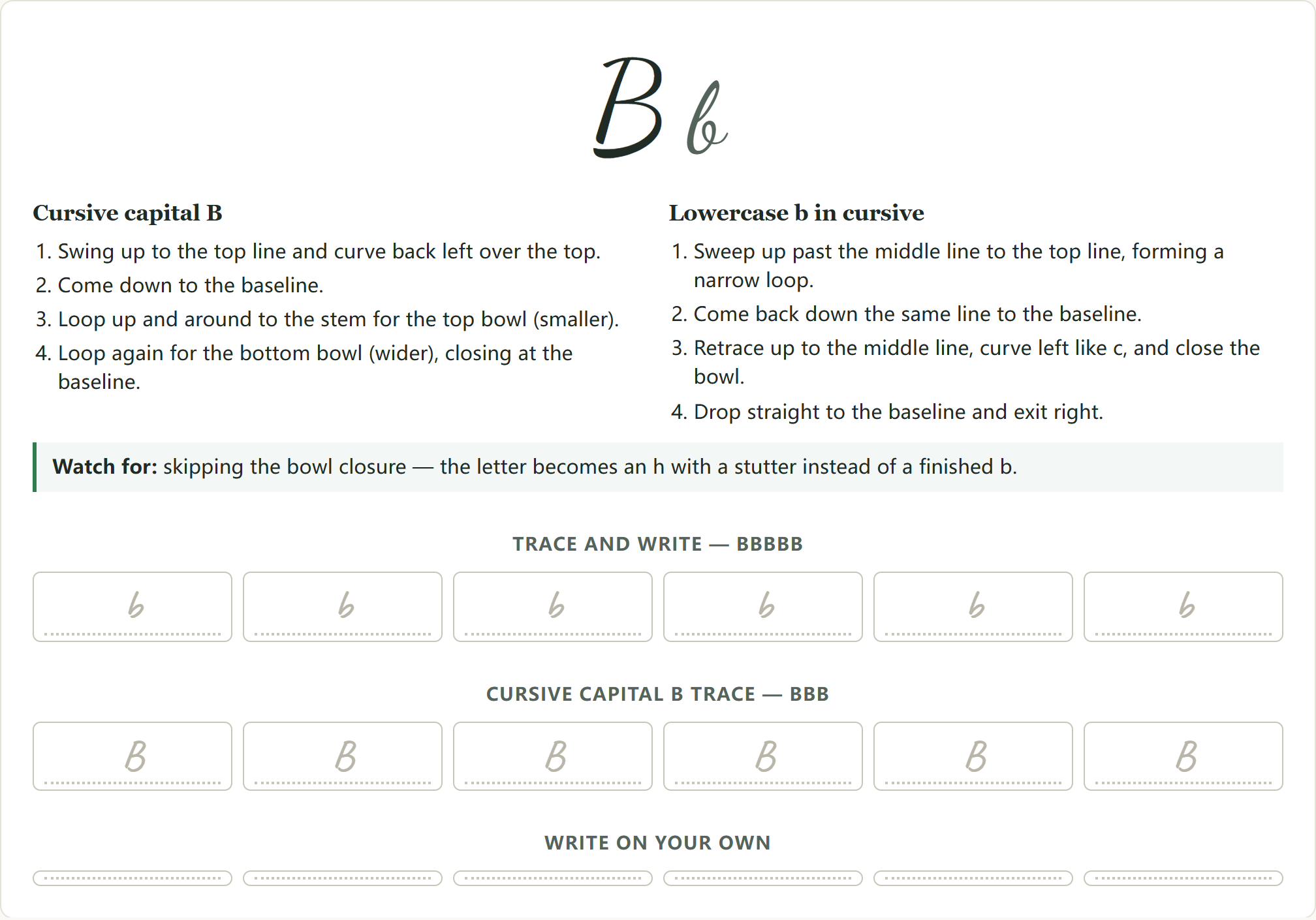
Cursive B
Lowercase b is two letters in one motion: the tall loop of l on top, the bowl of a on the bottom. This page numbers every stroke for both forms, prints as a practice sheet, and names the tell-tale mistake that makes a b collapse into an h.
Cursive capital B
- Swing up to the top line and curve back left over the top.
- Come down to the baseline.
- Loop up and around to the stem for the top bowl (smaller).
- Loop again for the bottom bowl (wider), closing at the baseline.
Lowercase b in cursive
- Sweep up past the middle line to the top line, forming a narrow loop.
- Come back down the same line to the baseline.
- Retrace up to the middle line, curve left like c, and close the bowl.
- Drop straight to the baseline and exit right.
Watch for: skipping the bowl closure — the letter becomes an h with a stutter instead of a finished b.
Trace and write — bbbbb
Cursive capital B trace — BBB
Write on your own
PNG version — the exact file Download PNG saves
A tall loop with a c stitched on
The lowercase b is where two families meet: it starts like the loop letters (l, h, k, f) with a narrow loop up to the top line, then finishes like the curve family — retrace up to the middle line, curve left exactly like c, close, and drop a clean downstroke to the baseline. Because it borrows from two learned motions, b is usually taught only after both are secure, and it is the letter that reveals whether a child really owns them. The stroke order matters more here than anywhere else in the lowercase: loop first, bowl second, and never the reverse.
The capital B is a stacked pair of loops — up-and-over at the top, down, then two bowls that get slightly wider toward the baseline. It is one of the busier capitals and rewards slow practice: the top bowl should be visibly smaller than the bottom, the way it is in print. Watch the width of the tall loop as well; a loop fatter than the letter is wide will collide with neighbors and slow the whole line down.
Capital B in cursive
The cursive capital B is a stem wearing two stacked bowls: an up-and-over loop at the top line, a stroke down to the baseline, then two rounded loops closing back against the stem — the top bowl smaller, the bottom bowl wider. Unlike print B, the letter is drawn in one continuous run (loop, down, bowl, bowl) with no pencil lift, and the whole left side is that single looped entry stroke rather than a straight vertical.
Its identity crisis is the numeral 3: when both bowls come out the same size, the eye reads a 3 with a loop on it. Keep the top bowl about two-thirds the width of the bottom and the letter snaps back to B. Loopier styles like D'Nealian close the bowls with extra flourish; rounder, more upright Zaner-Bloser keeps the letter plainer — but the uneven-bowl rule holds in both, and it is the difference between a B and a costume.
Teaching tips
Loop narrow, always
The tall loop should be a sliver, not a balloon — wide loops eat horizontal space and make b take up two letters of room. Aim for a loop you could thread a needle through.
Test it against h
b and h share the same first stroke. Write h, then b underneath: if the second halves look identical, the bowl is missing. The b bowl closes; the h bumps and slides.
Capitals: bottom bowl bigger
When tracing the capital, check that the lower loop is the wider of the two. Equal bowls read as a clumsy 3; uneven bowls read as B.
Frequently asked questions
How do you write a capital B in cursive?
Swing up and over at the top line, come down to the baseline, then loop up and around twice — a smaller top bowl, a wider bottom bowl — closing each back to the stem, and finish at the baseline.
How do you write a lowercase b in cursive?
Make a tall narrow loop to the top line and come back down to the baseline, retrace up to the middle line, curve left like a c, close the bowl, then drop straight down and exit right.
Why does my b look like an h or an l?
The bowl stroke is missing or never closed — usually because the retrace up skipped past the middle line straight into the exit. Go slower at the retrace: up only to the middle line, then the c-curve.
Is cursive b written in one stroke?
Yes — one continuous motion without lifting the pencil: loop down, retrace, bowl, down, tail. Lifting after the loop is the habit that breaks the letter's rhythm.
Why does my cursive capital B look like the number 3?
The two bowls came out the same width. Make the top bowl roughly two-thirds the size of the bottom one — unequal bowls read as B, equal bowls read as 3 wearing a loop.