Cursive K
Lowercase k is a tall l-loop with a tiny knot stitched into its stem. Both forms numbered stroke by stroke below, with a printable practice sheet and the size rule that keeps k from becoming R.
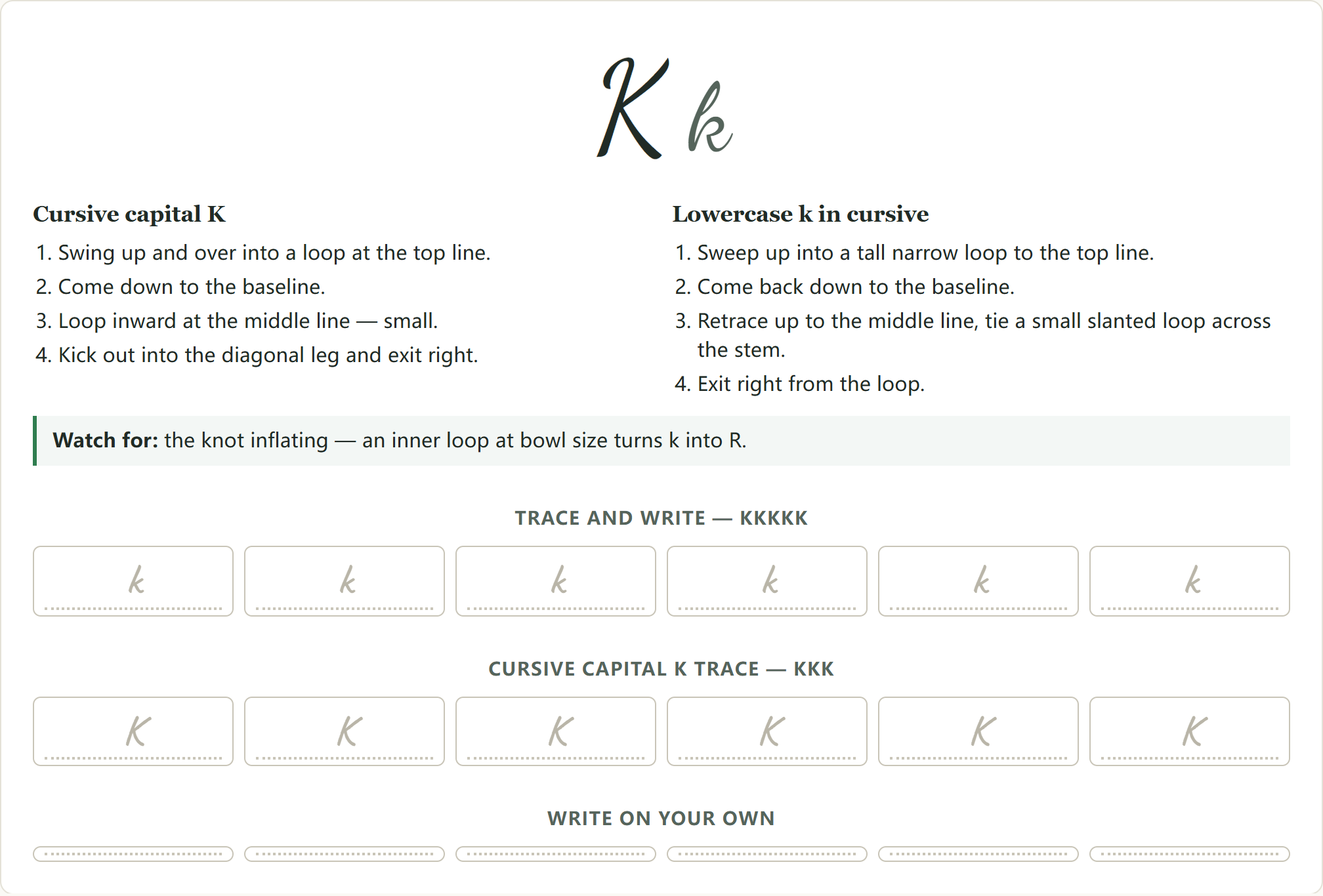
Cursive capital K
- Swing up and over into a loop at the top line.
- Come down to the baseline.
- Loop inward at the middle line — small.
- Kick out into the diagonal leg and exit right.
Lowercase k in cursive
- Sweep up into a tall narrow loop to the top line.
- Come back down to the baseline.
- Retrace up to the middle line, tie a small slanted loop across the stem.
- Exit right from the loop.
Watch for: the knot inflating — an inner loop at bowl size turns k into R.
Trace and write — kkkkk
Cursive capital K trace — KKK
Write on your own
PNG version — the exact file Download PNG saves
The loop with a knot
The lowercase k builds on l and adds the trickiest little structure in the lowercase: after the tall loop and its downstroke, the hand retraces up to the middle line and ties a small slanted loop — in, down across the stem, out. The loop is a knot, and like any knot it must be small: a loop the size of the letter's bowl turns k into a lowercase R or a drowning b. Programs teach k last among the loop letters for exactly this reason — it demands a retrace and a size judgment at the same time.
The capital K shares the l-loop opening and then splits into a kick: top loop, stem, then in toward the middle and out into a diagonal leg. The common error mirrors print muscle memory — a straight-in diagonal and straight-out leg with no loop, which is fine handwriting but not cursive. The small inward loop is the letter's cursive credential; trace it deliberately slow for the first several passes.
Capital K in cursive
The cursive capital K shares its opening with half the alphabet — a loop at the top line, a stroke down to the baseline — and then goes its own way: a small inward loop at the middle line that kicks out into a diagonal leg. That little inward loop is the letter's cursive credential. Hands trained on print K try to skip it and draw two straight diagonals off the stem, which produces fine handwriting but not cursive.
Keep the inward loop on the same diet as every other loop in the script — small, a sliver, barely closing — because a loop that grows turns the letter into a crowded R. And that is the practical comparison: capital R closes a round bowl against its stem before kicking into its leg, while K ties an open little knot and kicks straight out of it. Kevin, Kate and kindergartners' own names keep this capital in weekly rotation.
Teaching tips
The knot is a grain of rice
Same diet rule as the e loop: the k's inner loop should be the smallest thing on the page. If you can see daylight through it at ten paces, it is too big.
Retrace before you knot
Go up the stem first, then start the loop from the middle line. Knots tied from the baseline upward make the letter lean and collide with its tail.
Capital: loop, don't print
Watch for the print reflex — straight diagonal in, straight leg out. The inward loop at the middle is what makes capital K cursive; slow-trace it five times before speed.
Frequently asked questions
How do you write a capital K in cursive?
Swing up and over into a loop at the top line, come down to the baseline, then make a small inward loop at the middle line and kick out into the diagonal leg, finishing with the exit tail.
How do you write a lowercase k in cursive?
Tall narrow loop to the top line, down to the baseline, retrace up to the middle line, tie a small slanted loop in and back out across the stem, then exit right.
Why does my cursive k look like an R?
The inner loop has grown to bowl size — when the knot fills the space between the lines, k reads as a lowercase R. Shrink the loop until it barely closes.
Is cursive k one stroke or two?
One, without lifting: loop down, retrace, knot, exit. The knot feels like a separate motion at first, but keep the pencil down — lifting is what makes the knot clumsy.
Is cursive capital K written like a print K?
No — after the looped stem, the middle of the letter is a small inward loop that kicks out into the leg. Two straight diagonals off a stem is the print reflex; the little loop is what makes the capital cursive.