Cursive J
Lowercase j is an i sent below the line: same short downstroke, same dot, but the stroke dives through the baseline and hooks. The capital is the grandest single sweep in the alphabet. Both numbered below, with a printable sheet.
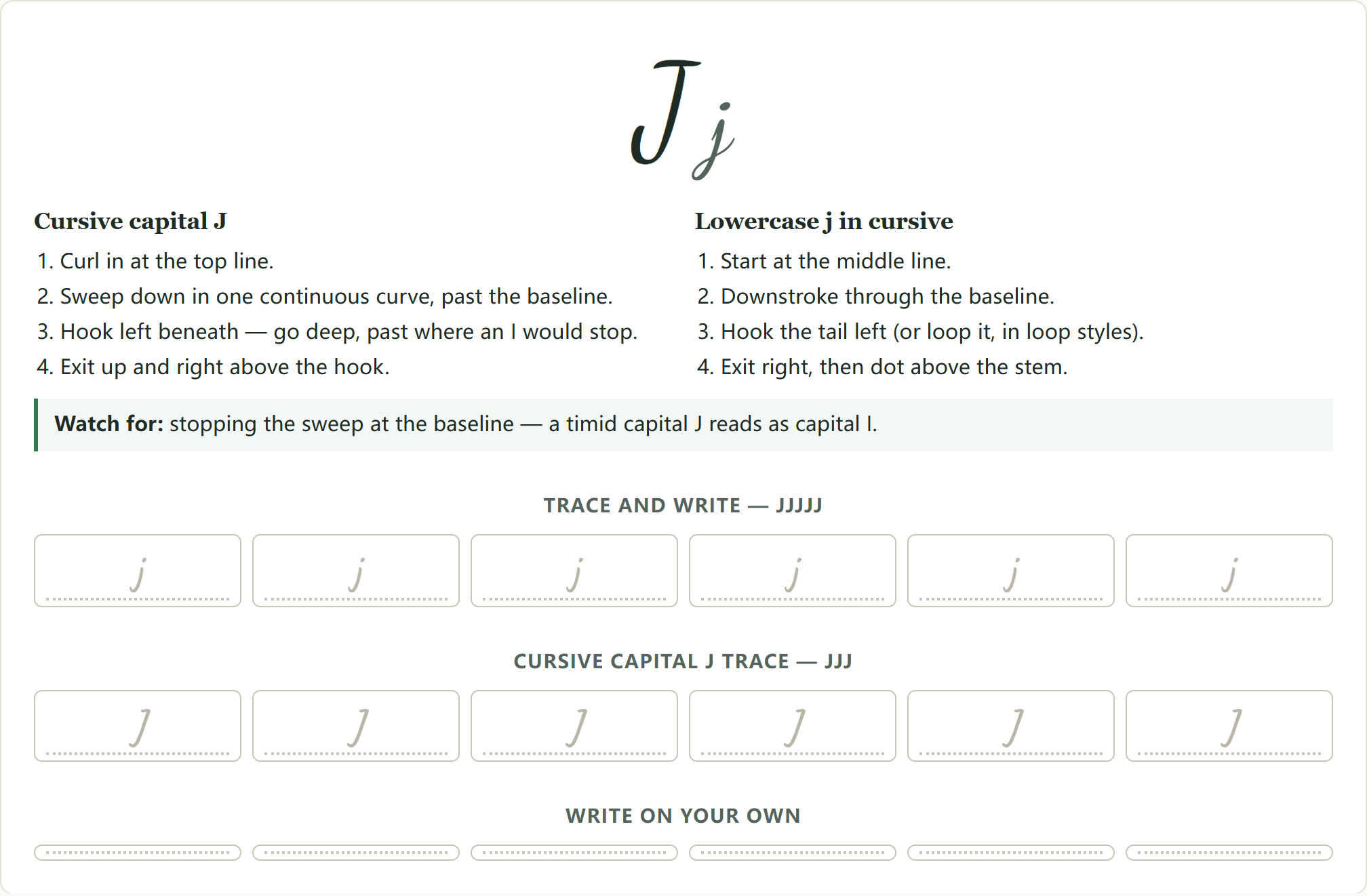
Cursive capital J
- Curl in at the top line.
- Sweep down in one continuous curve, past the baseline.
- Hook left beneath — go deep, past where an I would stop.
- Exit up and right above the hook.
Lowercase j in cursive
- Start at the middle line.
- Downstroke through the baseline.
- Hook the tail left (or loop it, in loop styles).
- Exit right, then dot above the stem.
Watch for: stopping the sweep at the baseline — a timid capital J reads as capital I.
Trace and write — jjjjj
Cursive capital J trace — JJJ
Write on your own
PNG version — the exact file Download PNG saves
The diving i
The lowercase j takes everything the i does and extends it one lane down: downstroke from the middle line, straight through the baseline, curving left into a hook (or loop, in D'Nealian style), then the exit, then the dot. It is the second letter children meet with a descender — g came first — and the pairing is worth making explicit: same dive rule, same lane, don't touch the line below. The j's dot follows the i's rule exactly: on the slant, above the stem, after the word.
The capital J is cursive's most dramatic stroke — a top curl into one continuous sweep all the way down past the baseline, hooking left and finishing with an exit above the hook. It is the letter that most often gets drawn too timidly: writers stop the sweep at the baseline as if writing a capital I. The J commits — the deeper curve belongs to it alone among the letters it resembles. Use the sentence-starting J ("January...") to give it room to breathe.
Capital J in cursive
The cursive capital J is the grandest single gesture in the alphabet: a curl at the top line, then one continuous sweep down the full height of the letter, past the baseline, hooking left beneath, and finishing with an exit stroke rising back to the right above the hook. No other capital commits so much ink below the line.
Its error is timidity. Writers brake at the baseline — as every capital-I instinct tells them to — and produce a shallow, apologetic letter. The J's sweep should pass clearly below the baseline before it hooks; trace it with the row beneath visible and check the depth against it. The capital earns its drama through use: January, June and July put it at the head of half the school year's calendar, so give the sweep room to breathe.
Teaching tips
Borrow the g dive
If j tails stall at the baseline, trace three g's first — the dive motion is identical, and the g primes the hand to keep going.
Capital: commit to the sweep
The J's curve should pass well below the baseline. A shallow J is just a sad I — check depth against the row beneath before moving on.
Hook, don't close
The lowercase tail hooks left with a gap; it does not close into a loop unless the style calls for it. Closed hooks in a hook-style program blur j into a tiny anchor.
Frequently asked questions
How do you write a capital J in cursive?
Curl in at the top line, then one continuous sweep down past the baseline, hooking left beneath — deeper than an I — and finish with an exit stroke rising to the right above the hook.
How do you write a lowercase j in cursive?
From the middle line, make a short downstroke through the baseline into a leftward hook (or loop, style-dependent), exit right, then dot above the stem on the slant.
Do you dot a cursive j?
Yes — same rule as i: a dot above the stem, placed on the slant after the word is written. The descender changes nothing about the dot.
How is cursive j different from g?
j has no bowl — it is a bare stroke with a tail and a dot, while g wraps its tail beneath a closed a-bowl. Straight dive vs curve-then-dive is the visual tell.
How deep should the sweep on a cursive capital J go?
Clearly below the baseline before it hooks left — if the curve stops at the line, you have written an I. Let the sweep own the descender lane without touching the writing line beneath, then rise back to the right for the exit.