Cursive R
Lowercase r is n's little sibling: the entry stroke, then a shoulder that starts a hump and changes its mind. Half a hill, by design. Both forms numbered below, with a printable sheet and the bump rule.
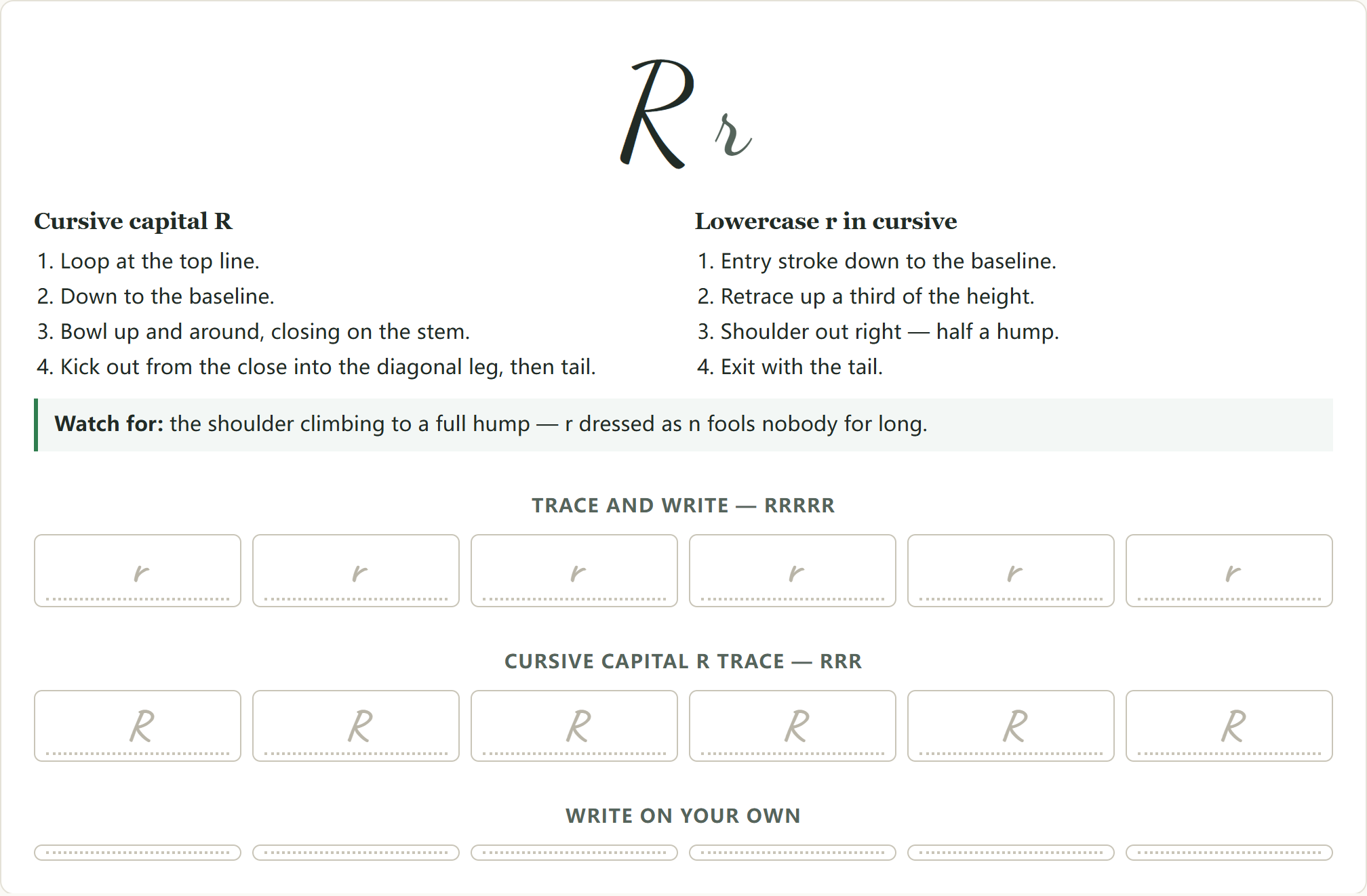
Cursive capital R
- Loop at the top line.
- Down to the baseline.
- Bowl up and around, closing on the stem.
- Kick out from the close into the diagonal leg, then tail.
Lowercase r in cursive
- Entry stroke down to the baseline.
- Retrace up a third of the height.
- Shoulder out right — half a hump.
- Exit with the tail.
Watch for: the shoulder climbing to a full hump — r dressed as n fools nobody for long.
Trace and write — rrrrr
Cursive capital R trace — RRR
Write on your own
PNG version — the exact file Download PNG saves
The half-hearted hump
The lowercase r is the shortest of the hill letters because its hump never happens: entry stroke, retrace up, then a small shoulder bump that rises and turns right immediately into the exit — an arch that begins and leaves before reaching a full n's ceiling. That brevity is the letter. Writers who let the bump keep climbing have written n; writers who skip it entirely have written v or a bare stem. r lives in the gap between, and tracing it directly against n is the fastest way to feel the boundary.
The capital R is a P that learned to kick: same top loop, same bowl, but from where the bowl meets the stem the stroke kicks out into a diagonal leg. It is one of the more elegant capitals — loop, bowl, leg, done — and its common failure is a leg that starts too low, dragging the letter into a stumble. The kick leaves from the bowl's closing point at the middle of the letter, not from the baseline.
Capital R in cursive
The cursive capital R is a P that learned to kick: the same top loop, the same stem, the same bowl closing against the stem — and then, from exactly that closing point, a diagonal leg launches out to the right. Everything elegant about the letter lives in that launch: the kick leaves from mid-letter, where bowl meets stem, not from the baseline.
A leg that starts too low drags the whole letter into a stumble — the classic capital R error — so trace the sequence as loop, stem, bowl, then kick, and let the kick begin the moment the bowl closes. Compared with print R, nothing is assembled from pieces: the cursive letter flows loop into stem into bowl into leg without a pencil lift. Ryan, Rachel and every Thursday keep it in heavy rotation.
Teaching tips
Trace r over n
Write a row of n, then r directly beneath on the same lines. Seeing the identical start and the early exit once is worth ten explanations of "half hump."
Bump, then bail
The shoulder rises a third of the way and turns right — say "up and out." Any higher and r is impersonating n; the costume never fits.
Capital kick from the middle
The leg launches at the bowl's close, mid-letter. A kick from the baseline makes R look like it tripped on its own coat.
Frequently asked questions
How do you write a capital R in cursive?
Loop at the top line, down to the baseline, bowl up and around closing against the stem, then kick out from that closing point into a diagonal leg, finishing with the tail.
How do you write a lowercase r in cursive?
Entry downstroke, retrace up, then a small shoulder bump that turns right almost immediately — half a hump — and exit with the tail.
Why does my r look like an n?
The shoulder climbed to the full middle line before exiting. r's bump is a suggestion, not a commitment — turn out a third of the way up.
How do you connect r to other letters?
Its exit tail is short and high, so r links cleanly into vowels (ri, re, ra) with a shallow join — one reason "are," "red" and "run" are standard early connected words.
Where does the leg start on a cursive capital R?
At the bowl's closing point against the stem — mid-letter, not at the baseline. Launching the kick from the floor is the stumble that makes the letter look broken; begin it the moment the bowl closes.