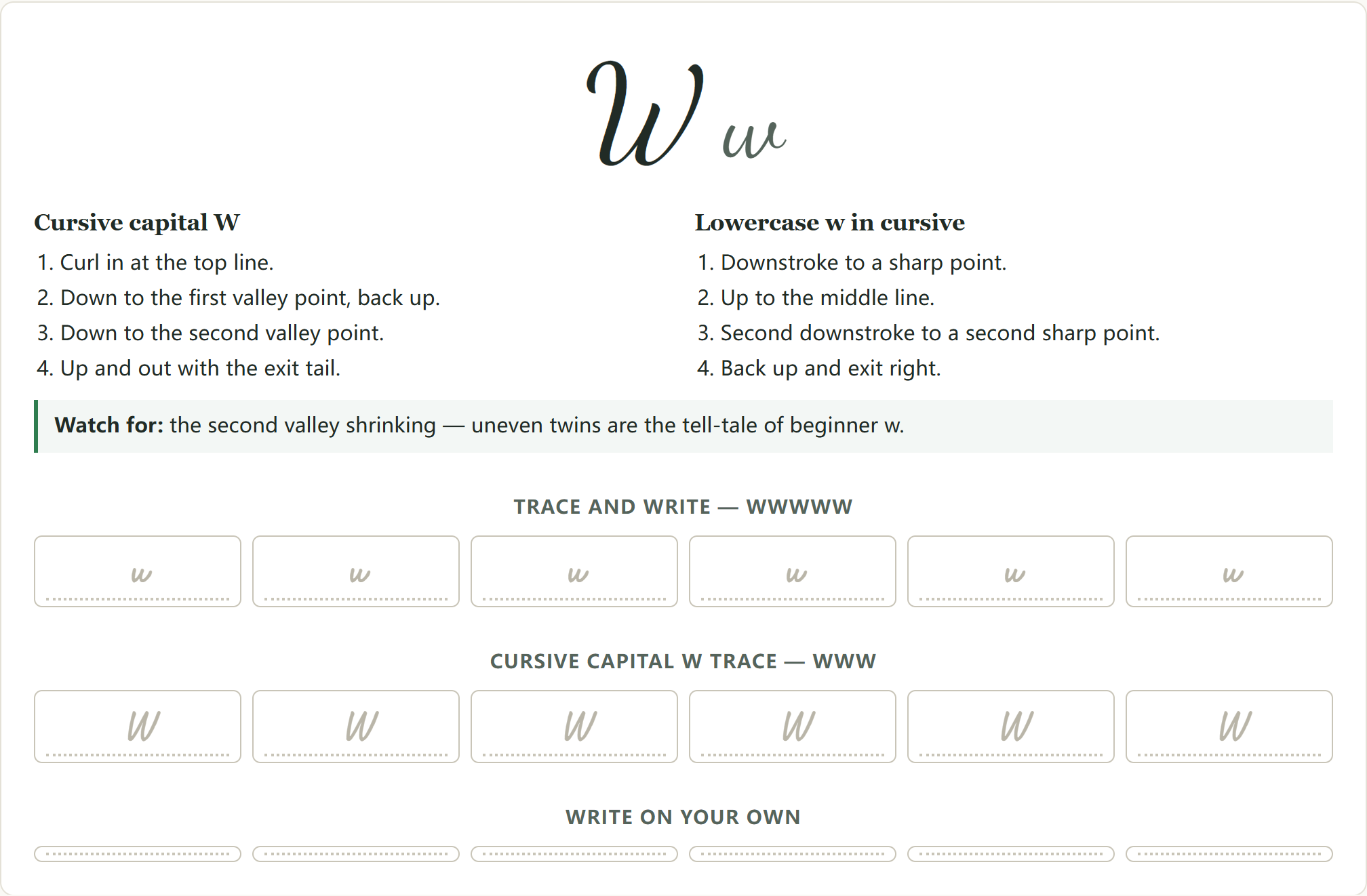
Cursive W
Lowercase w is v written twice without stopping — two sharp valleys, evenly matched. Both forms numbered below, with a printable sheet and the pairing rule.
Cursive capital W
- Curl in at the top line.
- Down to the first valley point, back up.
- Down to the second valley point.
- Up and out with the exit tail.
Lowercase w in cursive
- Downstroke to a sharp point.
- Up to the middle line.
- Second downstroke to a second sharp point.
- Back up and exit right.
Watch for: the second valley shrinking — uneven twins are the tell-tale of beginner w.
Trace and write — wwwww
Cursive capital W trace — WWW
Write on your own
PNG version — the exact file Download PNG saves
Two valleys, one letter
The lowercase w inherits everything from v — downstroke, sharp turn, upstroke — and simply repeats it: valley, valley, out. Its single demand is equality. The second valley, written by a hand already moving, tends to run narrower or shallower than the first, and an uneven w is instantly recognizable as beginner work. Trace the pair to a rhythm — "down-up, down-up, out" — and the two valleys come out twins.
The capital W is the doubled capital V: top curl, valley, peak, valley, and out with a tail. It is one of the wider capitals and needs its full width — a compressed W crams both valleys until the letter reads as a stack of slashes. Give the first valley the same depth as the second and both peaks the same height; symmetry is the entire job.
Capital W in cursive
The cursive capital W is the capital V written twice without stopping: curl in at the top, down to a valley point, up, down to a second valley point, then up and out into the exit tail. It is one of the widest capitals in the alphabet and needs every bit of that width — a compressed W crams its two valleys until the letter reads as a stack of slashes.
The distinction that matters in practice is W versus capital M, its upside-down neighbor. M's two humps are retraced arches rising from a stem to only the letter's middle; W's zigzag runs the full height, valley points touching the baseline and peaks touching the top line. Count the floor-touches — W has exactly two — and keep both valleys and both peaks matched, because symmetry is the entire job.
Teaching tips
Rhythm over geometry
"Down-up, down-up, out" — spoken evenly. A metronome mouth makes matched valleys faster than a careful eye does.
Give it width
The lowercase w is one of the widest small letters; squeezing it makes the valleys unreadable. Two v's of space, minimum.
Peaks match too
Both upstrokes return to the same middle-line ceiling. A second peak that quits early is the subtle version of the same error.
Frequently asked questions
How do you write a capital W in cursive?
Curl in at the top line, slant down to the first valley point at the baseline, back up, down to the second valley, then up and out with the exit tail — two matched V-shapes.
How do you write a lowercase w in cursive?
Downstroke to a sharp point, up to the middle line, then a second downstroke to another sharp point, back up, and exit right — v twice without lifting.
Why does my w look lopsided?
The second valley went narrower or shallower than the first — the standard autopilot error. Slow to a spoken rhythm and both valleys come out even.
Is cursive w just two v's?
Exactly — same point turn, same ceiling, written twice in one stroke. Every fix that works on v installs on w for free.
How is cursive capital W different from capital M?
Floor versus ceiling: M's two humps are retraced arches rising to the letter's middle from a stem, while W's zigzag runs full height — valley points on the baseline, peaks on the top line. If the letter touches the floor twice, it is a W.