Cursive O
Lowercase o is a c that shuts its door and exits over the top — the only letter that leaves from the summit. Both forms numbered below, with a printable practice sheet and the direction rule most self-taught writers get wrong.
Cursive capital O
- Swing in at the top line, arcing up.
- Curve over to the left — counterclockwise.
- Sweep down, around the bottom, and up.
- Close at the top, then exit right with a tail.
Lowercase o in cursive
- Swing in from the baseline up to the middle line.
- Continue around the left and along the bottom.
- Rise to close where the curve began.
- Exit at the top with a small rightward tail.
Watch for: traveling clockwise — a reversed o breaks the curve family's shared opening and every connection after it.
Trace and write — ooooo
Cursive capital O trace — OOO
Write on your own
PNG version — the exact file Download PNG saves
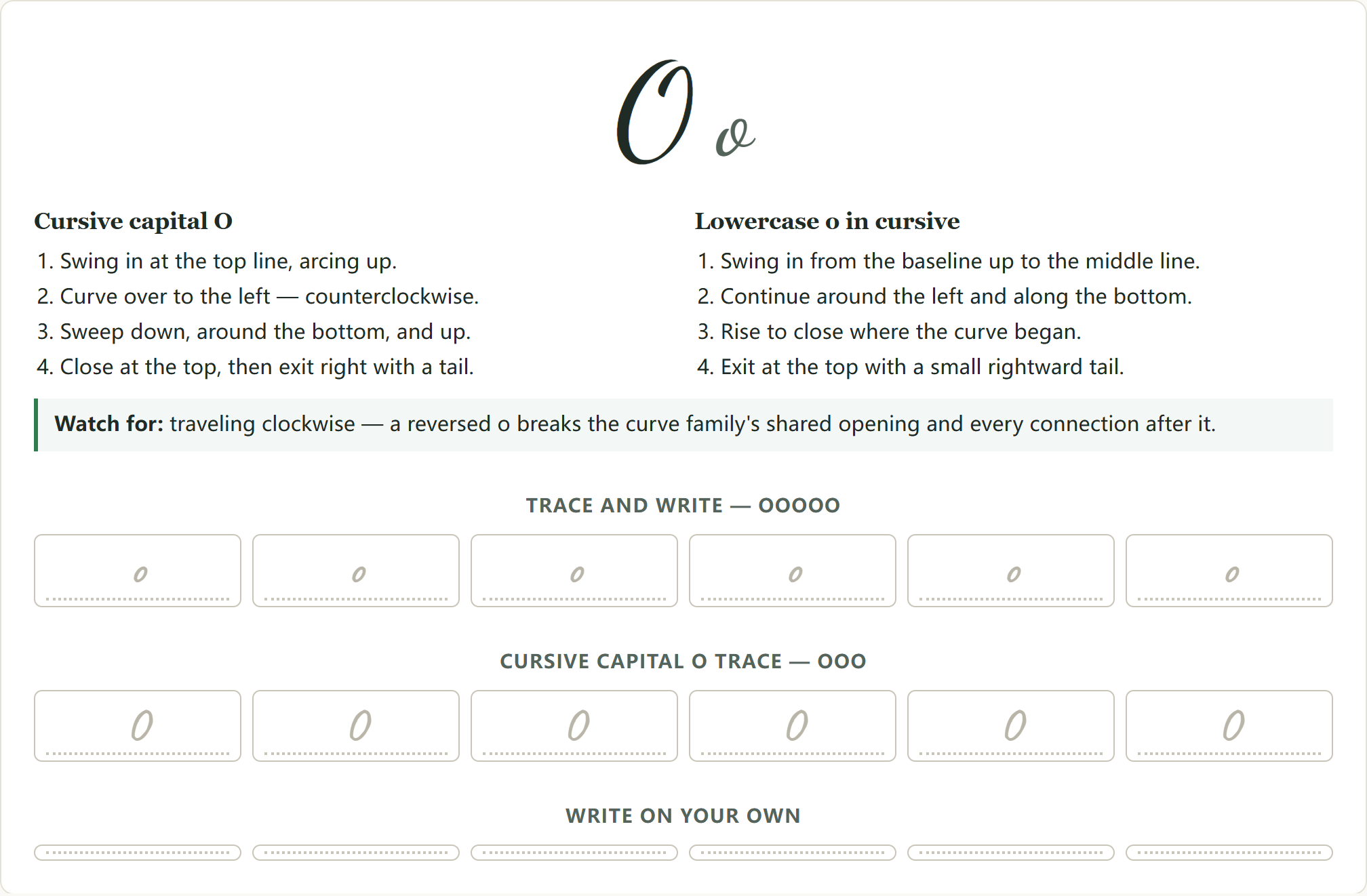
Close the door, leave from the top
The lowercase o starts like its whole family — swing in from the baseline, curve up to the middle line — then commits where c held back: around the left, down, along the bottom, and up to close exactly where the curve began. And then the twist that defines the letter: the exit stroke leaves from the top, a small tail flicking right at the middle line. Every other letter exits from the baseline; o alone departs from the summit. That high exit is why the oa in "boat" and the ow in "snow" connect with a visible horizontal link — a detail that looks decorative until you write it wrong.
The capital O is the lowercase at full height — same counterclockwise swing, close at the top, exit tail to the right. Direction is the rule most self-taught writers miss: the cursive o travels up and over to the left first (counterclockwise), the opposite of the print o most adults draw clockwise. Trace it big and slow a few times — the correct direction is what keeps o consistent with c, a, d and g, whose openings it shares.
Capital O in cursive
The cursive capital O is a full-height oval closed at the top, with its exit tail flicking right from the summit — the same departure quirk as the lowercase, at scale. And it obeys the family's direction law: counterclockwise, up and over to the left first, the identical opening that builds c, a, d and g. The capital is not a new letter to learn; it is the family's curve drawn at full height.
Most adults draw a print O clockwise without ever noticing, and that habit is the capital's one real trap — a clockwise cursive O fights the slant and looks subtly wrong next to its family. Trace it big and slow, watching the direction, then check its neighbors: the letter it most gets confused with is Q, which is an O that grew a tail from its right shoulder. No tail, no Q.
Teaching tips
Counterclockwise, always
Swing up and over to the left first — the same direction as c and a. A clockwise o is print with a slant, and it will fight every connection it meets.
Exit from the summit
The tail leaves at the top of the closed curve, not the baseline. Write "ol" and "on" to feel the high link — that is o's signature in connected words.
Round, not egg-shaped
Check traced o's for a tilt toward vertical egg shape — a wide egg o makes following letters crowd. The row lines on this sheet keep the proportion honest.
Frequently asked questions
How do you write a capital O in cursive?
Swing in at the top line, arc up and over to the left (counterclockwise), sweep down around the bottom and up to close at the top, then exit right with a tail.
How do you write a lowercase o in cursive?
Swing in from the baseline to the middle line like a c, keep going around the left and bottom, close at the starting point, and exit with a small tail at the top.
Which direction does a cursive o go?
Counterclockwise — up and over to the left first, the same opening direction as c, a, d and g. Clockwise o's are a print habit that breaks connections.
Why does my o look disconnected from the next letter?
The exit left from the baseline instead of the top. Cursive o closes its circle and departs from the summit — a small rightward tail at the middle line.
How do you keep cursive capital O and capital Q straight?
The tail decides: a bare closed oval is O, while Q sweeps a tail from its right side down past the baseline before curling. If the letter carries a tail, it is a Q — O never has one.