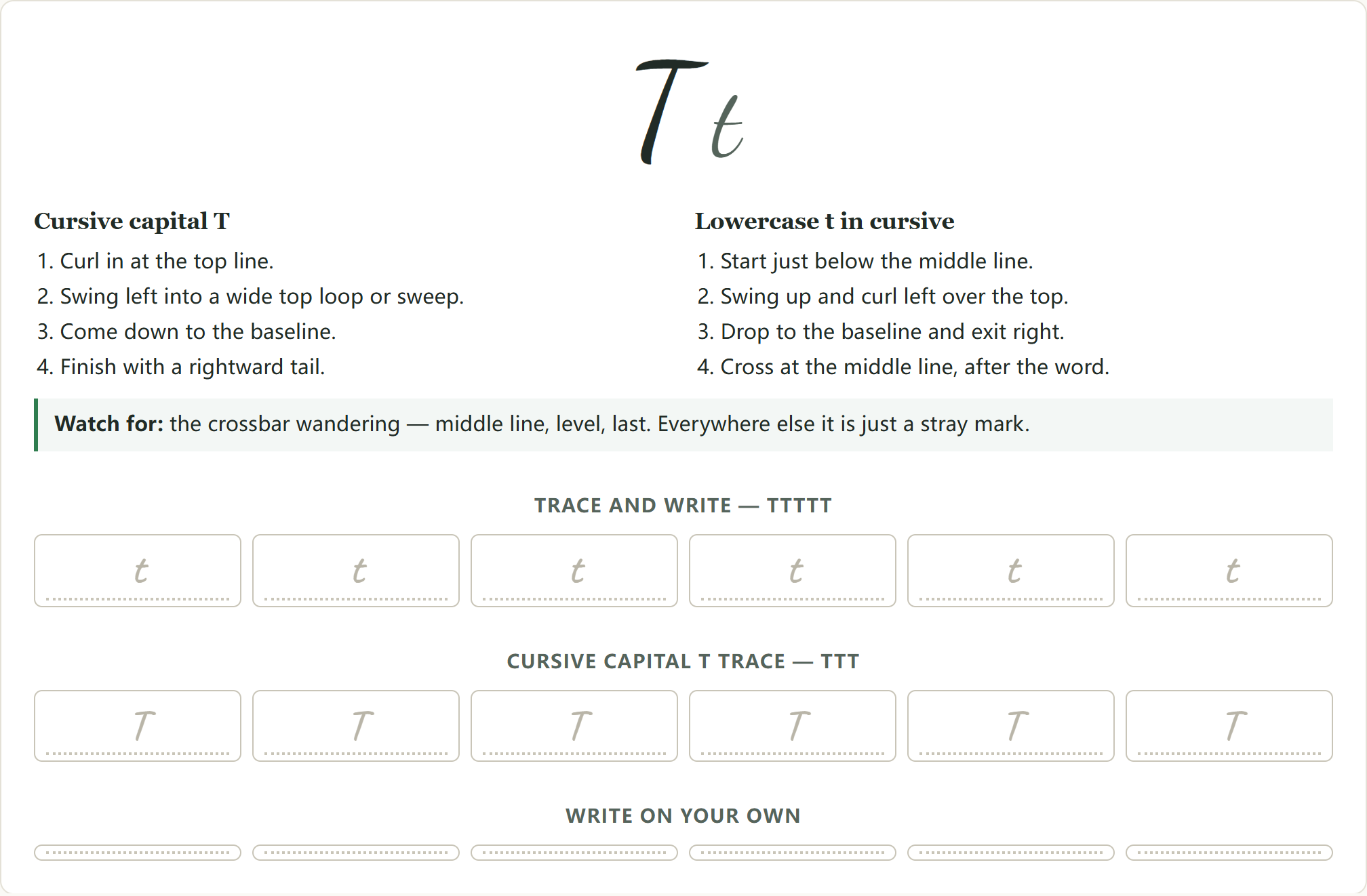
Cursive T
Lowercase t swings up and over before dropping to the baseline — a short stroke with a curl on top and a crossbar at the middle. Both forms numbered below, with a printable sheet and the crossbar rule.
Cursive capital T
- Curl in at the top line.
- Swing left into a wide top loop or sweep.
- Come down to the baseline.
- Finish with a rightward tail.
Lowercase t in cursive
- Start just below the middle line.
- Swing up and curl left over the top.
- Drop to the baseline and exit right.
- Cross at the middle line, after the word.
Watch for: the crossbar wandering — middle line, level, last. Everywhere else it is just a stray mark.
Trace and write — ttttt
Cursive capital T trace — TTT
Write on your own
PNG version — the exact file Download PNG saves
Up, over, down, cross
The lowercase t begins differently from every letter before it: instead of entering from the baseline, the stroke starts just below the middle line, swings up and curls left over the top, then drops to the baseline and exits. The crossbar comes after, at the middle line — and its placement is the letter's identity: a cross that rides high crowds the curl, one that rides low makes the t read as an undotted something. In connected writing t's tail flows on, and t is the letter that makes "it," "to" and "the" the first real words a cursive class writes.
The capital T is a top flourish and a stem: the stroke curls in at the top line, loops or swings left, then comes down to the baseline and sweeps out in a wide rightward tail — the whole top of the letter made in one horizontal gesture. That top sweep is T's signature and its trap: too small and the letter reads as a plain stem, too big and it bullies the next word. Aim for a top about as wide as the letter is tall — a gate, not a fence.
Capital T in cursive
The cursive capital T makes its entire top in one horizontal gesture: the stroke curls in at the top line, sweeps left into a wide loop or wave, and only then drops to the baseline and runs out into the rightward tail. There is no separate crossbar to add afterward — the sweep at the top is the crossbar, built into the letter's first movement.
That construction is the difference from print T, which assembles a bar and a stem as two pieces. The cursive letter's calibration is width: the top should run about as wide as the letter is tall — a gate, not a fence. Too small and the capital reads as a bare stem with ideas; too big and it bullies the next word. Tuesday, Thursday and Thank you keep it in constant classroom service.
Teaching tips
Cross at the middle, cross last
Same pass rule as i's dot: write the word, then cross every t in one sweep. Middle-line placement — high crosses crowd the curl, low crosses read as noise.
Feel the up-and-over entry
t is the first letter entered from above — starting just below the middle line and curling over. Trace it slowly; the reversed entry is t's only new skill.
Capital: gate, not fence
The big T's top sweep is letter-width — wide enough to declare itself, narrow enough to let the next word breathe.
Frequently asked questions
How do you write a capital T in cursive?
Curl in at the top line and swing left into a wide top loop or sweep, then come down to the baseline and finish with a rightward tail — the entire top of the letter made in one horizontal gesture.
How do you write a lowercase t in cursive?
Start just below the middle line, swing up and curl left over the top, drop straight to the baseline, exit right — then cross at the middle line.
Where does the crossbar go on cursive t?
On the middle line, added after the word is written in the same pass as i-dots. The cross is level and just wide enough to clear the stem's curl.
Why does cursive t start from the top?
Its entry stroke arrives from above — a small curl over the top — so the letter flows into downstroke letters like no baseline-entry letter can. That curl is also what keeps t distinct from a short l.
How is cursive capital T different from print T?
Print T assembles a horizontal bar and a separate upright; the cursive T curls in and makes its whole top in one sweeping gesture before dropping to the baseline. No separate crossbar exists — and no second stroke is needed.