Cursive Q
Lowercase q is an a with a comeback tail: the family stroke, the dive — then the tail crosses back to become its own exit. Both forms numbered below, with a printable sheet and the tail rule that keeps q from being a g.
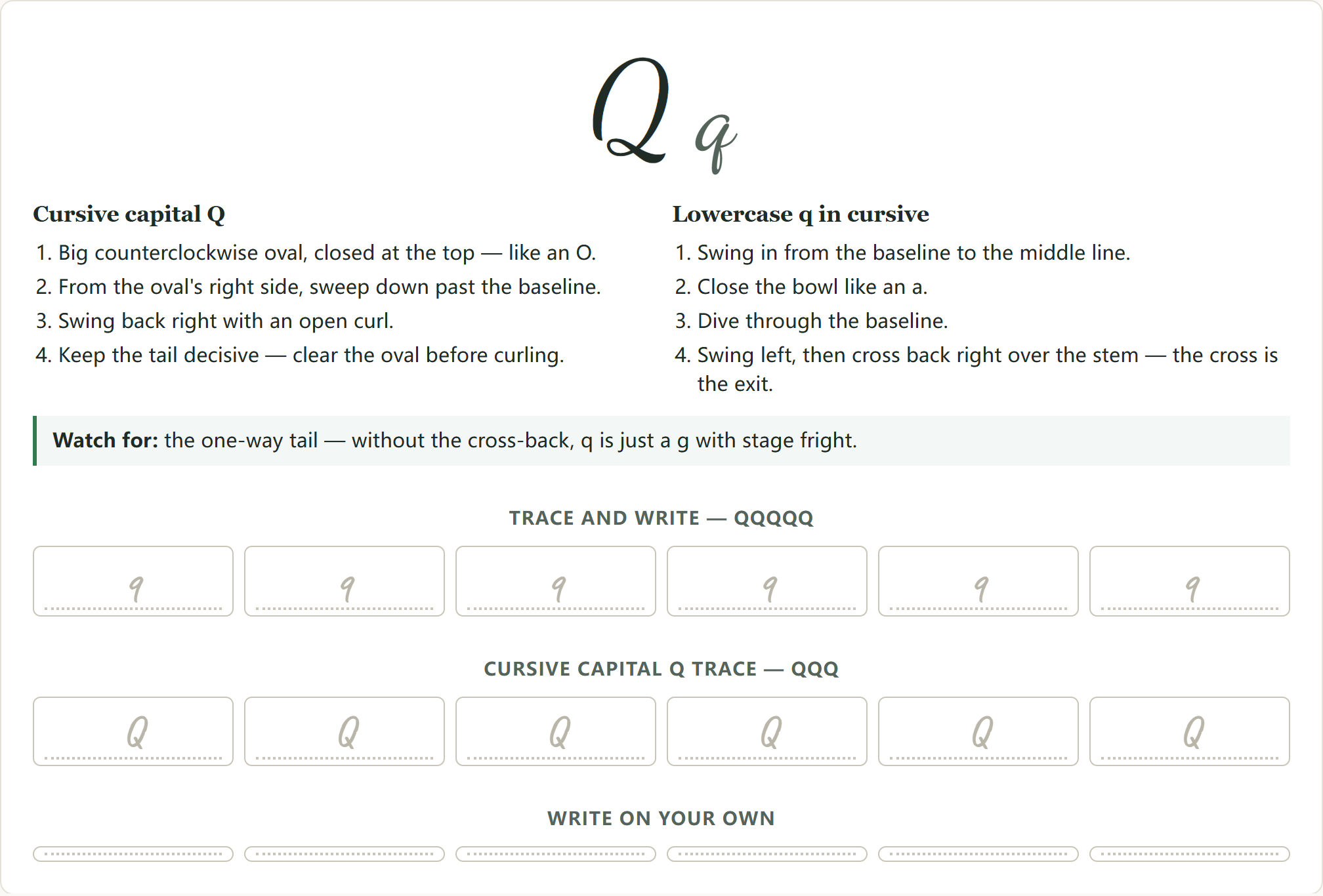
Cursive capital Q
- Big counterclockwise oval, closed at the top — like an O.
- From the oval's right side, sweep down past the baseline.
- Swing back right with an open curl.
- Keep the tail decisive — clear the oval before curling.
Lowercase q in cursive
- Swing in from the baseline to the middle line.
- Close the bowl like an a.
- Dive through the baseline.
- Swing left, then cross back right over the stem — the cross is the exit.
Watch for: the one-way tail — without the cross-back, q is just a g with stage fright.
Trace and write — qqqqq
Cursive capital Q trace — QQQ
Write on your own
PNG version — the exact file Download PNG saves
The tail that comes back
The lowercase q runs the family play — swing in like c, close the bowl, dive through the baseline — and then adds the alphabet's only crossed descender: the tail swings left, loops or angles back to the right, crossing the downstroke and becoming the exit itself. In many American styles the result is described as a tiny number 8 or an open curl, and that cross-back is the entire difference from g: g's tail ends its business below the line, while q's tail returns to street level to connect. In connected writing q almost never ends a word — English orthography settles that — so its tail's homecoming is not decoration; it is the letter's job.
The capital Q is a big O that grew a tail from its shoulder: full counterclockwise oval, closed at the top, then from the right side a sweep down past the baseline, swinging back right with an open curl. The D'Nealian tradition closes that sweep into a figure-8 flourish. Either way the tail must be decisive — a capital Q whose tail barely clears the oval is just an O in costume, and the difference matters on the very first page of every alphabet book.
Capital Q in cursive
The cursive capital Q is a big counterclockwise oval — drawn exactly like the capital O, closed at the top — with a tail that sweeps from the oval's right side down past the baseline, finishing in an open curl. Loopier styles close that sweep into a figure-8 flourish; plainer styles leave the curl open. Both are standard American forms; pick the one the school's program uses and stay consistent.
Of all the capitals, Q collects the most "wait, that's a Q?" reactions — the tail's rightward curl genuinely resembles a numeral 2 in several styles, and Zaner-Bloser's print Q is famous for exactly that shape. The resemblance is not an error. The one real rule is commitment: the tail must leave the oval decisively and clear it before curling, because a tail that hugs the oval leaves the letter reading as an O in costume.
Teaching tips
The tail returns
q's descender is round-trip: down, swing left, cross back right over the stem, exit. A one-way tail is a g — say "come back" while tracing until the cross is automatic.
Family review first
Warm up with c, a, d, g — q is the last of the curve family and reuses all of them. Arriving warm, it takes one session.
Capital: give the tail room
The big Q's tail should pass clearly below the baseline before curling. Trace it next to a capital O — the contrast locks in which letter owns a tail.
Frequently asked questions
How do you write a capital Q in cursive?
Draw a large counterclockwise oval closed at the top like an O, then from the right side sweep down past the baseline and swing back right into an open curl (D'Nealian styles close it into a figure-8).
How do you write a lowercase q in cursive?
Swing in like a c to the middle line, close the bowl, dive through the baseline, then swing the tail left and cross back right over the downstroke — the cross becomes the exit.
What's the difference between cursive q and g?
The tail's return trip: g's tail finishes below the line (hook or loop), while q's tail crosses back up over its stem to connect. g ends its dive; q comes home.
Why does cursive q look like an 8?
The bowl plus the round-trip tail form two stacked closed shapes — many American styles teach it as "a small 8 that starts like a." The description sticks because the shape is honest.
Does cursive capital Q look like the number 2?
In several American styles, yes — the right-side tail curls in a way that mirrors a 2, and Zaner-Bloser's print Q is famous for the same shape. The form is correct; just make sure the tail clearly leaves the oval so the letter reads as Q rather than O.