Cursive C
Cursive c is the most important letter on the page — not because it is hard, but because its opening curve is the entry stroke for a, d, g and q. Master c and you have pre-learned a third of the lowercase alphabet. Print this sheet first.
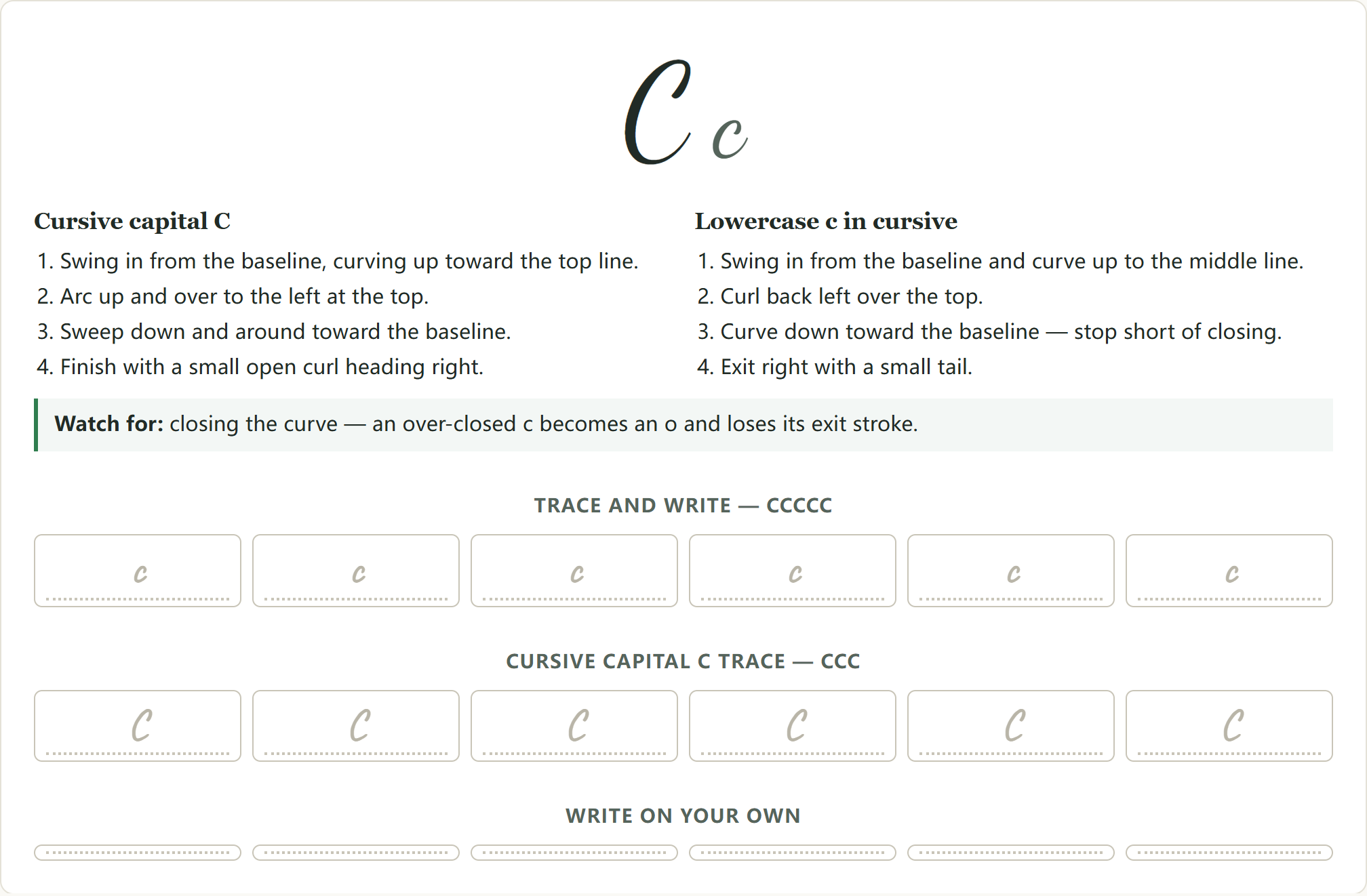
Cursive capital C
- Swing in from the baseline, curving up toward the top line.
- Arc up and over to the left at the top.
- Sweep down and around toward the baseline.
- Finish with a small open curl heading right.
Lowercase c in cursive
- Swing in from the baseline and curve up to the middle line.
- Curl back left over the top.
- Curve down toward the baseline — stop short of closing.
- Exit right with a small tail.
Watch for: closing the curve — an over-closed c becomes an o and loses its exit stroke.
Trace and write — ccccc
Cursive capital C trace — CCC
Write on your own
PNG version — the exact file Download PNG saves
The letter that teaches five
The lowercase c is a single unhurried curve: swing in from the baseline, arc up and over to the middle line, then back down toward the baseline — and stop. The door stays open. That open ending is what makes it c: close the curve and you have written an o, added a downstroke and you have an a. Teaching c first, then pointing out that a, d, g and q start with the identical motion, is how every major American cursive program builds early momentum — one stroke, five letters.
The capital C is the lowercase at full scale — same arc, same open door, with a small inward curl at the baseline that gives it finish. It is the first capital worth teaching because it reinforces rather than introduces. The classic error at both sizes is over-closing: the c that ends pointing down instead of right has nowhere to send its exit stroke, and the habit spreads to every letter in its family.
Capital C in cursive
The cursive capital C is the lowercase c at full height, and that is not laziness — it is design. The same counterclockwise swing (up and over to the left first, then down and around) builds both sizes, so the capital costs a learner nothing new once the lowercase is owned. The capital's one addition is a small inward curl where the stroke finishes at the baseline — a formal little tail the lowercase does not carry.
Direction is where self-taught writers go wrong: a clockwise C is a print habit, and it will fight every connection and every letter in the curve family that shares the opening. Keep the door open, too — a capital C that curls closed at the bottom is an O in costume. Say the same stroke words at both sizes ("over, around, open") and the two versions of the letter teach each other.
Teaching tips
Trace it as a family, immediately
After one session of c, have the writer try a, d and g cold — the shared opening does half the teaching. This is the highest-leverage five minutes in early cursive.
The door stays open
Picture the curve as a cup holding its water for the next letter. A c that closes becomes an o; a c that over-shoots downward loses its exit stroke.
Big C, same rules
The capital is not a new letter — it is the lowercase stretched to full height. Say the same stroke words at both sizes to anchor the connection.
Frequently asked questions
How do you write a capital C in cursive?
Swing in from the baseline and arc up over the top toward the left, then sweep down and around to the baseline, finishing with a small open curl — the curve never closes.
How do you write a lowercase c in cursive?
One smooth curve: enter from the baseline, arc to the middle line, curl back left and down toward the baseline, then exit right — leaving the bottom open.
Why is c taught first in cursive?
Its entry stroke is the opening move of a, d, g and q as well. Mastering c pre-loads a third of the lowercase alphabet, which is why nearly every program starts the curve family here.
What is the difference between cursive c and o?
The door. Cursive c ends open, with an exit stroke ready to connect; cursive o closes its circle at the top before exiting. If your c is closing, slow down the ending.
Is a cursive capital C just a bigger lowercase c?
Essentially yes — same counterclockwise swing, same open door — plus one upgrade: the capital finishes with a small inward curl at the baseline. If you own the lowercase, you already own the capital.