Cursive A
Lowercase a is a c in disguise — same opening curve, same swing, plus one straight downstroke to finish. This page breaks both forms into numbered strokes, gives you a trace-and-write sheet to print, and flags the one mistake that turns an a into a u.
Cursive capital A
- Start at the baseline and slant up-right toward the top line.
- At the top, make a small loop turning left (narrower than it feels).
- Slant down-left, parallel to the entry stroke, back to the baseline.
- Sweep right into a short tail.
Lowercase a in cursive
- Swing in from the baseline and curve up to the middle line — the c stroke.
- Slide back down along the same curve.
- Drop a straight downstroke to the baseline.
- Exit right with a small tail for the next letter.
Watch for: the closing downstroke landing beside the curve instead of on it, leaving a gap that turns a into u.
Trace and write — aaaaa
Cursive capital A trace — AAA
Write on your own
PNG version — the exact file Download PNG saves
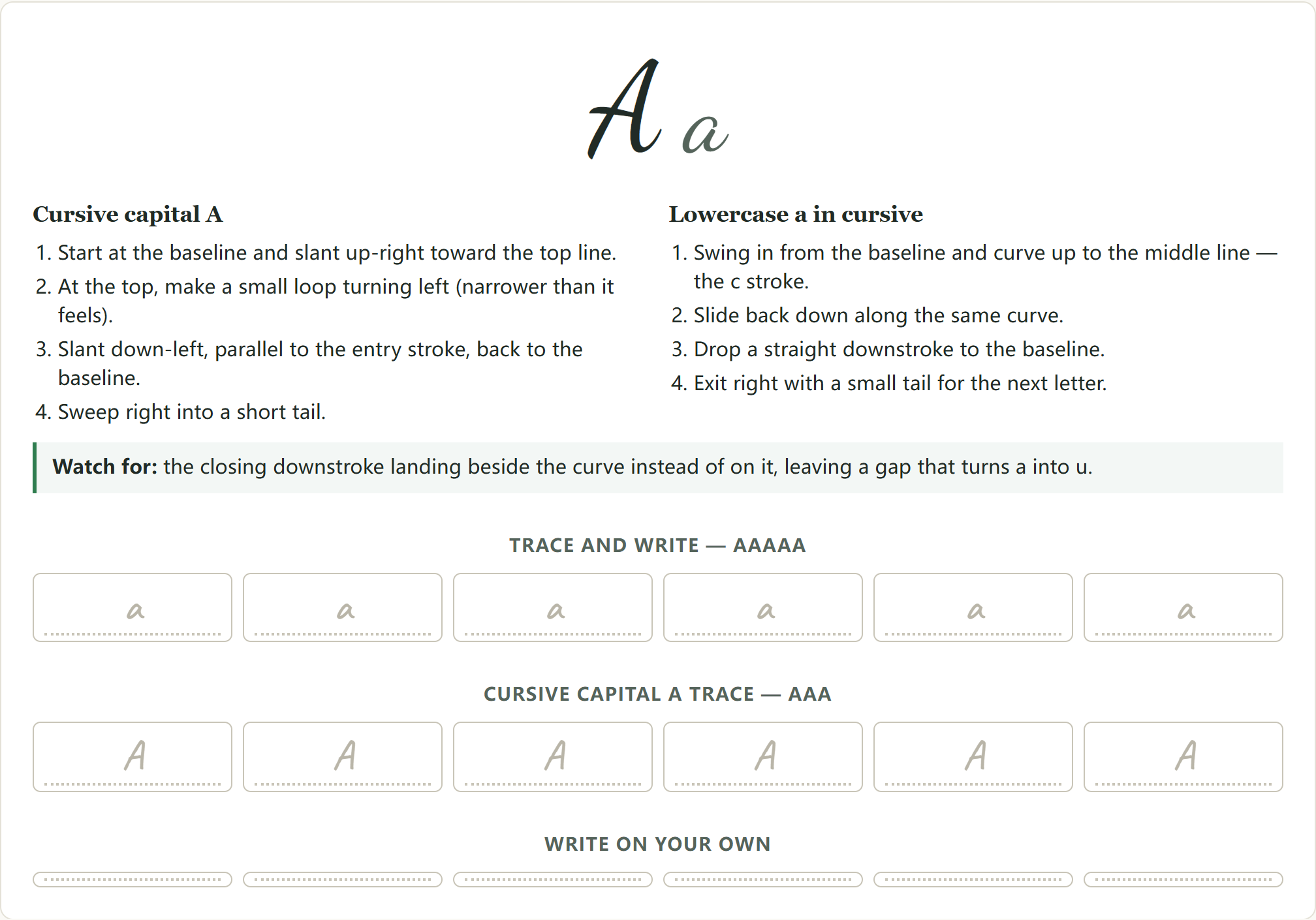
One motion, not a ball and a stick
The cursive a belongs to the curve family — the first family taught, because its opening stroke is the engine half the alphabet reuses. You do not draw a circle and add a stem the way print does; you swing in from the baseline, curve up to the middle line, then slide back down that same curve and drop a straight stroke to the baseline. One continuous motion, ending in a small tail that reaches for the next letter. That tail is the whole point of the exercise — a written without its exit stroke cannot connect, and a letter that cannot connect is just print with a slant.
The capital A runs on different geometry: a tall diagonal that peaks in a small left-turning loop at the top line, then slants back down and sweeps right. It is one of the quieter capitals — no crossing, no second bowl — which is why it is often taught early alongside C and L. In connected writing capitals never actually touch the next letter; the sweep-out is decorative tradition, not a connector. Practice the lowercase until the curve-plus-downstroke is automatic, because d, g and q are all waiting in line behind it.
Capital A in cursive
The capital A in cursive is a tall tent with a looped peak: the stroke slants up from the baseline to the top line, turns a small leftward loop at the summit, slants back down parallel to the entry, and sweeps right into its tail. It shares nothing with a print A — no crossbar, no flat apex — and that missing crossbar is the single biggest tell that a writer is still thinking in print. Some teachers describe the peak as a fish head or a tent flap; whatever the picture, the loop stays small and the two slants stay parallel.
Where the capital A goes wrong: the loop fattens until the peak looks like a balloon animal (it should be a sliver), or the downstroke drifts away from the entry slant and the letter fans open. It is taught early among capitals because it is structurally simple — two strokes and a tail — and like every capital it never connects to the letter that follows; the sweep-out is tradition, not a join. Names give it mileage fast: Adam, Ava and Austin all open with it.
Teaching tips
Say "swing, slide, drop" out loud
Three beats for three strokes — swing in, slide up the curve, drop straight down. First-graders who narrate the strokes drop ball-and-stick habits twice as fast as those who trace silently.
Check the exit before you check the shape
A slightly wobbly bowl with a confident tail is better cursive than a perfect bowl that stops dead. The tail tells the hand where the next letter starts.
Pair it with c and d in one session
Write c c c, then a a a, then d d d — same opening, three letters. Ten minutes of family practice beats thirty minutes of a-alone.
Frequently asked questions
How do you write a capital A in cursive?
Slant up from the baseline toward the top line, peak in a small loop that turns left, slant back down to the baseline, then sweep right into the tail. It resembles a pointed peak with a looped summit — no crossbar, unlike print.
How do you write a lowercase a in cursive?
Swing in from the baseline and curve up to the middle line (exactly like c), slide back down the curve, then make one straight downstroke to the baseline and exit right with a small tail.
Why does my cursive a look like a u?
The closing downstroke drifted right or the opening curve never reached the middle line, leaving the bowl open at the top. Slow the entry swing down and land the downstroke on the curve itself, not beside it.
Does a capital A connect to the next letter?
No — in standard American cursive, capitals never connect. The lowercase that follows starts fresh with its own entry stroke.
Does a cursive capital A have a crossbar?
No — that is the print reflex. The cursive capital A is a slanted peak with a small loop at the top and a sweeping tail; adding a crossbar mixes styles and is one of the first things teachers flag.