Cursive X
Lowercase x is two slanted strokes that cross — and then, unlike print, one of them keeps going into an exit tail. Both forms numbered below, with a printable sheet.
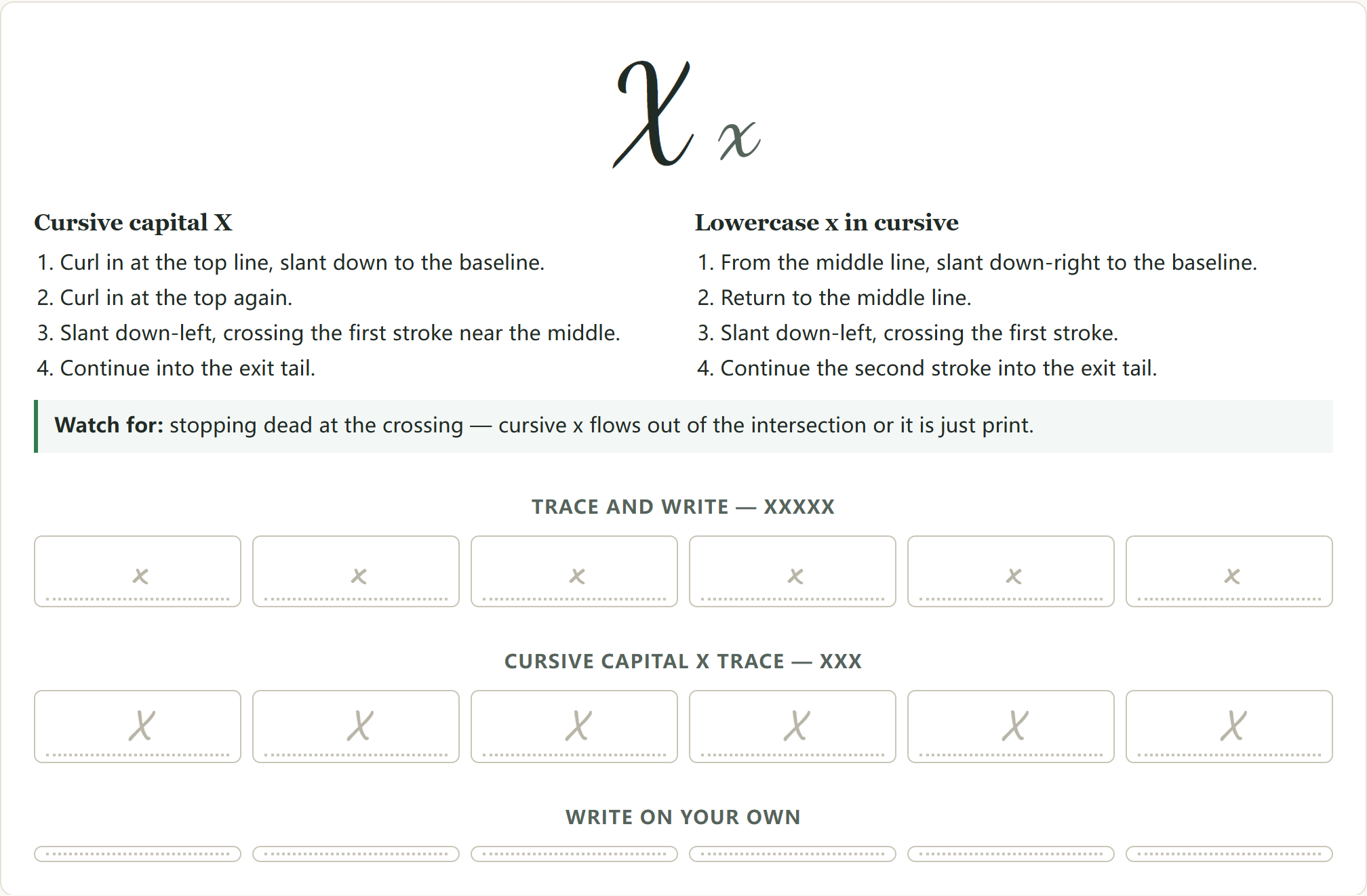
Cursive capital X
- Curl in at the top line, slant down to the baseline.
- Curl in at the top again.
- Slant down-left, crossing the first stroke near the middle.
- Continue into the exit tail.
Lowercase x in cursive
- From the middle line, slant down-right to the baseline.
- Return to the middle line.
- Slant down-left, crossing the first stroke.
- Continue the second stroke into the exit tail.
Watch for: stopping dead at the crossing — cursive x flows out of the intersection or it is just print.
Trace and write — xxxxx
Cursive capital X trace — XXX
Write on your own
PNG version — the exact file Download PNG saves
Crossed, and still connecting
The lowercase x is the hill family's rebel: two straight slants, drawn separately, crossing at the middle. The first stroke runs down-right from the middle line to the baseline; the second starts back at the middle line and slants down-left, crossing the first — and this second stroke, in cursive, continues past the crossing to become the exit tail. That continuing tail is the letter's cursive credential: print x stops dead at the crossing, cursive x flows out of it. In connected writing the tail is real work, because x ends plenty of words (box, fox, six) but begins almost none.
The capital X is two grand curves and a cross: curl in at the top, slant down to the baseline, then a second top curl slanting down-left through the first stroke, finishing with the exit. The mirrored top curls are what make it cursive rather than two printed diagonals — resist the reflex to draw bare sticks. X is rare enough in words that it survives mostly on assignments' "X the correct box" — which is, fittingly, one more place good handwriting shows.
Capital X in cursive
The cursive capital X is one of the few capitals honest about being two strokes: curl in at the top line and slant down to the baseline; then curl in at the top again and slant down-left, crossing the first stroke near the middle, continuing into the exit tail. What separates it from a printed X is entirely in the trim — the mirrored curls opening both strokes and the tail that flows out of the crossing.
Bare crossing diagonals are the print reflex, and they are the habit to drop: without its curls the letter stops matching anything around it on the page. X earns its keep outside of words more than in them — signatures, "X the box," the occasional Xylophone — which makes it a low-pressure letter to teach slowly and trace large. Get the crossing at the middle of both strokes and the curls at both tops, and the letter is done.
Teaching tips
Second stroke owns the tail
Only the down-left stroke continues into the exit. Drawing the tail off the first stroke makes the crossing lopsided — the exit belongs to stroke two.
Cross at the middle
The intersection sits at the middle line, halfway down both strokes. A high cross makes the letter top-heavy; a low one, anemic.
Curls, not sticks, on the capital
Both capital strokes open with the small top curl. Bare diagonals are print — the curls are the whole difference in style.
Frequently asked questions
How do you write a capital X in cursive?
Curl in at the top line and slant down to the baseline; then curl in again at the top and slant down-left, crossing the first stroke near the middle, finishing with the exit tail.
How do you write a lowercase x in cursive?
From the middle line, slant down-right to the baseline; return to the middle line and slant down-left, crossing the first stroke — then continue that second stroke into the exit tail.
Does cursive x connect to other letters?
Through the second stroke's tail — and mostly at the ends of words (box, six, fox), since almost no English word begins with x. The tail is still drawn; the next letter simply rarely comes.
Why does my cursive x look printed?
Missing exit tail, missing top curls. Cursive x flows out of its crossing — add the tail on the lowercase and the curls on the capital and the letter rejoins the script.
Is cursive capital X one stroke or two?
Two, each opening with a top curl: the first slants down-right, the second slants down-left through it near the middle and continues into the exit tail. The crossing plus the curls is the whole letter — bare sticks are print.