Cursive F
Lowercase f is the only letter that breaks both borders: a loop above the top line, a tail below the baseline, and a crossbar in between. Three extremes in one letter. Both forms numbered below, with a printable sheet and the connection rule most writers get wrong.
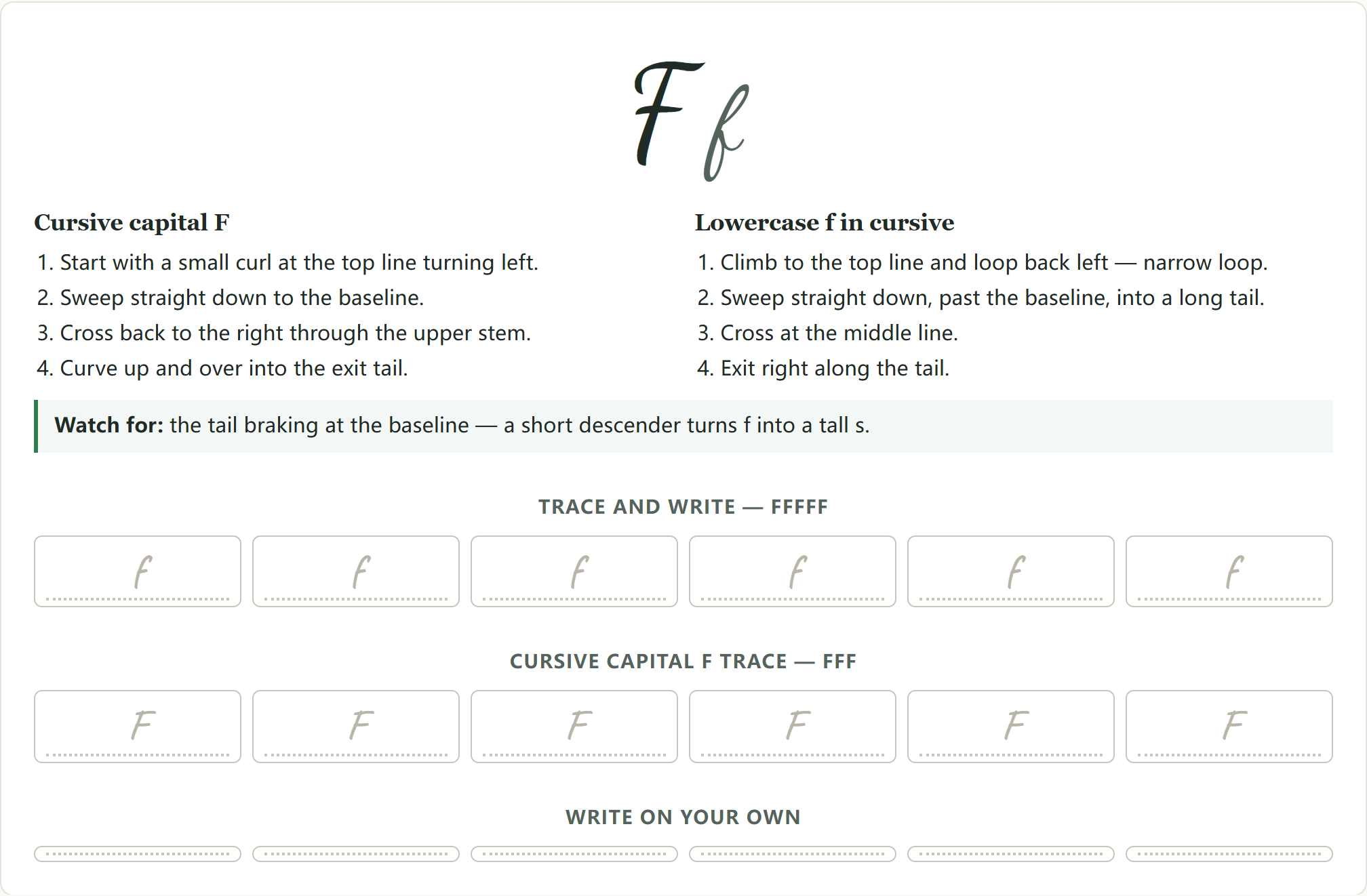
Cursive capital F
- Start with a small curl at the top line turning left.
- Sweep straight down to the baseline.
- Cross back to the right through the upper stem.
- Curve up and over into the exit tail.
Lowercase f in cursive
- Climb to the top line and loop back left — narrow loop.
- Sweep straight down, past the baseline, into a long tail.
- Cross at the middle line.
- Exit right along the tail.
Watch for: the tail braking at the baseline — a short descender turns f into a tall s.
Trace and write — fffff
Cursive capital F trace — FFF
Write on your own
PNG version — the exact file Download PNG saves
The letter that crosses every line
The lowercase f is cursive's showpiece: up to a tall loop at the top line, one long stroke down through the baseline into a sweeping tail, then a crossbar at the middle line. It is the tallest and deepest letter in the lowercase alphabet, and it is the letter that tests whether the writer trusts their lines — the downstroke must pass the baseline without slowing, or the tail dies. The crossbar comes last, after the tail, and in connected writing the tail itself often serves as the crossbar for the next letter's connection.
The capital F is a curl, a stem, and a crossbar with flourish: small loop at the top line, sweep down to the baseline, then cross back to the right through the upper stem, curving into the exit. It ranks among the trickier capitals because the crossbar must sit high — near the top, not the middle — and leaving it off entirely turns F into a naked J-adjacent squiggle. Take it slow; f rewards patience more than talent at both sizes.
Capital F in cursive
The cursive capital F runs on three moves: a small curl at the top line turning left, a straight sweep down the full height of the letter to the baseline, and a crossing stroke back to the right through the upper part of the stem, curving up into the exit. That crossbar is the letter's identity and its trap — it sits near the top of the stem, not the middle, and it is a curved crossing stroke, not the flat horizontal bar of print.
Tell capital F from capital T by the architecture: T's top is one wide sweep that the rest of the letter hangs beneath, while F is a stem that gets crossed high. Leave the crossbar off entirely and F collapses into an anonymous curl-stemmed squiggle — one of the three capitals (with G and S) teachers most often redraw on student work. Like every capital it connects to nothing, so the curved exit is pure flourish; enjoy it.
Teaching tips
Commit to the descender
The f tail must dive past the baseline without braking. A timid tail that stops at the line makes f read as a tall s. Trust the line, keep the speed.
Crossbar high on the capital
The capital's cross sits near the top of the stem, not the middle. Low crossbars are the number-one capital-F error on classroom walls.
Watch f in double duty
When f connects — as in "fl" or "ff" — the exit tail of the first letter becomes the crossbar of the next. Practicing "fl" pairs teaches the timing better than f alone.
Frequently asked questions
How do you write a capital F in cursive?
Make a small curl at the top line turning left, sweep straight down to the baseline, then cross back right through the upper part of the stem and curve up into the exit tail.
How do you write a lowercase f in cursive?
Climb to the top line and loop back left (narrow loop), sweep straight down past the baseline into a long tail, then cross at the middle line and exit right.
Do you cross an f before or after the tail?
After — the loop and full downstroke-with-tail come first as one motion, then the crossbar. Crossing early forces a pencil lift and kills the letter's flow.
Why is cursive f considered hard?
It is the only lowercase that exceeds the space both above (tall loop) and below (descender tail) while adding a crossbar — three extremes in one continuous stroke. Slow tracing of the loop-tail rhythm sorts it out fast.
How do you tell cursive capital F from capital T?
Architecture: capital F is a stem that gets crossed high near the top, while capital T is a wide top sweep with the stem hanging beneath it. The crossing stroke's high position is F's signature — a low cross reads as an error on both letters.