Cursive N
Lowercase n is one entry stroke and one hump — the simplest of the hill letters and the template m and v build on. Both forms numbered below, with a printable sheet and the hump-height rule.
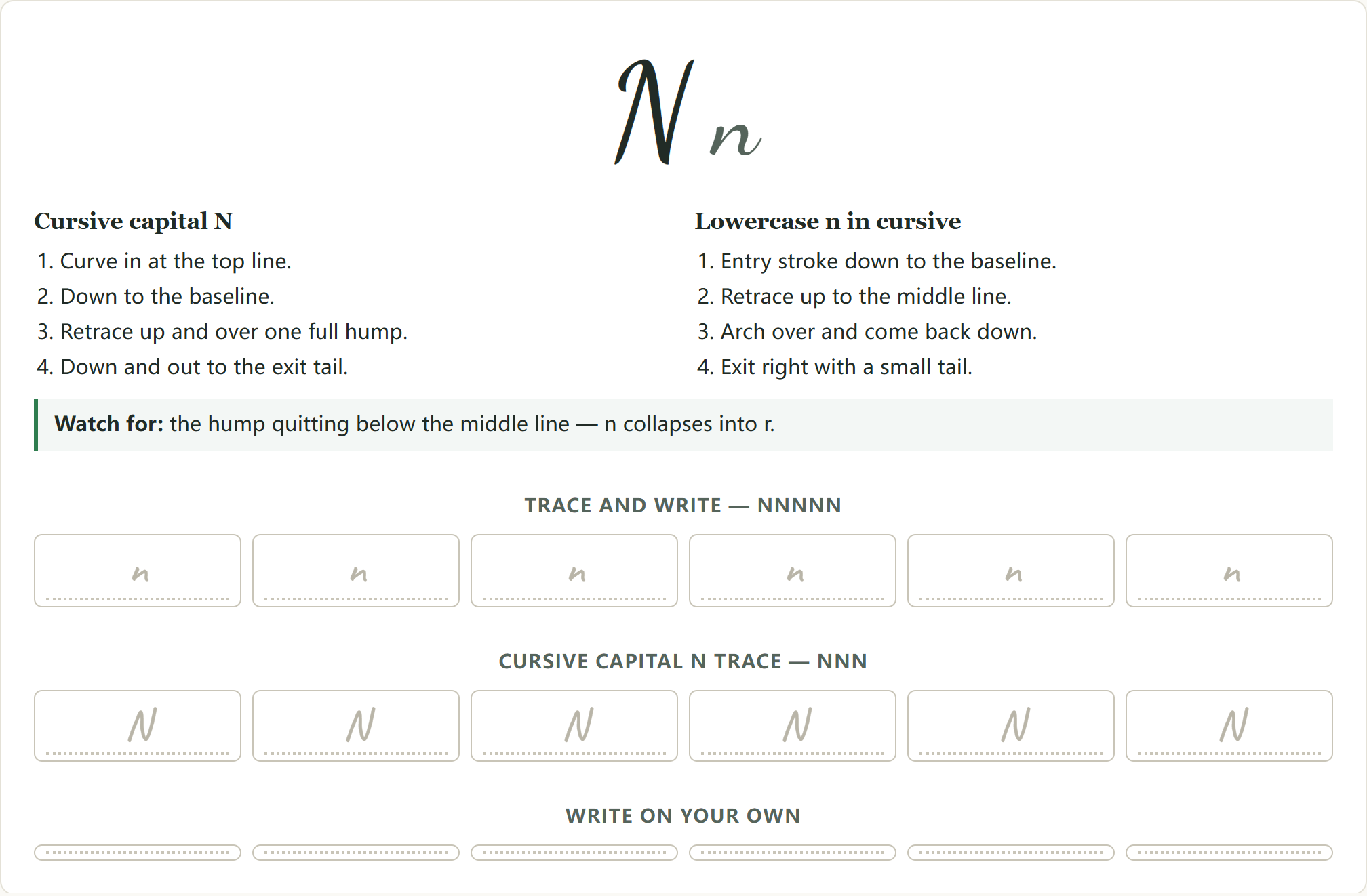
Cursive capital N
- Curve in at the top line.
- Down to the baseline.
- Retrace up and over one full hump.
- Down and out to the exit tail.
Lowercase n in cursive
- Entry stroke down to the baseline.
- Retrace up to the middle line.
- Arch over and come back down.
- Exit right with a small tail.
Watch for: the hump quitting below the middle line — n collapses into r.
Trace and write — nnnnn
Cursive capital N trace — NNN
Write on your own
PNG version — the exact file Download PNG saves
One hill, fully paid
The lowercase n is cursive's minimal hill: downstroke, then up to the middle line and over — one arch, one descent, one exit. It is the letter that teaches the retrace, the skill of climbing back up the same line before arching over, and it is deliberately taught before m so the doubled version is an extension, not a new challenge. The hump's height is the whole letter: an arch that stops short of the middle line produces r, and one that overshoots produces something read as h at a glance.
The capital N is the lowercase stretched — curve in at the top, down, then one retrace-hump and out. As with M, the capital is free once the lowercase is owned; the only calibration is scale, the hump still rising to the letter's own middle. Names make it stick — Noah, Natalie, November — and the classic capital error is the print reflex: two separate uprights and a diagonal, drawn as pieces. Cursive N is one continuous road.
Capital N in cursive
The cursive capital N is its lowercase stretched to full height: curve in at the top line, stem down to the baseline, one retrace-hump rising to the letter's middle, then down and out into the exit tail. Like M, it is a free capital — the only new skill is scale, and most learners write a serviceable one within minutes of mastering the small letter.
The enemy is the print reflex: two separate uprights with a diagonal inserted between them, drawn as three pieces. The cursive N is one continuous road — entry, down, up-and-over, down, tail — and when the pieces are drawn separately the letter visibly loses its flow. Noah, Natalie and November give it steady work; so does every "No" ever written at the head of a sentence.
Teaching tips
The retrace is the lesson
Go up the same line you came down — not beside it. A retrace that drifts right leaves a gap that makes n look stitched together from parts.
Hump to the ceiling
The arch tops out exactly at the middle line — short of it is r, past it is h. Trace rows with a visible middle line until the ceiling is felt, not checked.
n first, then m for free
Teach n alone until automatic; then m is "n, do it again." One new letter becomes two with almost no extra teaching.
Frequently asked questions
How do you write a capital N in cursive?
Curve in at the top line, down to the baseline, retrace up and over one hump to the middle of the letter, then down and out to the exit tail — one continuous stroke.
How do you write a lowercase n in cursive?
Entry downstroke to the baseline, retrace up to the middle line, arch over and come back down, then exit right with a small tail.
Why does my n look like an r?
The hump never reached the middle line. The arch has a ceiling — trace it against a marked middle line until full-height humps are automatic.
What's the difference between cursive n and m?
Hump count: n has one, m has two. They share the same entry, the same retrace, the same ceiling — m is just n asked to repeat itself.
Is cursive capital N one stroke?
Yes — curve in, stem down, retrace up and over one hump, then down and out: one continuous stroke with no pencil lift. The three-piece print N (two uprights plus a diagonal) is exactly the habit cursive replaces.