Place Value Chart With Periods
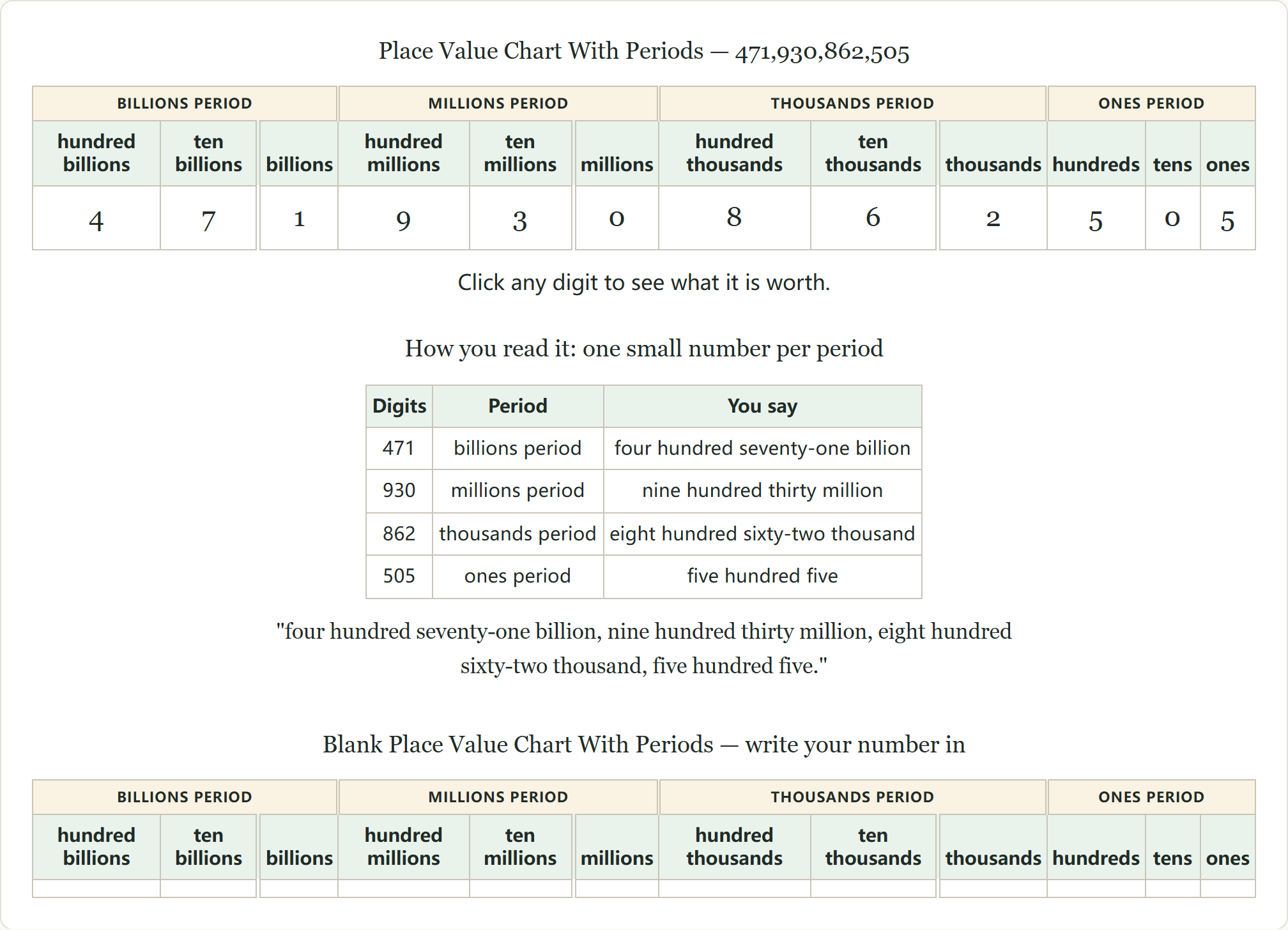
This is the place value chart built around periods: the three-digit groups the commas mark. Four bands — ones, thousands, millions, billions — each with its own ones, tens and hundreds column, separated by heavy lines. The worked example reads 471,930,862,505 one period at a time, and the second sheet is a blank version for writing numbers in.
Place Value Chart With Periods — 471,930,862,505
| billions period | millions period | thousands period | ones period | ||||||||
|---|---|---|---|---|---|---|---|---|---|---|---|
| hundred billions | ten billions | billions | hundred millions | ten millions | millions | hundred thousands | ten thousands | thousands | hundreds | tens | ones |
| 4 | 7 | 1 | 9 | 3 | 0 | 8 | 6 | 2 | 5 | 0 | 5 |
Click any digit to see what it is worth.
How you read it: one small number per period
| Digits | Period | You say |
|---|---|---|
| 471 | billions period | four hundred seventy-one billion |
| 930 | millions period | nine hundred thirty million |
| 862 | thousands period | eight hundred sixty-two thousand |
| 505 | ones period | five hundred five |
"four hundred seventy-one billion, nine hundred thirty million, eight hundred sixty-two thousand, five hundred five."
Blank Place Value Chart With Periods — write your number in
| billions period | millions period | thousands period | ones period | ||||||||
|---|---|---|---|---|---|---|---|---|---|---|---|
| hundred billions | ten billions | billions | hundred millions | ten millions | millions | hundred thousands | ten thousands | thousands | hundreds | tens | ones |
PNG version — the exact file Download PNG saves
What a period is, and why the chart groups in threes
A period is a family of three place value columns: ones, tens, hundreds. The chart above stacks four of those families side by side — the ones period, the thousands period, the millions period, the billions period. Every period contains the same three seats, and that is the whole trick: a student who can read a three-digit number can read any number, because a twelve-digit number is just four three-digit numbers with names attached.
The commas are the period markers, and each one has a name. Count three columns from the right and the first comma appears — the thousands comma. Three more columns, the millions comma. Three more, the billions comma. In American notation the comma lands after every third digit counted from the right, every time, which is why kids should add commas last: write the digits first, then count in threes from the ones column and drop a comma at each group boundary.
Period vs. place: the mix-up that costs the most points
A place is one column — the ten thousands place. A period is the three-column family that column belongs to — the thousands period. The 3 in 4,302,175 sits in the ten thousands place, inside the thousands period. Students who blur the two say "three million" for a digit worth 30,000: they grabbed the period but lost the seat. The fix is two questions, always in order: which period am I in, and which of its three seats does my digit hold?
The payoff is reading out loud. A twelve-digit number stops being intimidating the moment a hand covers all but the first band: read 471, say "billion," slide the hand one band right, read 930, say "million," slide again. Say the period name at every comma, and say nothing after the last group — the ones period never gets named. That hand-slide is a thirty-second routine and it works with this chart printed at any size.
Teaching tips
Read it wrong on purpose
Say the example as a flat string of digits — "four, seven, one, nine, three, zero…" — and let the class shout stop. Then read it period by period. The contrast teaches the comma's job faster than explaining it: commas are where the number takes a breath and names its place.
Commas go in after, never during
When dictating, students write digits first and add commas at the end by counting in threes from the right. Writing commas mid-dictation is how 471,93,862,505 happens — a comma with the wrong number of digits in front of it.
Zero holds a seat inside the period too
In 471,930,862,505 the millions period is 930 — the 0 sits in the millions column itself. Cover it and the number collapses. Placeholder zeros work inside periods exactly the way they work inside plain three-digit numbers, which is precisely why kids who are solid on 305 are ready for 930 million.
Dictate with period names
Say "four hundred seventy-one billion" as one breath group, pause, "nine hundred thirty million," pause. Students write each group into its band and the commas come free, because the breath and the comma mark the same boundary.
Frequently asked questions
What is a period in place value?
A group of three place value columns set off from the next group by a comma. The ones period holds ones, tens and hundreds; then come the thousands, millions and billions periods. Each period reuses the same three seats, so reading a big number means reading small numbers and saying the period name at each comma.
What is a place value chart with periods?
A place value chart whose columns are grouped into period bands — typically ones, thousands, millions and billions, each band holding its own ones, tens and hundreds column with a heavy separator between bands. The grouping turns twelve columns into four readable chunks that match the commas in the number.
How do you read 471,930,862,505 period by period?
"Four hundred seventy-one billion, nine hundred thirty million, eight hundred sixty-two thousand, five hundred five." Read each three-digit group, say the period name under it, and stop naming at the final group — the ones period never gets said.
Why do place value periods come in groups of three?
Because English names a new unit every thousand: ten ones make ten, ten tens make a hundred, and ten hundreds make a thousand — at which point the pattern restarts with a new name. Three columns per name is all English needs; the commas just mark where each new name gets announced.
What is the comma in a big number called?
It takes the name of the period it closes. First comma from the right is the thousands comma, the next is the millions comma, the next is the billions comma. Saying the comma's name while reading is what keeps "nine hundred thirty million" from collapsing into a string of digits.
Is the blank version free to print?
Yes — the filled chart and the blank write-in version both print free, one per letter page, no sign-up. The blank chart keeps the period bands and the heavy separators, so any number written into it groups correctly from the start.