Cursive Y
Lowercase y is v with commitment: the same sharp valley, then the second stroke dives through the baseline into a tail. Both forms numbered below, with a printable sheet and the dive rule.
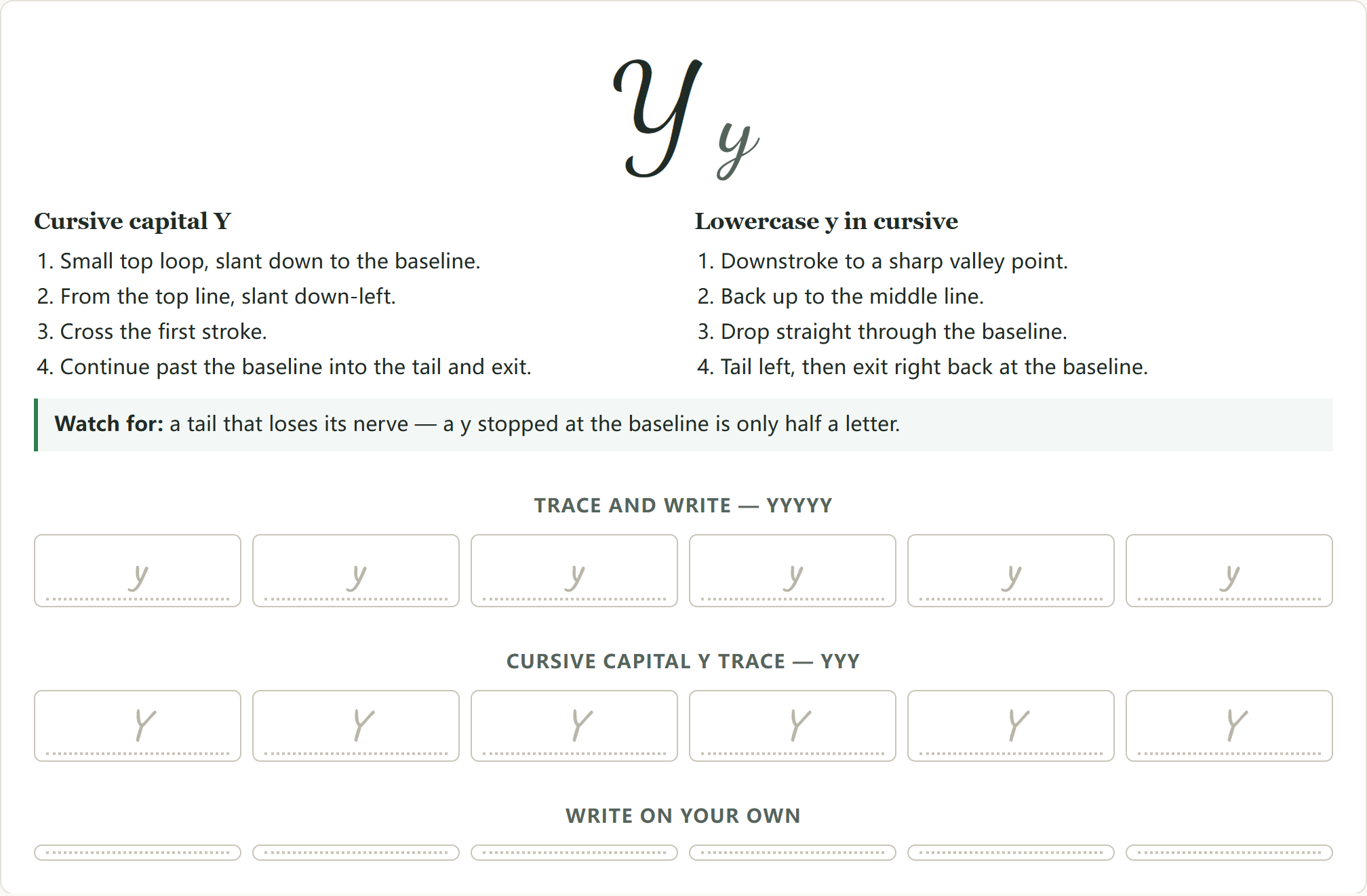
Cursive capital Y
- Small top loop, slant down to the baseline.
- From the top line, slant down-left.
- Cross the first stroke.
- Continue past the baseline into the tail and exit.
Lowercase y in cursive
- Downstroke to a sharp valley point.
- Back up to the middle line.
- Drop straight through the baseline.
- Tail left, then exit right back at the baseline.
Watch for: a tail that loses its nerve — a y stopped at the baseline is only half a letter.
Trace and write — yyyyy
Cursive capital Y trace — YYY
Write on your own
PNG version — the exact file Download PNG saves
The valley that dives
The lowercase y takes v's motion and extends its second act: downstroke to a sharp valley point, back up — and then a long drop through the baseline into the descender lane, tailing left and exiting right. The valley must keep its point even though the letter's center of gravity moves underground; a y that softens its turn becomes a u with a tail, and the eye notices instantly. The dive follows the standard descender rules — halfway into the space below, never touching the line beneath.
The capital Y is built two ways in American classrooms: the straightforward two-stroke — small top loop on the first slant, then the second slant crossing down through the baseline into a tail — or the more ornamental one-stroke swing. This sheet teaches the two-stroke: it is the version children meet in most programs, and its pitfall is the same as the lowercase's — a tail that loses its nerve at the baseline. The capital's tail should pass below the line with the same confidence the lowercase shows.
Capital Y in cursive
The cursive capital Y that most American programs teach is the two-stroke version: a small top loop and a slant down to the baseline, then a second slant from the top line that crosses the first and keeps going — past the baseline, into a tail, and out to the right. The letter's center of gravity lives below the line, exactly like its lowercase.
Ornamental one-stroke variants swing that descent into a full loop beneath the letter, and both forms are legitimate; what neither forgives is a tail that loses its nerve at the baseline. A capital Y that stops at the line is an unfinished, V-adjacent thing. Trace it beside the lowercase y and let the shared dive rule do the teaching — through the line, then out.
Teaching tips
Keep the point, add the dive
The letter is still v until the second stroke drops — sharp valley, then through the line. Softening the turn to "help" the dive is how y becomes u-with-tail.
Descender lane rules apply
The tail ends halfway into the space below — deep enough to claim the lane, clear of the next writing line. Trace with the row beneath visible.
Drill y next to v and g
v teaches the valley, g teaches the dive — y is both. A three-letter warm-up row (v g y) installs the combination faster than y alone.
Frequently asked questions
How do you write a capital Y in cursive?
Make a small top loop and slant down to the baseline, then from the top line slant down-left, crossing the first stroke and continuing past the baseline into a tail with the exit.
How do you write a lowercase y in cursive?
Downstroke to a sharp valley point at the baseline, back up to the middle line, then drop straight through the baseline into the descender lane, tailing left and exiting right.
Why does my y look like a v?
The second stroke stopped at the baseline instead of diving. The valley is only half the letter — "down, up, THROUGH" is the full count.
How does y connect to the next letter?
Its tail swings left below the baseline, then the exit rises right back to the baseline to meet the next letter — the same hook-and-return rhythm as g and j.
Why does cursive capital Y sometimes have a loop at the bottom?
Fancier one-stroke styles swing the tail into a descender loop beneath the letter, while the common two-stroke classroom version keeps a plain tail. Both are standard — what matters is that either one passes below the baseline before exiting.