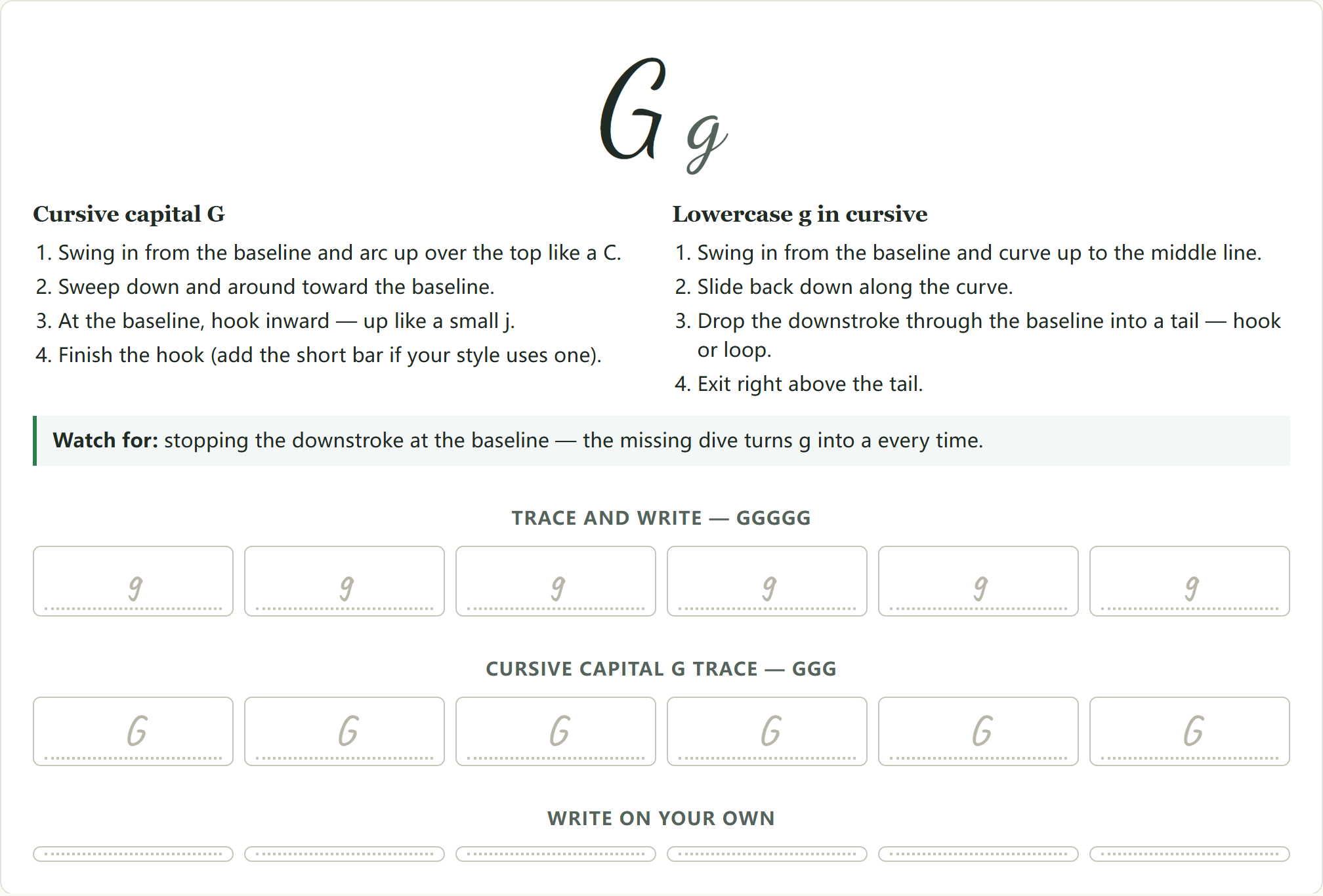
Cursive G
Lowercase g is an a that keeps going: same c-opening, same closing downstroke — then straight through the baseline into a tail. Both letterforms numbered below, with a printable practice sheet and the fix for the flat-tailed g.
Cursive capital G
- Swing in from the baseline and arc up over the top like a C.
- Sweep down and around toward the baseline.
- At the baseline, hook inward — up like a small j.
- Finish the hook (add the short bar if your style uses one).
Lowercase g in cursive
- Swing in from the baseline and curve up to the middle line.
- Slide back down along the curve.
- Drop the downstroke through the baseline into a tail — hook or loop.
- Exit right above the tail.
Watch for: stopping the downstroke at the baseline — the missing dive turns g into a every time.
Trace and write — ggggg
Cursive capital G trace — GGG
Write on your own
PNG version — the exact file Download PNG saves
The a that dives
Everything true of the cursive a is true of the g until the final stroke, where instead of stopping at the baseline the downstroke dives through into a tail — hooked left in Zaner-Bloser tradition, looped in D'Nealian. That continuation is the teaching moment: g is not a new letter but an old one extended, and presenting it that way (write a... now keep going) gets it in a single session. The tail has rules of its own: it must clear the baseline decisively but never reach the next line of writing — descenders that graze the line below turn a page fuzzy within a week.
The capital G is a C with a handshake: big open curve exactly like the capital C, then at the baseline the stroke hooks inward and up like a small j, sometimes finishing with a horizontal bar in D'Nealian styles. The hook is what separates it from C in reading, so give it real height — a lazy nub of a hook leaves G looking like a C wearing a costume.
Capital G in cursive
The capital G in cursive is a C with a handshake: the same big counterclockwise curve as the capital C, and then, at the baseline where C would finish, the stroke hooks inward and rises like a small j. Some styles close with a short horizontal bar through that hook; others leave it bare. The hook is not decoration — in fast reading it is the only thing separating G from C.
Give the hook real height, rising at least to the letter's middle — a lazy nub of a hook leaves G looking like a C wearing a costume. And unlike print G, there is no enclosed bowl with a little spur; the cursive G stays open, its identity living entirely in that inward hook. Trace C and G side by side and the lesson teaches itself: one extra stroke, two different letters.
Teaching tips
Teach it as "a, keep going"
Have the writer produce three a's, then on the fourth say "keep going." The g appears without a single new instruction — the cheapest win in the lowercase alphabet.
Tails respect the next line
The descender ends in the upper half of the space below, never touching the line beneath. Trace rows on this sheet keep that lane visible.
Hook with intent
The capital's inward hook should rise at least to the middle of the letter. A shallow hook reads as smudge; aim for a hook you could hang something on.
Frequently asked questions
How do you write a capital G in cursive?
Draw a big open curve like a capital C, then at the baseline hook inward and upward like a small j — some styles finish with a short horizontal bar through the hook.
How do you write a lowercase g in cursive?
Swing in like a c to the middle line, slide back down, drop the closing downstroke through the baseline into a tail — hooked left (or looped, style-dependent) — and exit right.
Should the g tail loop or hook?
Both are correct: Zaner-Bloser hooks the tail left; D'Nealian closes it into a loop. Match the school's style, and above all keep the tail in the descender lane without touching the line below.
Why does my g look like an a?
The downstroke stopped at the baseline instead of passing through it. Re-trace with the cue "through the line, then out" — the tail is just the stroke's momentum continuing.
How is cursive capital G different from capital C?
The inward hook: capital C ends its curve with an open curl, while capital G hooks inward at the baseline and rises like a small j (some styles add a short bar through it). No hook, no G — that stroke is the whole letter.