Cursive E
Lowercase e is a short slant with a loop-de-loop: up to the middle line, loop back across the entry, curve down and away. Simple — until the loop grows. This page numbers both letterforms, prints a practice sheet, and keeps the loop on a diet.
Cursive capital E
- Swing up to the top line and curve back left.
- Make a small loop at the top turning downward.
- Retrace down toward the baseline.
- Sweep out right at the baseline, finishing with an open curl.
Lowercase e in cursive
- Slant up from the baseline to the middle line.
- Loop back left, crossing the entry stroke — keep the loop small.
- Curve around to the right and down to the baseline.
- Exit right with a small tail.
Watch for: the oversized loop — a fat e-loop reads as a leaning l and swamps the line's rhythm.
Trace and write — eeeee
Cursive capital E trace — EEE
Write on your own
PNG version — the exact file Download PNG saves
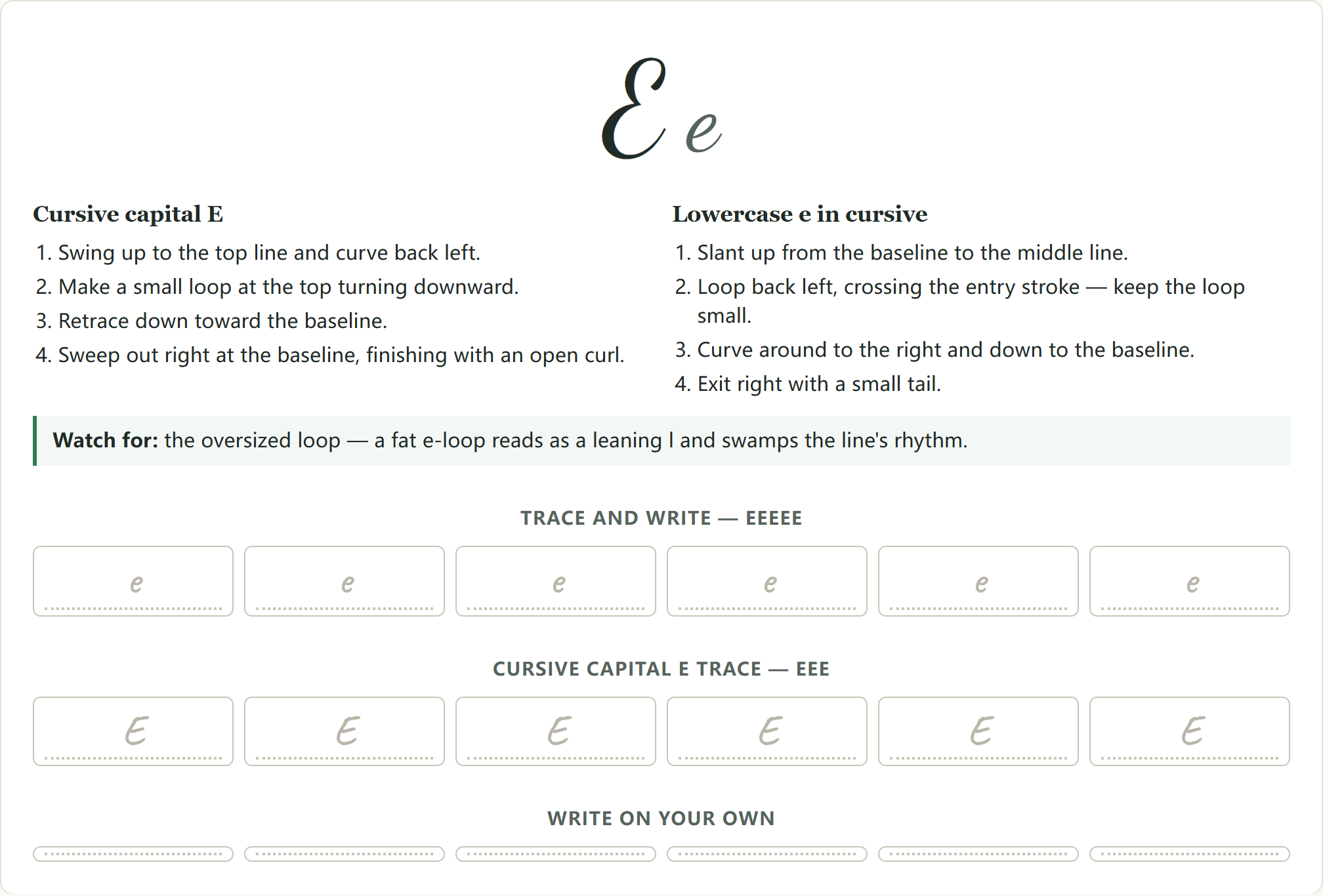
The loop that must stay small
The lowercase e is cursive's first loop letter and its easiest bad habit. The stroke is quick — slant up from the baseline to the middle line, loop back left crossing the entry stroke, then curve around and down to the baseline — but the loop wants to grow. A loop the size of the whole letter turns e into a leaning l; the fix is a loop no bigger than a grain of rice, crossed exactly where the entry stroke meets the middle line. Because e is the most common letter in English, a sloppy e multiplies across every line of writing — worth policing early.
The capital E surprises people: it looks like a backwards 6 with an open tail. Up-and-over at the top line, a small loop turning down, retrace, then sweep out right at the baseline with a curl. There is no crossbar in cursive E — writers who add one are remembering print. It is one of the less intuitive capitals, so trace it larger and slower than feels necessary the first few passes.
Capital E in cursive
The cursive capital E is the alphabet's best party trick: it looks like a backwards 6 with an open tail. The stroke swings up and over at the top line, turns a small loop downward, retraces past it, curves down to the baseline, and sweeps out to the right in an open curl. There is no crossbar and none of the print E's three arms — first-time viewers genuinely need to be told what they are looking at.
The error to watch for is the print reflex: hands that have written thousands of printed E's try to sneak a crossbar or a middle arm into the shape, and the cursive E wants neither. Trace it next to a written 6 once — seeing the mirror relationship locks the shape into memory faster than any verbal description, which is why that pairing shows up in classroom after classroom.
Teaching tips
Rice-grain loop rule
Say it out loud while tracing: small loop, small loop. An e loop wider than the letter is tall is doing l's job — and crowding the neighbors.
Cross at the corner
The loop should cross the entry stroke right at the middle line. Cross lower and the e looks like it is tripping; not crossing at all leaves a stray c.
Capitals: it's a backwards 6, embrace it
Trace the capital next to a written 6 — seeing the mirror relationship once fixes the shape in memory faster than ten blind repetitions.
Frequently asked questions
How do you write a capital E in cursive?
Swing up and over at the top line into a small loop turning down, retrace past it, then curve down to the baseline and sweep out right with an open curl — no crossbar.
How do you write a lowercase e in cursive?
Slant up from the baseline to the middle line, loop back left crossing the entry stroke (small loop), then curve around and down to the baseline, exiting right.
Why does my cursive e look like an l?
The loop is too big or too tall — a wide loop converts e into a leaning l. Shrink the loop to rice-grain size and cross exactly at the middle line.
Does cursive capital E have a crossbar?
No — that is the print habit. The cursive E is a loop-and-retrace shape ending in an open tail; adding a crossbar is a mixed-style error teachers flag.
Why does cursive capital E look like a backwards 6?
Because it is one — the top loop and the descending curve mirror the numeral almost exactly. That is the intended shape, not a mistake; the open tail at the baseline is what turns the mirror-image 6 back into an E.