9 Times Table
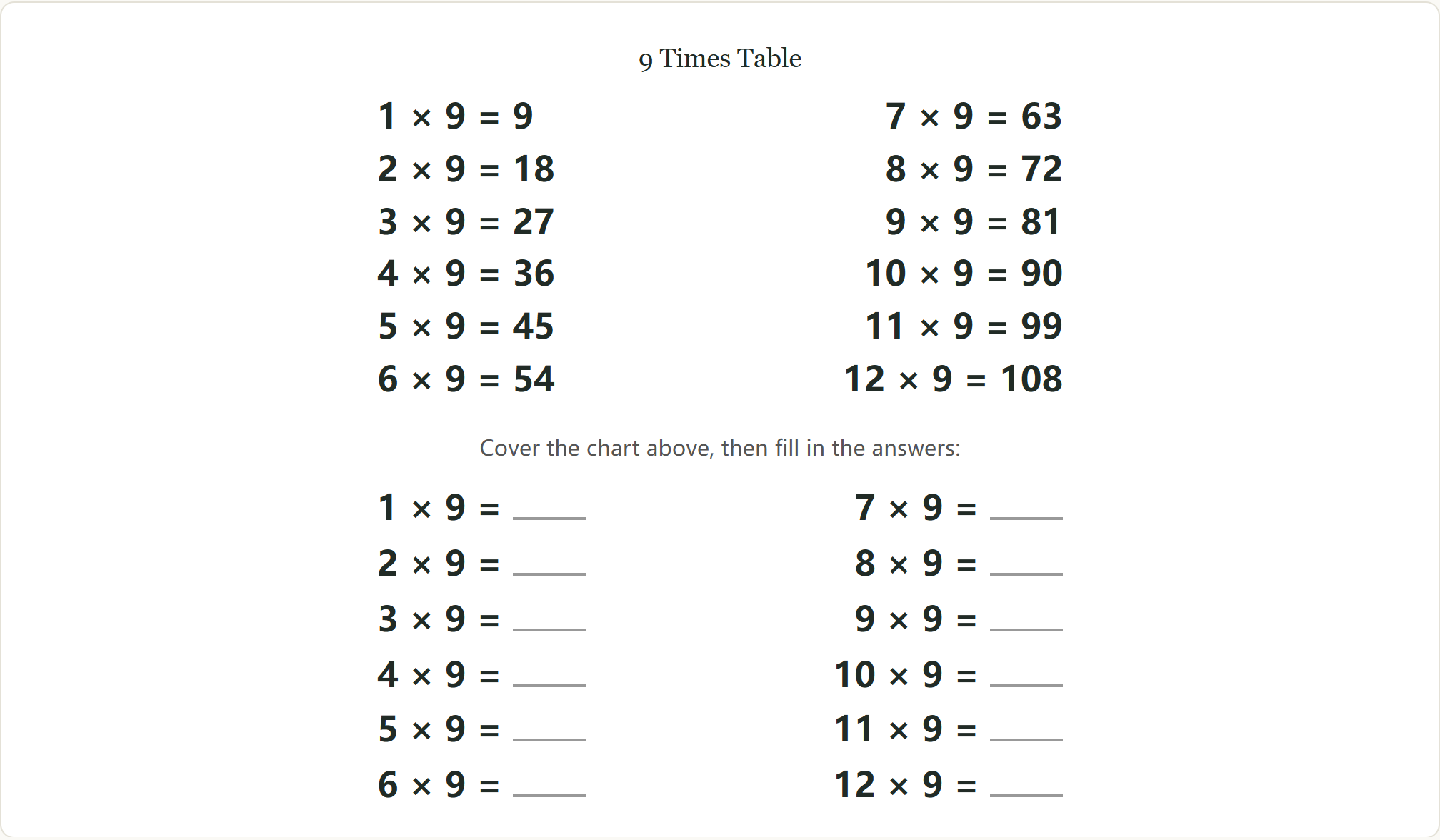
The 9 times table is 9, 18, 27, 36, 45, 54, 63, 72, 81, 90, 99, 108 — the hard table that turns easy: fold a finger and the answer appears, and every answer’s digits add up to 9. 9 × n is also just 10 × n minus n.
9 Times Table
1 × 9 = 97 × 9 = 63
2 × 9 = 188 × 9 = 72
3 × 9 = 279 × 9 = 81
4 × 9 = 3610 × 9 = 90
5 × 9 = 4511 × 9 = 99
6 × 9 = 5412 × 9 = 108
Cover the chart above, then fill in the answers:
1 × 9 = 7 × 9 =
2 × 9 = 8 × 9 =
3 × 9 = 9 × 9 =
4 × 9 = 10 × 9 =
5 × 9 = 11 × 9 =
6 × 9 = 12 × 9 =
PNG version — the exact file Download PNG saves
The easiest hard table
The 9s wear two tricks that actually work. First, the finger fold: hold up ten fingers, fold the nth one for 9 × n — fingers to the left of the fold are the tens digit, fingers to the right are the ones. Fold your 7th finger for 9 × 7: six fingers, three fingers, 63. Second, the digit check: every multiple of 9 up to 90 has digits summing to 9 (18 → 9, 27 → 9, 99 → 18 → 9), which makes wrong answers self-announcing.
Under the tricks sits the idea worth keeping: 9 × n = 10 × n − n. Nine nines is ten nines, one nine fewer — 90 − 9 = 81. That “one group less than a round number” build generalizes far beyond the 9s (it is how adults compute 19 × 7), so teach it alongside the finger trick: the fingers are the shortcut, the ten-minus-one is the understanding.
Skip counting by 9
Skip counting is the fallback path when a fact will not come: 9, 18, 27, 36, 45, 54, 63, 72, 81, 90, 99, 108. Counting by 9s IS the 9 times table — each step is one more group of 9 — so thirty seconds of rhythmic counting a day quietly drills the whole row.
Use it as a self-check too: any answer to a 9s fact has to land somewhere in that list. A student who writes 9 × 6 = 55 can catch it without an answer key, because 55 is not on the skip-count path.
Teaching tips
The finger fold, taught once
Ten fingers up, fold the nth finger for 9 × n. Left of the fold = tens, right = ones. It looks like a magic trick to third graders, works for the whole row through 9 × 10, and buys confidence while real recall builds.
Ten minus one set
9 × n = 10 × n − n. “Nine fours … forty, minus four … thirty-six.” This is the understanding under the trick, and it is the same move as computing 19 × 7 as 140 − 7 years later.
Digits sum to nine
The self-check: 9, 18, 27, 36 … every answer’s digits add to 9 (or 18 for 99). Students can verify their own answers with zero external key, which is worth more than the checking itself.
The descending-ascending pattern
Write the row downward: the tens go 0,1,2,3…9 while the ones go 9,8,7…0. Kids spot this within a minute of looking at the chart and it locks the sequence visually — let them discover it rather than showing them.
Frequently asked questions
What is the 9 times table?
The 9 times table is 9 × 1 through 9 × 12: 9, 18, 27, 36, 45, 54, 63, 72, 81, 90, 99, 108.
How does the 9 times table finger trick work?
Hold up all ten fingers and fold the nth finger for 9 × n. Fingers still up to the LEFT of the fold are the tens digit; to the RIGHT are the ones. For 9 × 7, fold your seventh finger: six fingers left, three right — 63. It works through 9 × 10.
What are the 9 times tables up to 12?
9, 18, 27, 36, 45, 54, 63, 72, 81, 90, 99 and 108 — 9 × 1 through 9 × 12. The first ten answers all have digits summing to 9; 9 × 11 = 99 sums to 18; 9 × 12 = 108 sums to 9 again.
Why do 9s answers always add up to 9?
Because 9 is one less than 10: every time the tens digit goes up by 1, the ones digit drops by 1, so their sum never changes. Formally, every multiple of 9 has a digit sum divisible by 9 — the same rule used to check divisibility by 9 and by 3.
What grade are the 9s taught in?
Grade 3, after the 2s through 5s. The finger trick and digit patterns mean the 9s usually fall faster than the 6s, 7s and 8s despite being “bigger” facts.