7 Times Table
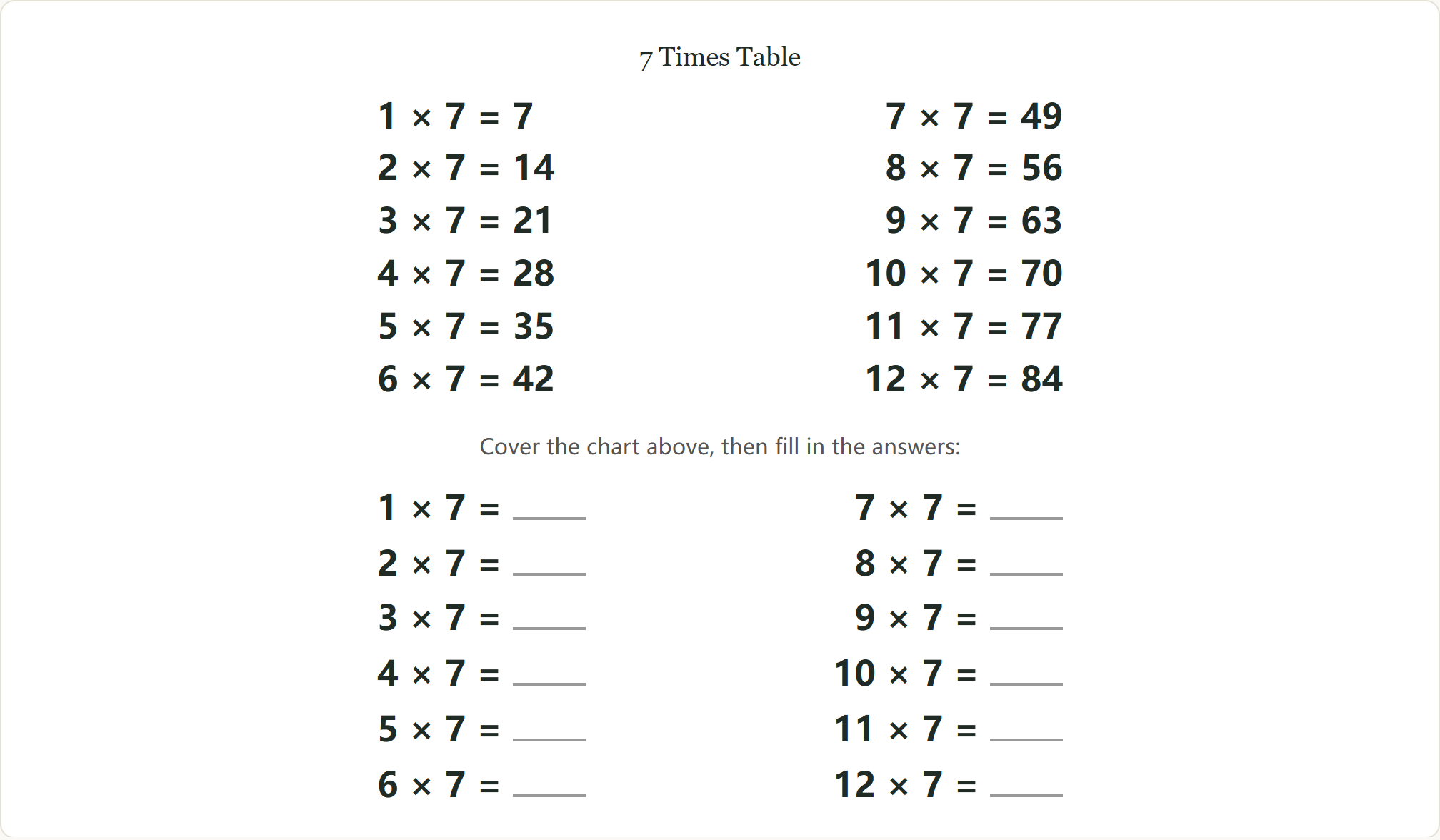
The 7 times table is 7, 14, 21, 28, 35, 42, 49, 56, 63, 70, 77, 84 — famous as the hardest row in the chart, because sevens offer no pattern at all. The fixes: build from 5s + 2s, drill 7×7=49 and 7×8=56 as landmarks, and lean on 7×8 = 56, the “5 6 7 8” fact.
7 Times Table
1 × 7 = 77 × 7 = 49
2 × 7 = 148 × 7 = 56
3 × 7 = 219 × 7 = 63
4 × 7 = 2810 × 7 = 70
5 × 7 = 3511 × 7 = 77
6 × 7 = 4212 × 7 = 84
Cover the chart above, then fill in the answers:
1 × 7 = 7 × 7 =
2 × 7 = 8 × 7 =
3 × 7 = 9 × 7 =
4 × 7 = 10 × 7 =
5 × 7 = 11 × 7 =
6 × 7 = 12 × 7 =
PNG version — the exact file Download PNG saves
The table with no pattern — by design
Ask any adult which times table they never quite learned and the answer is the 7s. Sevens are prime, so nothing in the row repeats a friendlier table, skip counting by 7s has no rhythm a child has ever heard, and the answers (21, 28, 35…) do not end in anything predictable. The honest teaching move is to name that out loud: this table is hard for everyone, it is hard for a mathematical reason, and the way through is building facts, not hoping a pattern appears.
Two builds carry the row. First, 7 × n = 5 × n + 2 × n (five sevens plus two sevens: 35 + 14 = 49). Second, the landmark facts: 7 × 7 = 49 (a perfect square, worth owning cold) and 7 × 8 = 56, the single most-missed multiplication fact in America — and the one with the best mnemonic, because the answer reads the counting line: 56 = 7 × 8, five-six-seven-eight. Students who own those two plus the build can reach every fact in the row inside three seconds.
Skip counting by 7
Skip counting is the fallback path when a fact will not come: 7, 14, 21, 28, 35, 42, 49, 56, 63, 70, 77, 84. Counting by 7s IS the 7 times table — each step is one more group of 7 — so thirty seconds of rhythmic counting a day quietly drills the whole row.
Use it as a self-check too: any answer to a 7s fact has to land somewhere in that list. A student who writes 7 × 6 = 43 can catch it without an answer key, because 43 is not on the skip-count path.
Teaching tips
Five-and-two build
7 × n = 5 × n + 2 × n. Both smaller tables are already fluent by the time 7s arrive. Practice narrating it: “7 × 6 … 30 plus 12 … 42.” The narration is temporary; the recall it produces is permanent.
Own 49 and 56 cold
7 × 7 = 49 and 7 × 8 = 56 are the two facts to over-drill. 56 = 7 × 8 is the “five, six, seven, eight” fact — the answer and the question read as one counting string, the best free mnemonic in multiplication.
Neighbors from the square
Once 7 × 7 = 49 is solid, the facts beside it are one step away: 7 × 8 is one more seven (56), 7 × 6 is one less (42). Anchor facts pay rent in every direction.
Seven days a week
Weeks are the 7s anchor: 2 weeks = 14 days, 10 weeks = 70 days. “How many days until the field trip, 5 weeks out?” is a 7s question children genuinely want answered.
Frequently asked questions
What is the 7 times table?
The 7 times table is 7 × 1 through 7 × 12: 7, 14, 21, 28, 35, 42, 49, 56, 63, 70, 77, 84.
Why is the 7 times table so hard?
Because 7 is prime and awkwardly sized: no 7s answer ends in a predictable digit, skip counting by 7s has no familiar rhythm, and the row does not repeat any easier table. Every other hard row (6s, 8s) can be built from doubles; the 7s mostly cannot, which is why they need strategies and landmark facts.
What are the 7 times tables up to 12?
7, 14, 21, 28, 35, 42, 49, 56, 63, 70, 77 and 84 — from 7 × 1 to 7 × 12.
What is the 7×8 mnemonic?
56 = 7 × 8 — read the digits in order: five, six, seven, eight. It is the most reliable trick in the times tables and covers the single most-missed fact in US classrooms.
What grade are the 7s taught in?
Grade 3, typically last of the core tables alongside the 8s, after every table that can build them (2s, 5s, 10s, then 3s, 4s, 6s) is in place. Fluency with 7s is the standard marker for grade-4 readiness in multiplication.