8 Times Table
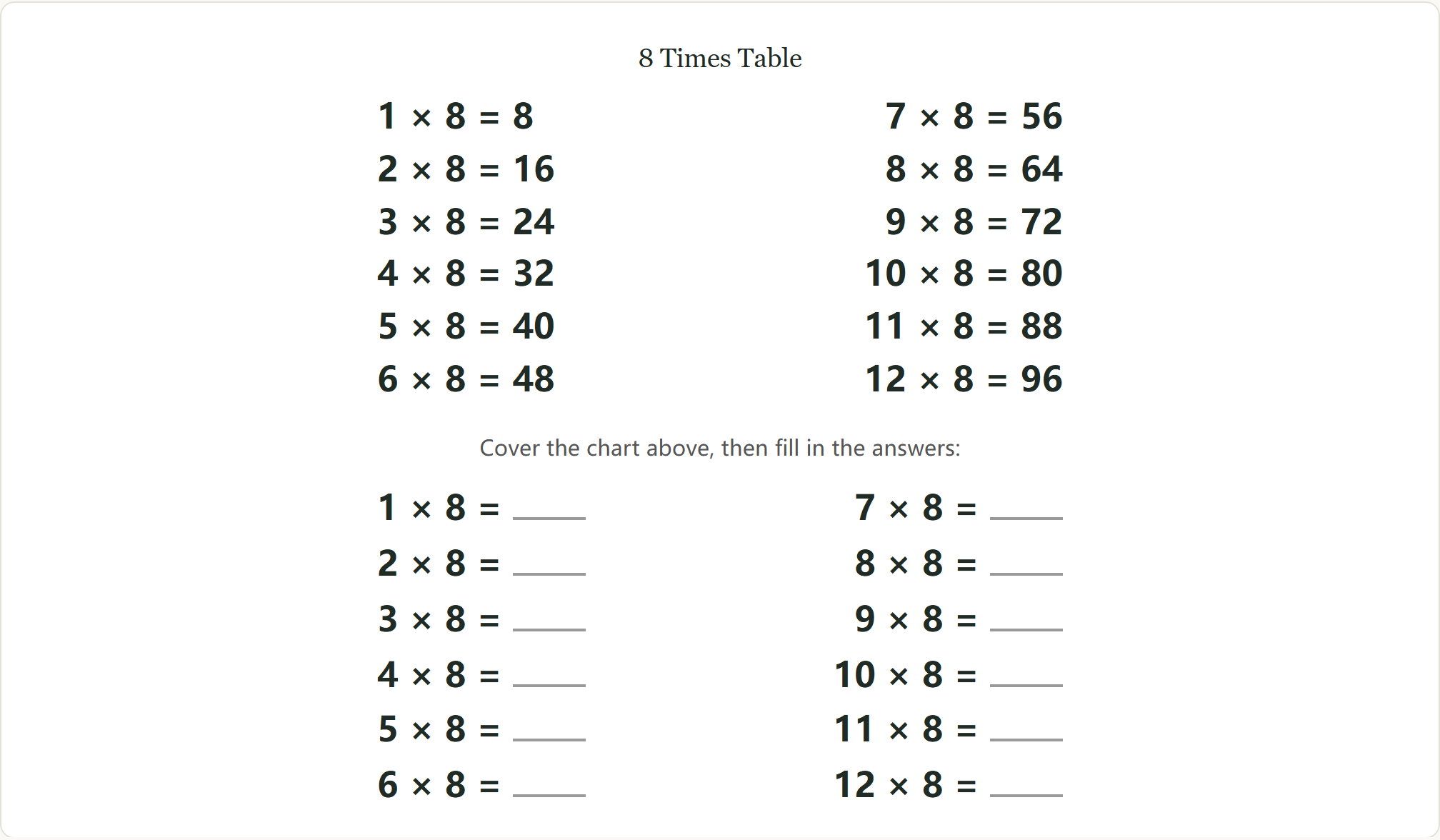
The 8 times table is 8, 16, 24, 32, 40, 48, 56, 64, 72, 80, 88, 96 — the doubles of the 4s: 8 × n = 2 × (4 × n). Double seven to 28, double again to 56. Students with solid 4s already own this table; they just have not noticed yet.
8 Times Table
1 × 8 = 87 × 8 = 56
2 × 8 = 168 × 8 = 64
3 × 8 = 249 × 8 = 72
4 × 8 = 3210 × 8 = 80
5 × 8 = 4011 × 8 = 88
6 × 8 = 4812 × 8 = 96
Cover the chart above, then fill in the answers:
1 × 8 = 7 × 8 =
2 × 8 = 8 × 8 =
3 × 8 = 9 × 8 =
4 × 8 = 10 × 8 =
5 × 8 = 11 × 8 =
6 × 8 = 12 × 8 =
PNG version — the exact file Download PNG saves
One doubling away from the 4s
The 8s look like the second-hardest row and are secretly one of the easier builds: every 8s fact is a 4s fact doubled. 8 × 6 = 48 because 4 × 6 = 24. The full chain — 2s to 4s to 8s — is three doublings, and it is worth drawing as a family portrait: 7, 14, 28, 56 down one line. Kids who see that ladder stop fearing the “big” tables, because big is just small doubled.
The 8s also hold two landmark facts. 8 × 8 = 64 is a perfect square with cultural range — the chessboard, the squares on a checkerboard, “sixty-four” in music — and 8 × 7 = 56 shares the five-six-seven-eight mnemonic with the 7s. Between the doubling chain and those two anchors, the row is fully covered before any cold memorization starts.
Skip counting by 8
Skip counting is the fallback path when a fact will not come: 8, 16, 24, 32, 40, 48, 56, 64, 72, 80, 88, 96. Counting by 8s IS the 8 times table — each step is one more group of 8 — so thirty seconds of rhythmic counting a day quietly drills the whole row.
Use it as a self-check too: any answer to a 8s fact has to land somewhere in that list. A student who writes 8 × 6 = 49 can catch it without an answer key, because 49 is not on the skip-count path.
Teaching tips
Double the 4s
The whole table in one rule: 8 × n = double (4 × n). Practice down the ladder — 6, 12, 24, 48 — so the doubling chain itself becomes automatic, not just the 8s answers.
64 is a landmark square
8 × 8 = 64: chessboard, checkerboard, squares in a pantry of 8×8 grids. Own it cold; it anchors 8 × 7 (56) and 8 × 9 (72) as one-step neighbors.
Spider legs and octopuses
Eight is the animal number: spider legs, octopus arms. “Five spiders have how many legs?” gives the 8s a picture the bare facts never provide — and second graders volunteer to draw the model.
Watch the 6s/8s cross-wiring
Under pressure, 8 × 6 and 8 × 7 swap with 6 × 8 and 7 × 8 — same facts, but students often answer 48 vs 54 vs 56 inconsistently. Drill the 48-54-56 cluster as a set until each has its own instant answer.
Frequently asked questions
What is the 8 times table?
The 8 times table is 8 × 1 through 8 × 12: 8, 16, 24, 32, 40, 48, 56, 64, 72, 80, 88, 96.
What is the trick for the 8 times table?
Double the 4s: 8 × n = 2 × (4 × n). For 8 × 9, four nines is 36, doubled is 72. The 2-4-8 doubling family covers three tables with one skill.
What are the 8 times tables to 12?
8, 16, 24, 32, 40, 48, 56, 64, 72, 80, 88 and 96 — 8 × 1 through 8 × 12. All even, each answer eight more than the last.
What grade are the 8s taught in?
Grade 3, alongside the 7s in the last wave of tables. Because the 8s reduce to doubling the 4s, they usually fall faster than the 7s despite looking scarier.
What is 8×8 and why does it matter?
8 × 8 = 64, a perfect square. It is the size of a chessboard and shows up constantly in grids and arrays from grade 3 on. With 8 × 7 = 56 beside it, the two facts anchor the top of the 8s row.