11 Times Table
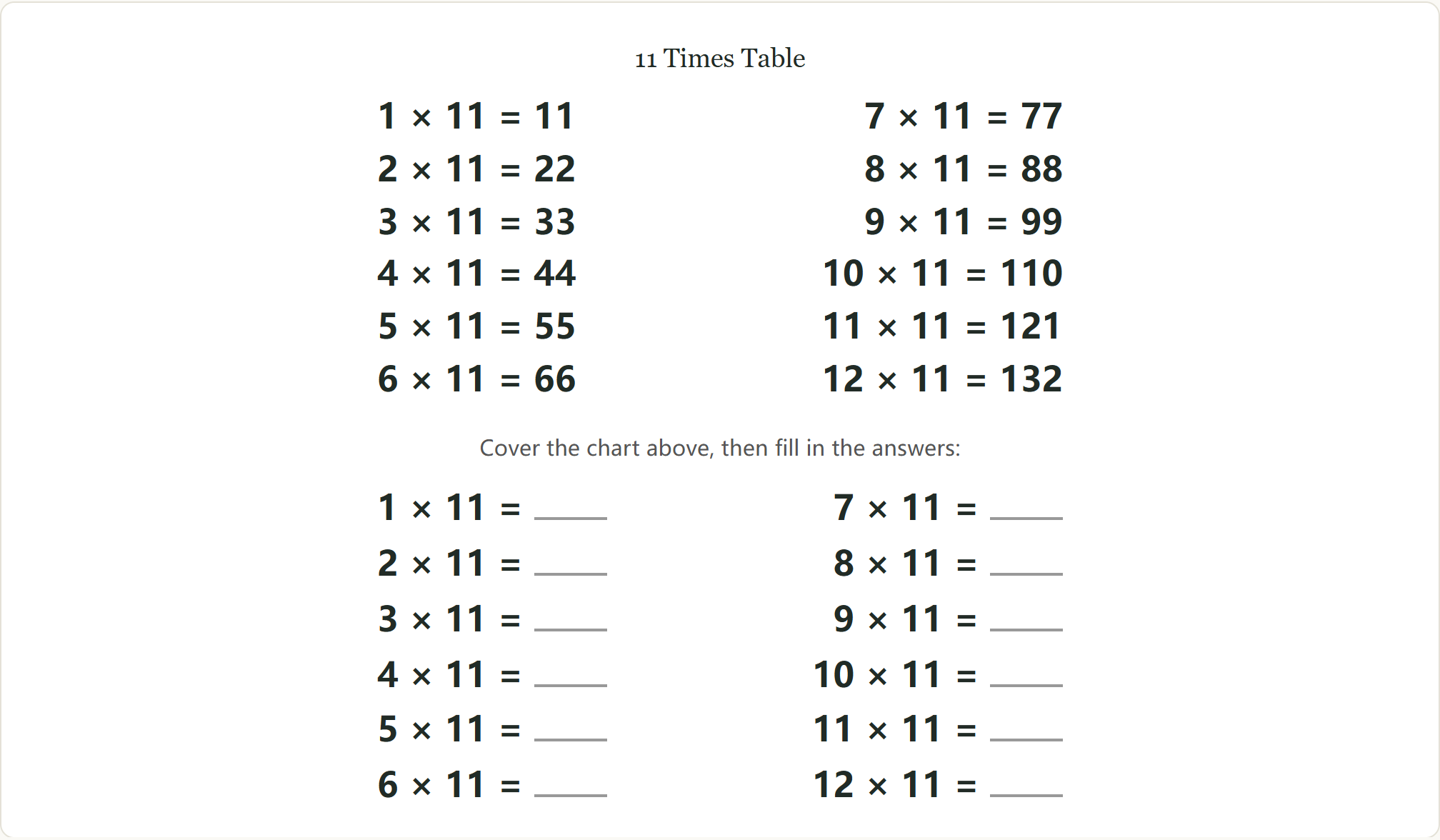
The 11 times table is 11, 22, 33, 44, 55, 66, 77, 88, 99, 110, 121, 132 — through 9 it is the digit repeated (11 × 4 = 44), which makes it the confidence table students meet right after the 10s. 11 × 11 = 121 lands a palindrome.
11 Times Table
1 × 11 = 117 × 11 = 77
2 × 11 = 228 × 11 = 88
3 × 11 = 339 × 11 = 99
4 × 11 = 4410 × 11 = 110
5 × 11 = 5511 × 11 = 121
6 × 11 = 6612 × 11 = 132
Cover the chart above, then fill in the answers:
1 × 11 = 7 × 11 =
2 × 11 = 8 × 11 =
3 × 11 = 9 × 11 =
4 × 11 = 10 × 11 =
5 × 11 = 11 × 11 =
6 × 11 = 12 × 11 =
PNG version — the exact file Download PNG saves
The confidence table
Through 11 × 9, the rule is irresistible: repeat the digit. 11 × 7 = 77, no thinking required. That makes the 11s the best fluency-builder in the chart — students who have struggled with the 6s and 7s get a whole table where the answers arrive instantly, and the feeling of “I know all of these” is worth more pedagogically than the facts themselves. Confidence is an input to memorization, not a byproduct.
The pattern breaks exactly twice, and both breaks are gifts. 11 × 10 = 110 follows the 10s rule (one shift), and 11 × 11 = 121 is a palindrome — read it forward or backward — plus a perfect square, the square of eleven. 11 × 12 = 132 is the one fact in the row that genuinely needs a look: build it as 10 × 12 plus 1 × 12 (120 + 12). Pointing at where patterns break, and why, is how students learn that patterns are observations, not laws.
Skip counting by 11
Skip counting is the fallback path when a fact will not come: 11, 22, 33, 44, 55, 66, 77, 88, 99, 110, 121, 132. Counting by 11s IS the 11 times table — each step is one more group of 11 — so thirty seconds of rhythmic counting a day quietly drills the whole row.
Use it as a self-check too: any answer to a 11s fact has to land somewhere in that list. A student who writes 11 × 6 = 67 can catch it without an answer key, because 67 is not on the skip-count path.
Teaching tips
The repeat rule, then its edge
Teach the repeat through 99, then deliberately break it: “What about 11 × 10? Why does the pattern stop?” The moment of noticing a pattern fail teaches more about number structure than ten worksheets of drills.
121 is a palindrome
11 × 11 = 121 reads the same both directions — and it is 11 squared. Palindromic squares are rare (11 × 11 and 22 × 22 = 484 are the famous small ones); students who catch this collect it like a trading card.
Build 11×12 honestly
The one row-fact without a free pattern: 11 × 12 = 10 × 12 + 1 × 12 = 132. Practice the build — it is the same “friendly number plus adjustment” move as 21 × 4 later on.
Use it to repair the 7s and 8s
Because 11 × n is quick, ask for 11 × 7 (77) right before 7 × 7 (49) — the instant fact primes the hard one. Interleaving easy and hard rows is a standard fluency technique, and the 11s are the easiest row you own.
Frequently asked questions
What is the 11 times table?
The 11 times table is 11 × 1 through 11 × 12: 11, 22, 33, 44, 55, 66, 77, 88, 99, 110, 121, 132.
What is the trick for the 11 times table?
Through 11 × 9, repeat the digit: 11 × 4 = 44, 11 × 8 = 88. After that, build from 10s: 11 × 12 = 120 + 12 = 132. (For two-digit numbers beyond the table there is also the “split the digits” trick — 11 × 23 = 2_3 with 2+3 in the gap — but the times-table row itself needs only the repeat.)
What are the 11 times tables up to 12?
11, 22, 33, 44, 55, 66, 77, 88, 99, 110, 121 and 132 — 11 × 1 through 11 × 12.
Why is 11 × 11 special?
121 is both a perfect square (11²) and a palindrome — it reads the same forward and backward. Squares that are palindromes are rare, which makes this the collectible fact of the row.
What grade are the 11s taught in?
Grade 3-4, after the core tables. The repeat rule makes them a fast win and a natural confidence reset after the 6s-8s grind; the 12s follow as the last table.