5 Times Table
The 5 times table is 5, 10, 15, 20, 25, 30, 35, 40, 45, 50, 55, 60 — the friendliest table in the book: every answer ends in 0 or 5, the skip count is how Americans already read clock minutes, and half of every answer is the 10s table.
5 Times Table
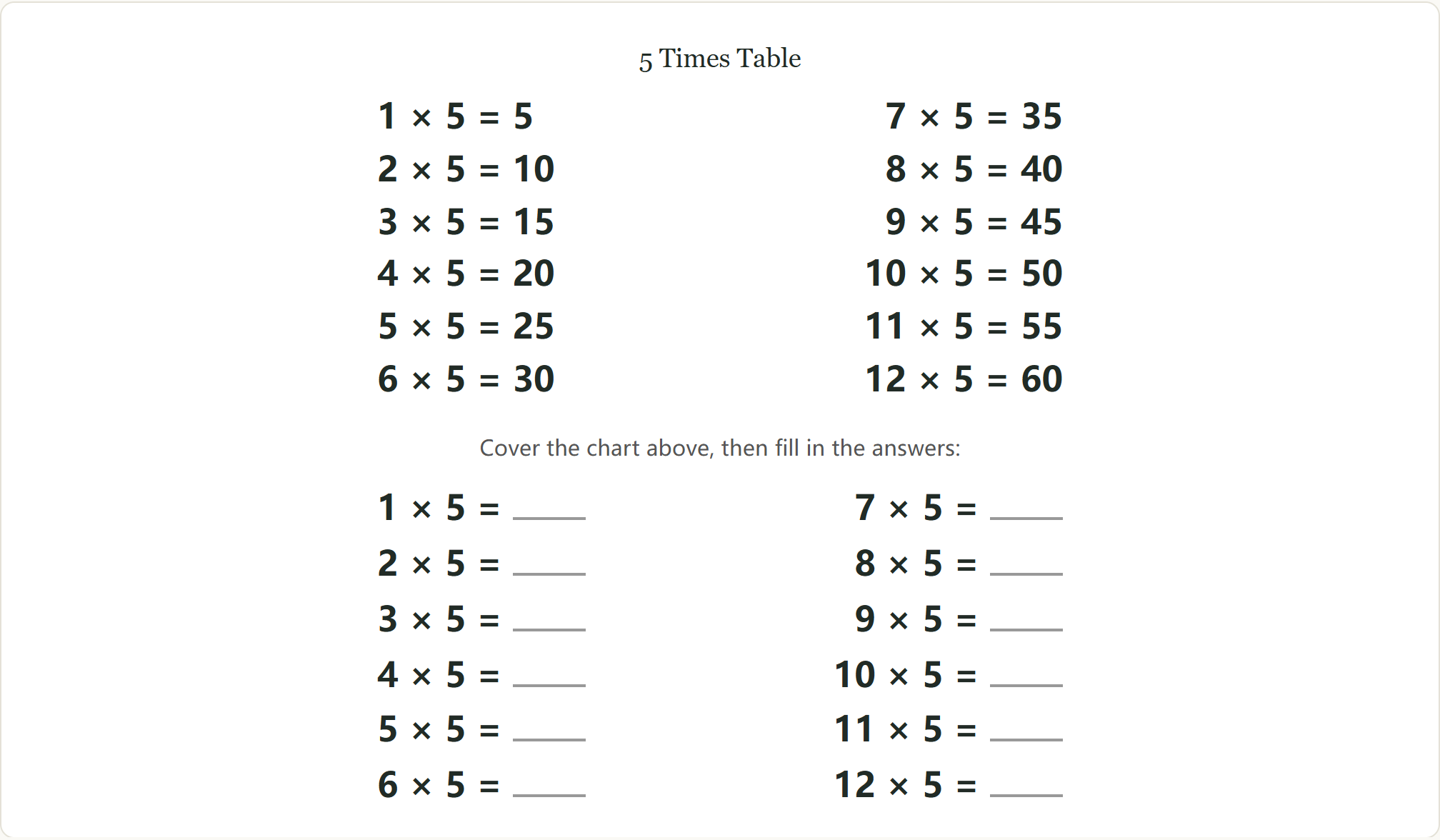
1 × 5 = 57 × 5 = 35
2 × 5 = 108 × 5 = 40
3 × 5 = 159 × 5 = 45
4 × 5 = 2010 × 5 = 50
5 × 5 = 2511 × 5 = 55
6 × 5 = 3012 × 5 = 60
Cover the chart above, then fill in the answers:
1 × 5 = 7 × 5 =
2 × 5 = 8 × 5 =
3 × 5 = 9 × 5 =
4 × 5 = 10 × 5 =
5 × 5 = 11 × 5 =
6 × 5 = 12 × 5 =
PNG version — the exact file Download PNG saves
The table you already use every day
Most children can count by 5s before they know what multiplication is, because it is how minutes are read on a clock and how nickels are counted. The 5s table formalizes that existing skill: 5 × 6 is “six nickels” (30¢) and “the minute hand on the 6” (30 minutes past). No other table arrives with this much real-world rehearsal already banked.
The pattern does the rest of the teaching: answers alternate ending in 5 and 0, and each answer is exactly half the matching 10s fact — 5 × 8 = 40 because 10 × 8 = 80. That halving connection is worth saying out loud; it is the student’s first taste of how tables reference each other, a habit that pays off when the 6s and 7s get hard.
Skip counting by 5
Skip counting is the fallback path when a fact will not come: 5, 10, 15, 20, 25, 30, 35, 40, 45, 50, 55, 60. Counting by 5s IS the 5 times table — each step is one more group of 5 — so thirty seconds of rhythmic counting a day quietly drills the whole row.
Use it as a self-check too: any answer to a 5s fact has to land somewhere in that list. A student who writes 5 × 6 = 31 can catch it without an answer key, because 31 is not on the skip-count path.
Teaching tips
Use the clock face
The minute hand is a 5s skip counter: on the 3 means 15, on the 7 means 35. Practicing “what does the hand say?” converts time-telling drills into 5s fluency for free.
Count nickels, then dimes
Five cents × how many nickels — money is the 5s table with a reason to care. Then set dimes beside them: the dime stack shows why every 5s answer is half the 10s one.
The 0-or-5 self-check
Teach the fastest self-check in all of multiplication: a 5s answer always ends in 5 or 0. It catches finger-slips instantly and gives shaky students a rule to trust while recall firms up.
Half of ten, stated out loud
“5 × 7 … the 10s say 70 … half is 35.” Deriving 5s from 10s feels slow at first but installs the tables-reference-each-other habit that later carries the 6s (5s + one more set).
Frequently asked questions
What is the 5 times table?
The 5 times table is 5 × 1 through 5 × 12: 5, 10, 15, 20, 25, 30, 35, 40, 45, 50, 55, 60.
What is the pattern of the 5 times table?
Answers alternate between ending in 5 and ending in 0 — 5, 10, 15, 20 — and each answer is half the matching 10s fact: 5 × 6 = 30 because 10 × 6 = 60. Both patterns make the 5s one of the fastest tables to master.
What are the 5 times tables up to 12?
5, 10, 15, 20, 25, 30, 35, 40, 45, 50, 55 and 60 — from 5 × 1 to 5 × 12. The last one, 5 × 12 = 60, is the number of minutes in an hour, which is a nice anchor to point out.
What grade is the 5 times table for?
Grade 2-3, taught in the first batch alongside the 2s and 10s. Because skip counting by 5 is already familiar from clocks and money, most classrooms reach fluency here in a week or two.
How does the 5s table help with telling time?
The minute hand counts by fives: on the 4 is 20 minutes, on the 9 is 45. A student fluent in the 5s reads any clock to the minute; a student still counting by ones around the face is the one still writing “9:43” at 9:47.