4 Times Table
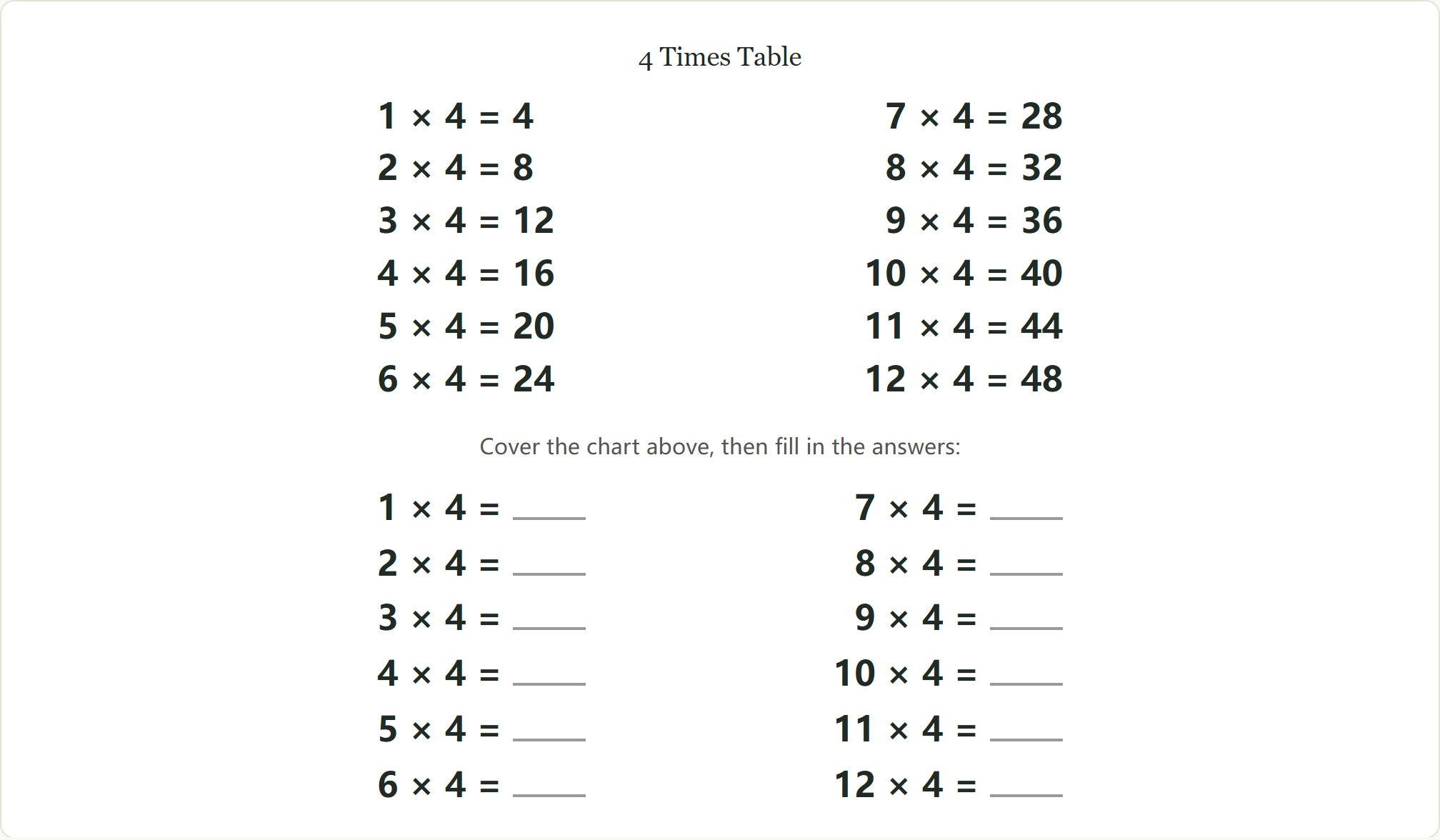
The 4 times table is 4, 8, 12, 16, 20, 24, 28, 32, 36, 40, 44, 48 — and every fact is two doublings: 4 × 7 is double 7 (14), double again (28). If the 2s are doubles, the 4s are the doubles of the doubles, and kids who own that chain never memorize this table cold.
4 Times Table
1 × 4 = 47 × 4 = 28
2 × 4 = 88 × 4 = 32
3 × 4 = 129 × 4 = 36
4 × 4 = 1610 × 4 = 40
5 × 4 = 2011 × 4 = 44
6 × 4 = 2412 × 4 = 48
Cover the chart above, then fill in the answers:
1 × 4 = 7 × 4 =
2 × 4 = 8 × 4 =
3 × 4 = 9 × 4 =
4 × 4 = 10 × 4 =
5 × 4 = 11 × 4 =
6 × 4 = 12 × 4 =
PNG version — the exact file Download PNG saves
Double, then double again
The 4s strategy is the cleanest derived-fact chain in elementary math: 4 × n = 2 × (2 × n). Double seven to fourteen, double fourteen to twenty-eight. Two steps, both using a skill the student has had since before multiplication started. This is worth teaching as an idea, not just a table — “when a fact feels too big, halve the problem and double the answer” returns later in mental math, in fractions (fourths are halves of halves), and in area problems.
The 4s are also full of real-world anchors, which is what makes them stick: four quarters in a dollar (4 × 25 later), four wheels on a car, four legs on a chair or a dog, four seasons. And the row contains a landmark square — 4 × 4 = 16 — the first perfect square past the trivial ones, worth pointing at on the multiplication chart’s shaded diagonal.
Skip counting by 4
Skip counting is the fallback path when a fact will not come: 4, 8, 12, 16, 20, 24, 28, 32, 36, 40, 44, 48. Counting by 4s IS the 4 times table — each step is one more group of 4 — so thirty seconds of rhythmic counting a day quietly drills the whole row.
Use it as a self-check too: any answer to a 4s fact has to land somewhere in that list. A student who writes 4 × 6 = 25 can catch it without an answer key, because 25 is not on the skip-count path.
Teaching tips
Two doubles beat one memorization
Practice the chain out loud: “4 × 6 … double 6 is 12 … double 12 is 24.” After a week of deriving, the recall arrives on its own — and the habit of building big facts from small ones transfers to the 6s and 8s.
Legs, wheels, quarters
Pictures carry the 4s: 5 dogs = 5 × 4 = 20 legs; 6 cars = 24 wheels; a dollar = 4 quarters. Ask “what comes in fours?” and let the student generate the facts.
All answers even — mostly ×4 apart
Point out the rhythm: each answer jumps by 4. Cover the reference strip and ask “what is 10 after 36?” Skip counting by 4s is the fallback path when recall stalls mid-table.
16 is the square to know
4 × 4 = 16 shows up everywhere — fourth grade area problems, 4×4 arrays, later powers of 2. Say it as “four squared” once in a while so the vocabulary arrives early and free.
Frequently asked questions
What is the 4 times table?
The 4 times table is 4 × 1 through 4 × 12: 4, 8, 12, 16, 20, 24, 28, 32, 36, 40, 44, 48.
What is the trick for the 4 times table?
Double, then double again: 4 × n is 2 × (2 × n). For 4 × 9, double 9 to 18, double 18 to 36. Students who own their doubles can build any 4s fact in under three seconds.
What are the 4 times tables to 12?
4, 8, 12, 16, 20, 24, 28, 32, 36, 40, 44 and 48 — 4 × 1 through 4 × 12. All even, each four more than the last.
What grade are the 4s taught in?
Grade 3, usually after the 2s and alongside or just after the 3s. The doubling chain makes the 4s feel like an extension of the 2s rather than new memorization.
How are the 4s and 8s related?
The 8s are the 4s doubled — 8 × n = 2 × (4 × n). Learning the 4s first makes the 8s a one-step build later, which is exactly the order most curricula teach them.