3 Times Table
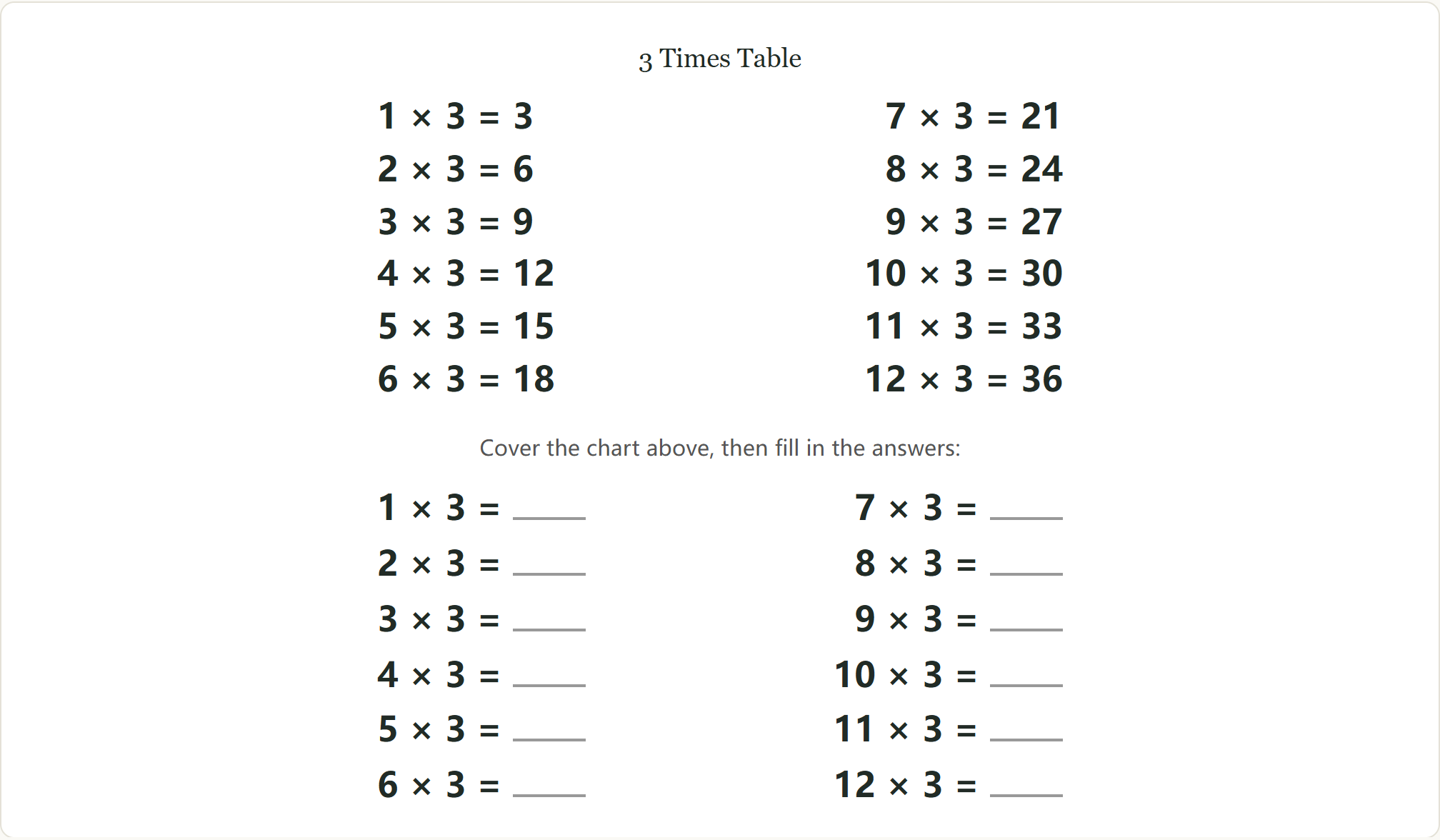
The 3 times table is 3, 6, 9, 12, 15, 18, 21, 24, 27, 30, 33, 36 — the first table with no free pattern, and the first that rewards a real strategy: double the number, then add one more set. 3 × 7? Double 7 (14), add one more 7 (21).
3 Times Table
1 × 3 = 37 × 3 = 21
2 × 3 = 68 × 3 = 24
3 × 3 = 99 × 3 = 27
4 × 3 = 1210 × 3 = 30
5 × 3 = 1511 × 3 = 33
6 × 3 = 1812 × 3 = 36
Cover the chart above, then fill in the answers:
1 × 3 = 7 × 3 =
2 × 3 = 8 × 3 =
3 × 3 = 9 × 3 =
4 × 3 = 10 × 3 =
5 × 3 = 11 × 3 =
6 × 3 = 12 × 3 =
PNG version — the exact file Download PNG saves
The first table you cannot fake
The 1s answer themselves, the 2s are doubles, the 5s and 10s have obvious patterns — and then the 3s arrive with nothing to grab. That is not a flaw; it is the point where multiplication stops being pattern-matching and starts being derived facts. The workhorse strategy is “double plus one set”: 3 × 8 is 2 × 8 (16) plus one more 8 (24). Every 3s fact can be built that way from a known double.
Teachers also love the 3s for skip counting with body weight: three, six, nine, twelve is the waltz rhythm, and counting by 3s while stepping or clapping installs the sequence faster than any flashcard drill. The answers do have one soft pattern — the digits cycle 3, 6, 9, 2, 5, 8, 1, 4, 7, 0 through the multiples of ten — but that is a curiosity to notice after the facts are solid, not a shortcut to rely on before.
Skip counting by 3
Skip counting is the fallback path when a fact will not come: 3, 6, 9, 12, 15, 18, 21, 24, 27, 30, 33, 36. Counting by 3s IS the 3 times table — each step is one more group of 3 — so thirty seconds of rhythmic counting a day quietly drills the whole row.
Use it as a self-check too: any answer to a 3s fact has to land somewhere in that list. A student who writes 3 × 6 = 19 can catch it without an answer key, because 19 is not on the skip-count path.
Teaching tips
Double, then add one set
Teach 3 × n as a two-step build: double n, then add n once more. Students who own their 2s can derive any 3s fact in two seconds — and deriving counts as knowing while the memory firms up.
Waltz while you count
THREE-six-nine-TWELVE with a step or clap on each number. The 3s cadence is dance rhythm, and rhythm beats flashcards for sequence memory. Thirty seconds of stepping per day outperforms a ten-minute drill.
Triangles and tricycles
Anchor the table in threes kids can picture: triangle sides (4 triangles = 4 × 3 = 12 sides), tricycle wheels, three-leaf clovers. A picture per fact is a memory hook a naked “3 × 4” never provides.
Do not teach the digit trick too early
The multiples-of-3 digit-sum rule (a number divides by 3 if its digits sum to a multiple of 3) is real math — but it checks divisibility, it does not produce the answer. Show it after fluency, or students use it to avoid recalling.
Frequently asked questions
What is the 3 times table?
The 3 times table is 3 × 1 through 3 × 12: 3, 6, 9, 12, 15, 18, 21, 24, 27, 30, 33, 36.
Is there a trick for the 3 times table?
The reliable one is a build, not a trick: 3 × n = 2 × n plus one more n. Double the number, add it again. There is also a divisibility check — a number is a multiple of 3 if its digits sum to 3, 6 or 9 (later: any multiple of 3) — but that confirms answers, it does not generate them.
What are the 3 times tables up to 12?
3, 6, 9, 12, 15, 18, 21, 24, 27, 30, 33 and 36 — that is 3 × 1 through 3 × 12. The last fact, 3 × 12 = 36, doubles as 36 = 6 × 6, a nice square-number conversation.
What grade do students learn the 3s?
Grade 2-3. The 3s usually follow the 2s, 5s and 10s — the first table without a visible pattern, which is why strategies like “double plus one set” get taught right here.
Why is 3 × 7 = 21 worth extra reps?
Because it sits in the 3s row with no landmark near it — no square, no money anchor, no finger trick — so it is one of the first facts kids lose under pressure. Put it on the fridge; it repays the attention.