12 Times Table
The 12 times table is 12, 24, 36, 48, 60, 72, 84, 96, 108, 120, 132, 144 — the last row in US fluency standards and the one grown-ups actually use: dozens of eggs, inches in a foot, months in a year. Build every fact as 10 × n + 2 × n; 12 × 12 = 144 is the finish line.
12 Times Table
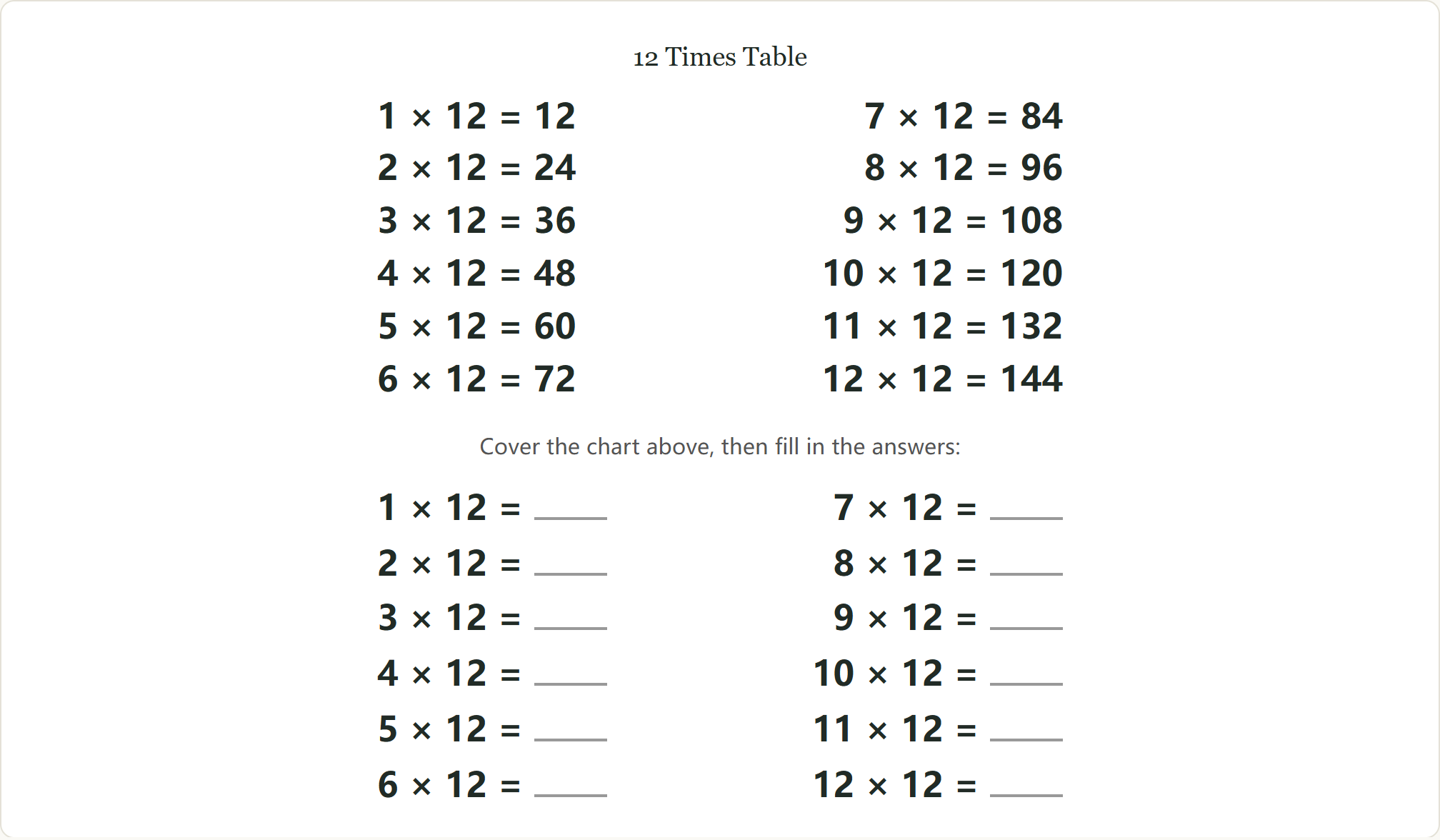
1 × 12 = 127 × 12 = 84
2 × 12 = 248 × 12 = 96
3 × 12 = 369 × 12 = 108
4 × 12 = 4810 × 12 = 120
5 × 12 = 6011 × 12 = 132
6 × 12 = 7212 × 12 = 144
Cover the chart above, then fill in the answers:
1 × 12 = 7 × 12 =
2 × 12 = 8 × 12 =
3 × 12 = 9 × 12 =
4 × 12 = 10 × 12 =
5 × 12 = 11 × 12 =
6 × 12 = 12 × 12 =
PNG version — the exact file Download PNG saves
The top of the chart, and the most useful one
American life runs on twelves: 12 months, 12 inches in a foot, 12 in a dozen, 12 hours on the clock. That makes the 12s the table adults unconsciously use most, and the one with the richest anchors for kids. It is also the last row in the standard US fluency expectation (through 12 × 12), so 12 × 12 = 144 — a gross, and a perfect square — is literally the finish line of multiplication memorization.
No one drills the 12s cold; the build is too good: 12 × n = 10 × n + 2 × n. Twelve fours is ten fours plus two fours, 40 + 8 = 48. Both parts are instant by the time the 12s arrive, and this “split into friendly parts” strategy is the single most transferable skill in the whole times-table sequence — it is exactly how people multiply by 21, 15 or 45 in real life. The 12s are where multiplication stops being memorization and becomes arithmetic.
Skip counting by 12
Skip counting is the fallback path when a fact will not come: 12, 24, 36, 48, 60, 72, 84, 96, 108, 120, 132, 144. Counting by 12s IS the 12 times table — each step is one more group of 12 — so thirty seconds of rhythmic counting a day quietly drills the whole row.
Use it as a self-check too: any answer to a 12s fact has to land somewhere in that list. A student who writes 12 × 6 = 73 can catch it without an answer key, because 73 is not on the skip-count path.
Teaching tips
Ten-and-two build
12 × n = 10 × n + 2 × n. Narrate it until the narration is unnecessary: “12 × 7 … 70 plus 14 … 84.” This build is the graduation skill of the entire times-table sequence.
Dozens, inches, months
The 12s have the best anchors in arithmetic: a dozen eggs (12 × 2 = 24 in a half-flat), a foot (12 × 5 = 60 inches in 5 feet), a year (12 × 4 = 48 months). Ask which anchor each student prefers — the fact sticks to the anchor.
144 is the diploma
12 × 12 = 144 closes the chart. It is also “a gross” — an old counting word for 144 that kids find hilarious and never forget. A perfect square AND the finish line: celebrate it.
Telling time runs on 12s
Hours on a clock face: 12 × 2 = 24 hours in a day. Half the schedule math children do — “how many hours in 3 days?” — is a 12s fact wearing a costume.
Frequently asked questions
What is the 12 times table?
The 12 times table is 12 × 1 through 12 × 12: 12, 24, 36, 48, 60, 72, 84, 96, 108, 120, 132, 144.
What is the trick for the 12 times table?
Split it: 12 × n = 10 × n + 2 × n. For 12 × 8: ten eights is 80, two eights is 16, total 96. Both pieces are instant by the time the 12s arrive, so the row falls faster than the 7s despite being “bigger.”
What are the 12 times tables up to 12?
12, 24, 36, 48, 60, 72, 84, 96, 108, 120, 132 and 144 — 12 × 1 through 12 × 12. All even, each answer twelve more than the last.
Why do the times tables stop at 12?
Tradition plus utility: 12 divides evenly by 2, 3, 4 and 6, which made dozens the currency of commerce for centuries, and US customary units (inches per foot, months per year, hours per day) still run on 12. Modern fluency standards say 10 × 10; the 11s and 12s remain the customary ceiling in American classrooms.
Why is 144 called a gross?
A gross is 144 — a dozen dozen. It is a real old trade quantity (buttons, pencils, screws still sell by the gross), and it doubles as 12², a perfect square. Two facts in one word.