6 Times Table
The 6 times table is 6, 12, 18, 24, 30, 36, 42, 48, 54, 60, 66, 72 — where the easy patterns run out. The strategy that carries it: 6 × n is the 5s fact plus one more set (6 × 7 = 35 + 7 = 42), and every answer is even.
6 Times Table
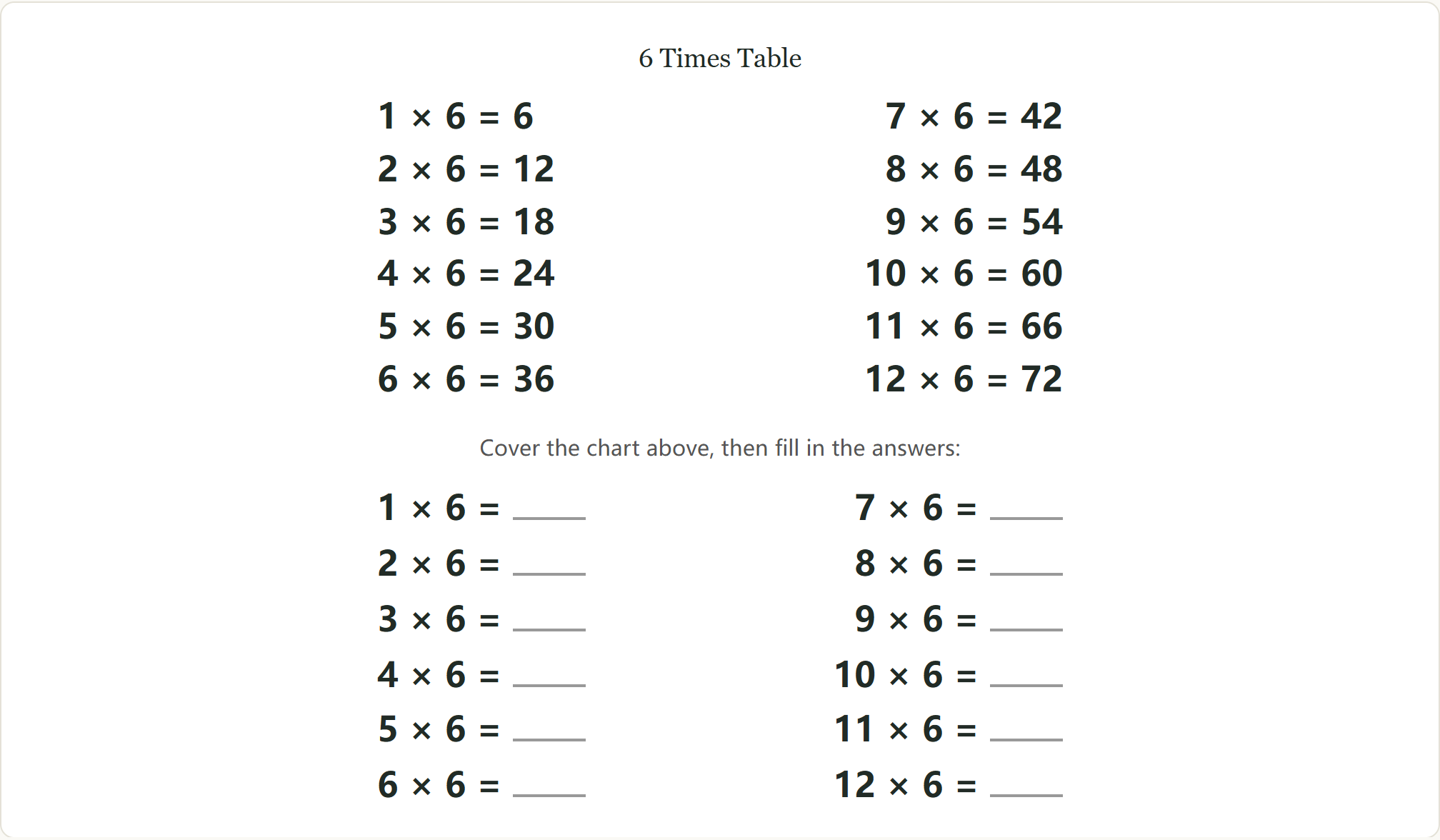
1 × 6 = 67 × 6 = 42
2 × 6 = 128 × 6 = 48
3 × 6 = 189 × 6 = 54
4 × 6 = 2410 × 6 = 60
5 × 6 = 3011 × 6 = 66
6 × 6 = 3612 × 6 = 72
Cover the chart above, then fill in the answers:
1 × 6 = 7 × 6 =
2 × 6 = 8 × 6 =
3 × 6 = 9 × 6 =
4 × 6 = 10 × 6 =
5 × 6 = 11 × 6 =
6 × 6 = 12 × 6 =
PNG version — the exact file Download PNG saves
Where the training wheels come off
The 6s sit at the start of the hard tier — 6s, 7s, 8s — where there is no ending-in-0 trick and no finger fold. What saves students is building: 6 × n = 5 × n + n. Five sevens is 35, one more seven is 42. The 5s are solid by now, so every 6s fact is one easy addition away. That is not a workaround; derived facts are how adults do arithmetic, and this table is where the skill gets built.
The 6s also carry more real-world weight than any table past the 5s: half-dozens and egg cartons (6 × 2 = a dozen, 6 × 12 = 72), six-packs, hexagons in nature. And the row holds one of the great landmark facts: 6 × 7 = 42, which combines with 6 × 6 = 36 and 6 × 8 = 48 to form the fact trio teachers probe first when checking fluency.
Skip counting by 6
Skip counting is the fallback path when a fact will not come: 6, 12, 18, 24, 30, 36, 42, 48, 54, 60, 66, 72. Counting by 6s IS the 6 times table — each step is one more group of 6 — so thirty seconds of rhythmic counting a day quietly drills the whole row.
Use it as a self-check too: any answer to a 6s fact has to land somewhere in that list. A student who writes 6 × 6 = 37 can catch it without an answer key, because 37 is not on the skip-count path.
Teaching tips
5s plus one more set
The workhorse: 6 × n = 5 × n + n. Say it as a chant — “five sixes is thirty, one more six is thirty-six.” Students with solid 5s derive the whole table in a day.
Egg cartons are the 6s model
A carton is 2 × 6; half a carton is 6. Baking in dozens means the 6s come with the territory — 6 × 4 = 24 muffins is a real question a kid has actually faced.
Probe the 36-42-48 trio
6 × 6, 6 × 7, 6 × 8 are the three facts that separate real fluency from pattern-guessing. Drill them as a set — mixed order, not in sequence — until all three fire instantly.
Even answers, jumping by 6
Skip counting by 6s is the safety net when recall stalls mid-problem. Practice it as “six, twelve, eighteen” on fingers — twelve answers, twelve fingers, one pass through the table.
Frequently asked questions
What is the 6 times table?
The 6 times table is 6 × 1 through 6 × 12: 6, 12, 18, 24, 30, 36, 42, 48, 54, 60, 66, 72.
How can I learn my 6 times table easily?
Build it from the 5s: 6 × n is 5 × n plus one more n. For 6 × 8, five eights is 40, one more eight is 48. The 5s are already solid for most students, so every 6s fact is a one-step build.
What are the 6 times tables to 12?
6, 12, 18, 24, 30, 36, 42, 48, 54, 60, 66 and 72 — 6 × 1 through 6 × 12. All even, each answer six more than the one before.
What grade are the 6s taught in?
Grade 3, in the second wave after the 2s, 5s and 10s. The 6s, 7s and 8s are the memorization core of grade 3, with fluency expected by the end of grade 4.
Why do eggs come in 6s and 12s?
Old English units: a dozen is 12, a half-dozen is 6. It makes egg cartons a ready-made 6s teaching model — one carton 2 × 6, a flat of six cartons 6 × 12 = 72 eggs.