2 Times Table
The 2 times table is the doubles row: 2, 4, 6, 8, 10, 12, 14, 16, 18, 20, 22, 24. Kids arrive already knowing most of it, because doubling is the first mental-math trick addition ever teaches — this page turns that head start into the first multiplication table they truly own.
2 Times Table
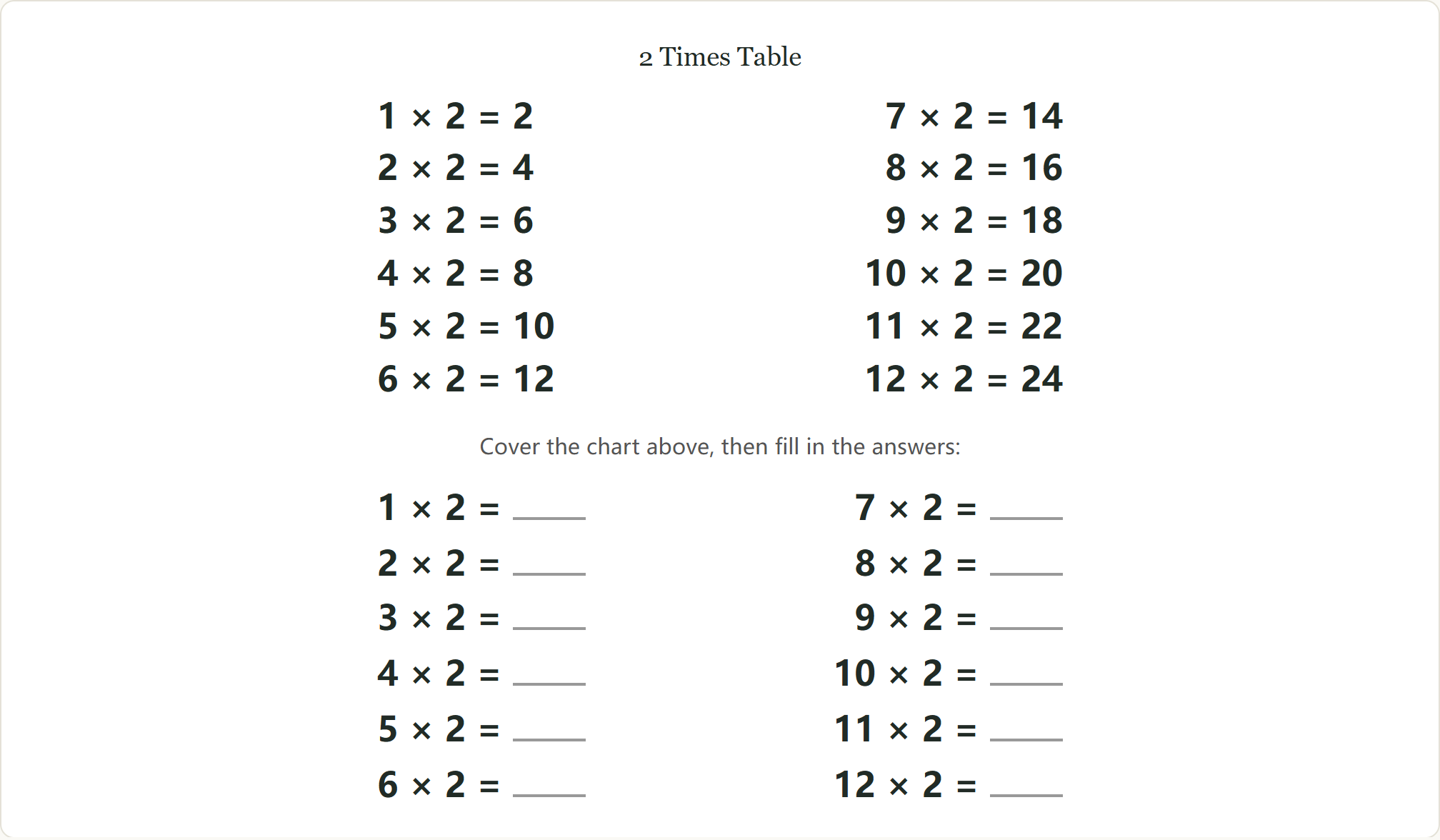
1 × 2 = 27 × 2 = 14
2 × 2 = 48 × 2 = 16
3 × 2 = 69 × 2 = 18
4 × 2 = 810 × 2 = 20
5 × 2 = 1011 × 2 = 22
6 × 2 = 1212 × 2 = 24
Cover the chart above, then fill in the answers:
1 × 2 = 7 × 2 =
2 × 2 = 8 × 2 =
3 × 2 = 9 × 2 =
4 × 2 = 10 × 2 =
5 × 2 = 11 × 2 =
6 × 2 = 12 × 2 =
PNG version — the exact file Download PNG saves
The table that is already in their head
Every 2s fact is an addition double wearing a costume: 2 × 7 is 7 + 7, and by the time multiplication starts in grade 2-3, most children can double single-digit numbers without thinking. That is why curricula teach the 2s first (with the 5s and 10s) — the answers are effectively pre-loaded, so all the effort goes into the new skill: recalling doubles as multiplication facts instead of adding on fingers.
The 2s also carry the first structural insight in the whole chart: the answers are exactly the even numbers, every other number on the number line. Say them out loud — two, four, six, eight — and you are skip counting, the skill that underlies every times table from here on. A student who can count by 2s while bouncing a ball has already memorized this page.
Skip counting by 2
Skip counting is the fallback path when a fact will not come: 2, 4, 6, 8, 10, 12, 14, 16, 18, 20, 22, 24. Counting by 2s IS the 2 times table — each step is one more group of 2 — so thirty seconds of rhythmic counting a day quietly drills the whole row.
Use it as a self-check too: any answer to a 2s fact has to land somewhere in that list. A student who writes 2 × 6 = 13 can catch it without an answer key, because 13 is not on the skip-count path.
Teaching tips
Rebrand the doubles
Write 7 + 7 = 14 and 2 × 7 = 14 side by side on the same card. The connection is the lesson: same fact, two costumes. One week of “if you can double it, you know it” retires half the table.
Count the pairs around you
Shoes, gloves, eyes, wings, socks — the world is full of twos. “Three pairs of shoes is 3 × 2 shoes” is the sentence that turns skip counting into multiplication meaning.
Bounce or clap the evens
Rhythm carries skip counting better than worksheets: clap on 2, 4, 6, 8 while counting aloud, then ask “what comes after 12?” The body remembers the cadence and supplies the next number.
Watch for the 2n + 2 slip
The common 2s error is answering 2 × 7 with 9 (adding 2 instead of doubling). Cover the top reference strip of this sheet, have the student write answers, and the slip is obvious immediately — and cheap to fix.
Frequently asked questions
What is the 2 times table?
The 2 times table is 2 × 1 through 2 × 12: 2, 4, 6, 8, 10, 12, 14, 16, 18, 20, 22, 24.
How do you learn the 2 times table fast?
Use the doubles you already have: 2 × n is the same as n + n. Practice recalling doubles as multiplication facts — 2 × 7 is “double seven,” 14 — and the whole table falls in one or two sessions.
What are the numbers in the 2 times table?
2, 4, 6, 8, 10, 12, 14, 16, 18, 20, 22, 24 — the even numbers in order, from 2 × 1 through 2 × 12. Because the list is so regular, skip counting by 2 and knowing the table are the same skill.
What grade is the 2 times table for?
Grade 2 introduces it as repeated addition and doubles; grade 3 expects fluency. It is usually the first or second table taught, right alongside the 5s and 10s.
Why are all the answers even?
Doubling any number gives an even number — an even number is literally “a number that can be split into two equal groups,” and 2 × n is exactly two equal groups of n. Seeing that connection is an early look at the structure behind the whole chart.