1 Times Table
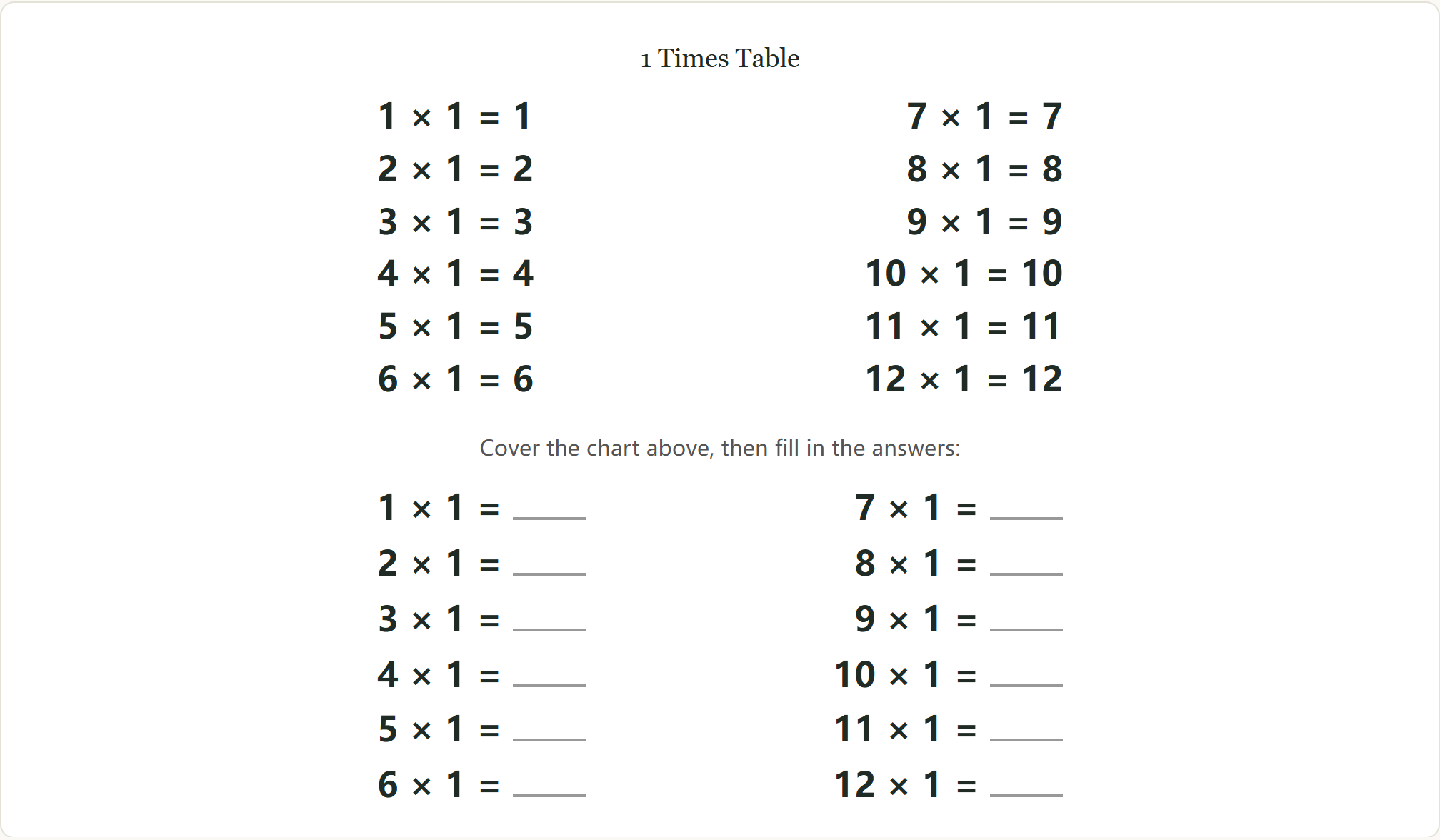
The 1 times table is every number itself: 1, 2, 3, 4, 5, 6, 7, 8, 9, 10, 11, 12. That sounds like nothing to practice — it is actually the first property of multiplication kids ever meet, and the row that explains what the × sign means.
1 Times Table
1 × 1 = 17 × 1 = 7
2 × 1 = 28 × 1 = 8
3 × 1 = 39 × 1 = 9
4 × 1 = 410 × 1 = 10
5 × 1 = 511 × 1 = 11
6 × 1 = 612 × 1 = 12
Cover the chart above, then fill in the answers:
1 × 1 = 7 × 1 =
2 × 1 = 8 × 1 =
3 × 1 = 9 × 1 =
4 × 1 = 10 × 1 =
5 × 1 = 11 × 1 =
6 × 1 = 12 × 1 =
PNG version — the exact file Download PNG saves
Why the 1s matter more than they look
Read “7 × 1” out loud as “seven, one time” and the answer is obviously seven: one group of seven things is just those seven things. That is the identity property — multiplying by 1 leaves a number unchanged — and it is the first rule of multiplication children can state in words. The 1s row earns its page not because it is hard, but because it is the sentence kids say for every later table: “how many groups, how many in each group.”
The 1s row is also the header row of the whole multiplication chart. Every column of the 12×12 grid starts with 1, 2, 3 … 12 because one group of n is n. A student who can explain why 12 × 1 = 12 without counting on fingers is ready for the 2s; a student who cannot is telling you the × sign still means nothing, and no amount of drilling bigger tables will fix that.
Skip counting by 1
Skip counting is the fallback path when a fact will not come: 1, 2, 3, 4, 5, 6, 7, 8, 9, 10, 11, 12. Counting by 1s IS the 1 times table — each step is one more group of 1 — so thirty seconds of rhythmic counting a day quietly drills the whole row.
Use it as a self-check too: any answer to a 1s fact has to land somewhere in that list. A student who writes 1 × 6 = 7 can catch it without an answer key, because 7 is not on the skip-count path.
Teaching tips
Say it the long way first
Before memorizing anything, have your student read each fact as “one group of ___”: one group of 8 is 8. The × sign means “groups of,” and the 1s table is where that sentence gets installed.
Use it as a pattern hunt
The 1s answers are just the counting numbers — point at that out loud. Kids love that the “trick” table is secretly the number line itself, and it makes the 2s row (“add the number to itself”) feel like the next step in a game.
The classic wrong answer
Some children answer 1 × n with n + 1 because they add the two numbers they see. If that shows up here, slow down: it means facts are being added, not multiplied, and it will follow them into every table.
One day is enough
Unlike the 6s or 7s, the 1s need one session, not a week. Take the win, print the practice strip, and move to the 2s while the momentum is hot.
Frequently asked questions
What is the 1 times table?
The 1 times table is 1 × 1 through 1 × 12: 1, 2, 3, 4, 5, 6, 7, 8, 9, 10, 11, 12.
Why is anything times 1 itself?
Multiplication counts groups of equal size. “n × 1” asks for one group of n — and one group of anything is just the thing itself. This rule is called the identity property of multiplication, and it stays true for every number your student will ever meet, including fractions and decimals.
What grade is the 1 times table for?
Grade 2-3, at the very start of multiplication. The 1s (with the 0s and 10s) are taught first precisely because the answers are already known — the lesson is what the × sign means, not what the answers are.
Should we drill the 1s at all?
Briefly. One page of practice is plenty — the point is fluency with reading “groups of,” not memorizing answers that are already automatic. If a student misses 1s facts later, it is almost always an adding-not-multiplying habit, not a memory problem.
What comes after the 1 times table?
The 2s and 5s and 10s, in most curricula — the tables whose patterns are visible on the first look. Our 2 times table page is the natural next print.