10 Times Table
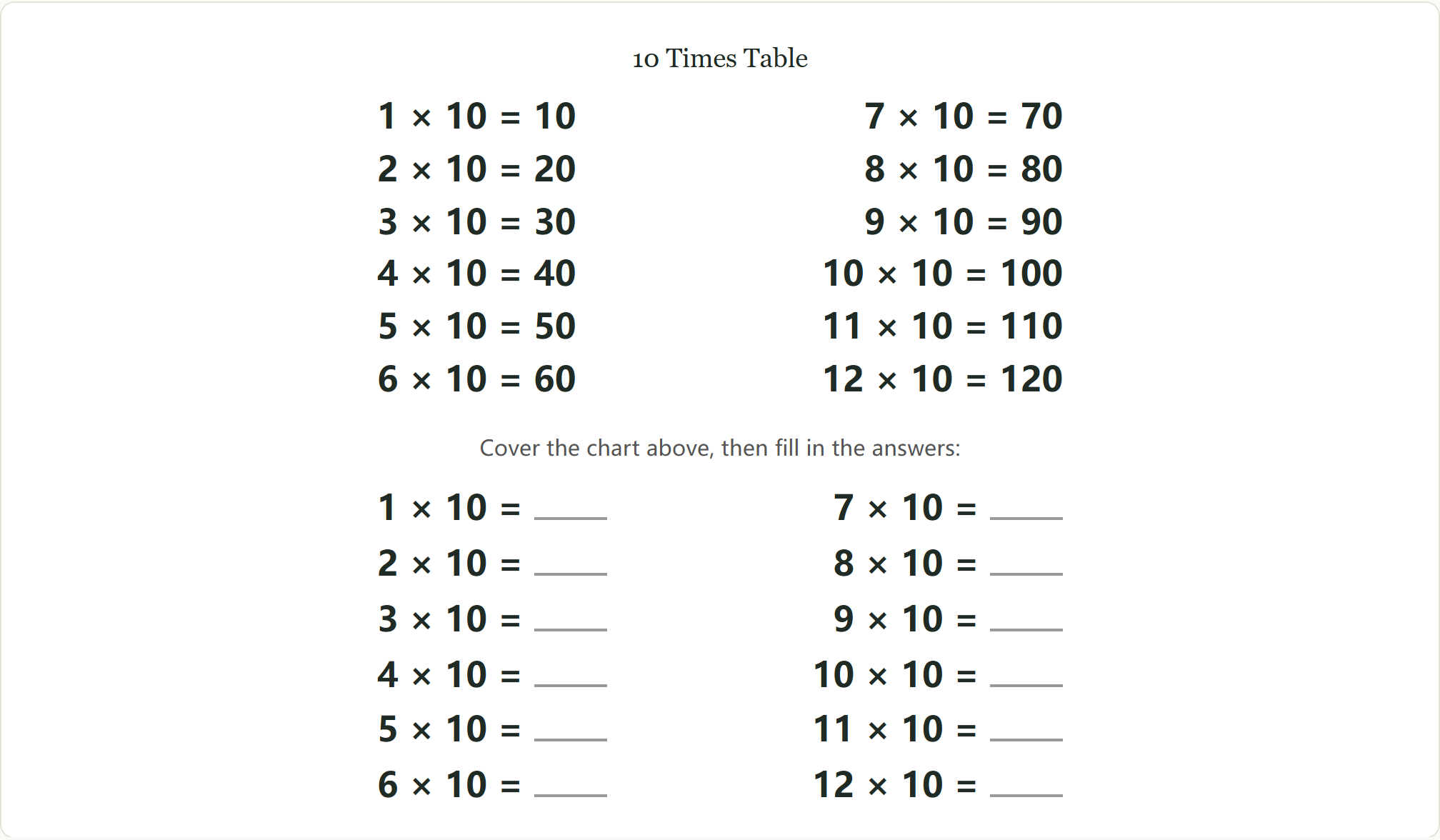
The 10 times table is 10, 20, 30, 40, 50, 60, 70, 80, 90, 100, 110, 120 — one fact per line, and the fact is place value itself: 10 × n is n with a zero after it. No drill required; this table is an idea, and the idea is how our number system works.
10 Times Table
1 × 10 = 107 × 10 = 70
2 × 10 = 208 × 10 = 80
3 × 10 = 309 × 10 = 90
4 × 10 = 4010 × 10 = 100
5 × 10 = 5011 × 10 = 110
6 × 10 = 6012 × 10 = 120
Cover the chart above, then fill in the answers:
1 × 10 = 7 × 10 =
2 × 10 = 8 × 10 =
3 × 10 = 9 × 10 =
4 × 10 = 10 × 10 =
5 × 10 = 11 × 10 =
6 × 10 = 12 × 10 =
PNG version — the exact file Download PNG saves
The table that teaches place value
Multiplying by 10 does not add anything — it moves the number one place left and parks a zero in the old seat. That is the place-value shift, the single most important structural idea in elementary arithmetic, and the 10s table is where it becomes visible: 10 × 4 shifts the 4 into the tens place and writes 40. Students who see the shift here meet decimals years later with far less panic, because “moving by tens” is already an old friend.
The 10s also anchor estimation and mental math for life: if you know 10 × 7 is 70, then 9 × 7 is one seven less (63), 20 × 7 is two of them (140), and 15 × 7 is halfway between (105). Almost every friendly-number strategy in later grades is built on 10s facts. That is why this table, which never needs a drill session, still deserves its own page.
Skip counting by 10
Skip counting is the fallback path when a fact will not come: 10, 20, 30, 40, 50, 60, 70, 80, 90, 100, 110, 120. Counting by 10s IS the 10 times table — each step is one more group of 10 — so thirty seconds of rhythmic counting a day quietly drills the whole row.
Use it as a self-check too: any answer to a 10s fact has to land somewhere in that list. A student who writes 10 × 6 = 61 can catch it without an answer key, because 61 is not on the skip-count path.
Teaching tips
Say it as a shift, not a rule
“The zero is not added — the digits move.” Write 10 × 4 with the 4 in a place-value chart and slide it one column left. The sentence costs thirty seconds and prevents years of “just add a zero” confusion when decimals arrive.
Dimes and dollars
Ten dimes is a dollar, ten tens is a hundred. Money makes the 10s concrete: 10 × 6 = 60 dimes = $6.00 in dimes. The shift and the currency land together.
Estimate with 10s first
Train the habit: for 8 × 43, think “10 × 43 is 430, so 8 × 43 is a bit under 400.” Estimation built on 10s is the skill state tests actually probe in grades 4-6.
The launchpad for other tables
Use 10 × n as the reference point for 9 × n (one less set) and 5 × n (half). Every table past the 5s is faster to learn when the 10s are instant — which they already are.
Frequently asked questions
What is the 10 times table?
The 10 times table is 10 × 1 through 10 × 12: 10, 20, 30, 40, 50, 60, 70, 80, 90, 100, 110, 120.
Why does multiplying by 10 add a zero?
It does not add anything — the digits shift one place to the left and a zero holds the empty seat. 10 × 4 moves the 4 from the ones place to the tens place: 40. Saying “shift,” not “add a zero,” keeps decimals from becoming a mystery later (10 × 0.5 is 5, not 0.50).
What are the 10 times tables to 12?
10, 20, 30, 40, 50, 60, 70, 80, 90, 100, 110 and 120 — 10 × 1 through 10 × 12. Past 100, the pattern keeps going without changing, which is exactly the point.
Do students need to drill the 10s?
Almost never — the pattern is the answer. What deserves practice is using the 10s: halving them for 5s, stepping down one set for 9s, doubling for 20s. Those moves are real math and do need reps.
What grade is the 10 times table for?
Grade 2-3, first among tables taught, right with the 2s and 5s. It doubles as early place-value instruction, which is why teachers spend more time talking about it than drilling it.