Christmas Color by Number
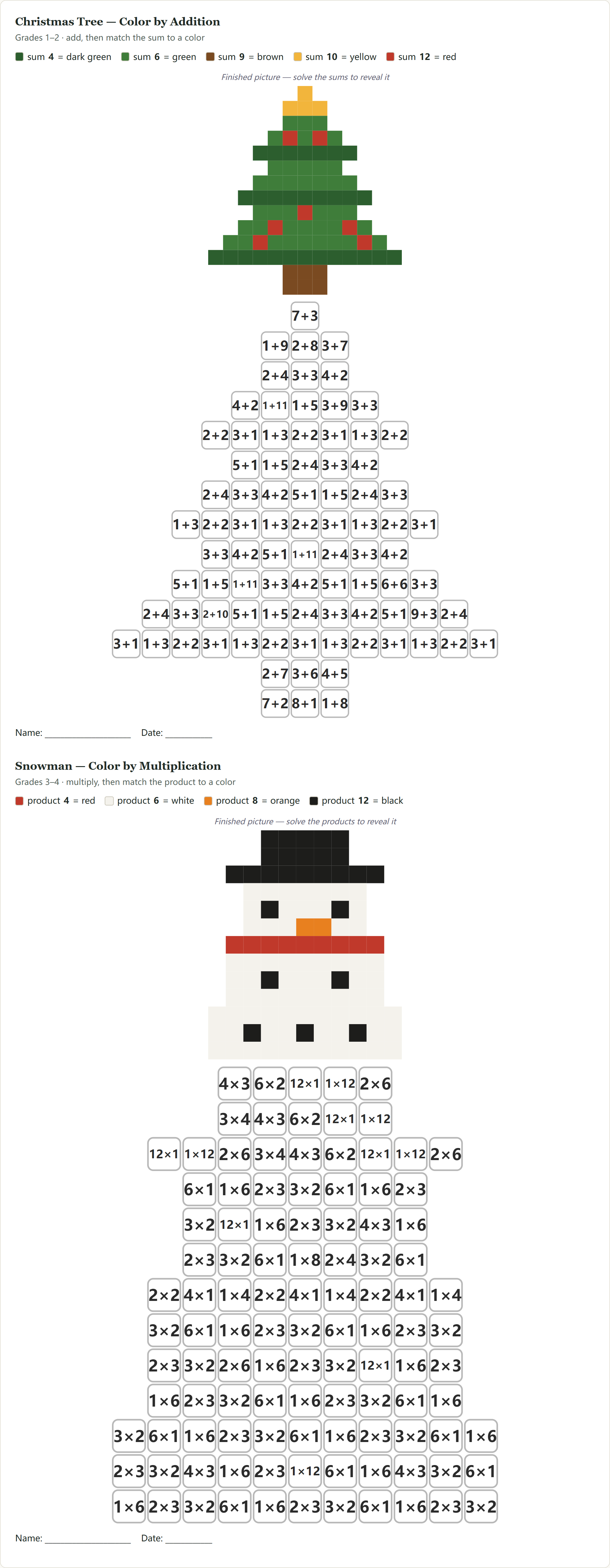
A December coloring page that is secretly a math sheet: every cell of the Christmas tree holds an addition fact whose sum points to a legend color, and every cell of the snowman holds a multiplication fact. Solve, check the legend, color — a full page works dozens of math facts without ever feeling like a worksheet, and the last week of December needs exactly that.
Christmas Tree — Color by Addition
Grades 1–2 · add, then match the sum to a color
Name: ______________________ Date: ____________
Snowman — Color by Multiplication
Grades 3–4 · multiply, then match the product to a color
Name: ______________________ Date: ____________
PNG version — the exact file Download PNG saves
Why math-facts coloring works
A color-by-number page is retrieval practice in costume: each cell asks one fact, the legend checks the answer, and the picture rewards a full page of correct recall. Wrong answers announce themselves — a red patch where the green tree should be tells a student exactly which fact to fix before an adult ever sees the paper. That built-in answer key is why these sheets hold up during the week before break when ordinary worksheets do not.
The tree sheet uses addition facts with sums to 12, the grade 1-2 sweet spot, with wide bands of green so the picture reads early and momentum holds. The snowman sheet uses multiplication facts with products to 12 for grades 3-4 — the white body regions are the forgiving cells, while the hat, scarf, buttons and carrot nose split the remaining facts into small patches that demand care.
Teaching tips
Color the legend first
Have students outline each legend square with its crayon before starting. It prevents the classic mid-page discovery that the red is buried at the bottom of the pencil box, and it fixes the color-to-number mapping in memory before the math starts.
Answers in the corner
Ask students to write each answer lightly in the cell corner before coloring. Thirty sheets grade in ten seconds flat, and the picture still comes out clean under the crayon.
Read the error patches
The colors make error patterns visible at a glance: a student who colors 2×3 cells with the 2+3 color is telling you exactly which fact family to reteach before the break. A wrong-colored patch is a diagnostic, not a mess.
Pair it with the word search
Printed double-sided with the Christmas word search, the two sheets make a complete party-day or pre-break packet: reading on one side, math on the other, zero preparation for the teacher.
Frequently asked questions
Is this a real math worksheet?
Yes — every cell contains an addition or multiplication fact, and its answer maps to a legend color. The Christmas tree drills addition facts with sums to 12; the snowman drills multiplication facts with products to 12. Coloring without solving gets the picture wrong.
What grades is it for?
The addition tree fits grades 1-2 (sums capped at 12); the multiplication snowman fits grades 3-4 (facts through 12). Both print on one letter page each.
Can I print it in black and white?
The legend squares print in color, but every legend entry also names its color — dark green, green, brown, yellow and red for the tree; white, black, orange and red for the snowman — so a black-and-white copy still works: students match the answer to the color name, not just the swatch.
Why is the snowman mostly white?
By design. The white body regions carry the friendliest products (1×6, 2×3 and friends), so early success comes fast, while the hat, scarf and nose hold the smaller, trickier patches. Students can leave white cells uncolored or shade them lightly with a white or gray crayon.
Do the two pictures share answers?
No. The tree keys colors to sums; the snowman keys colors to products. Same format, two operations — pick the sheet that matches the week's math focus.